Liber XVII · Islam · Chapter I: The Five Pillars
The Five Pillars of Islam: Faith, Prayer, Alms, Fast, Hajj
The Five Pillars of Islam explained: the shahada, the five daily prayers, zakat, the Ramadan fast and the hajj, with their history, rules and meaning.

The Five Pillars of Islam are the five basic acts of worship that Muslims regard as obligatory: the testimony of faith (shahāda), ritual prayer five times a day (ṣalāt), annual almsgiving (zakāt), fasting during the month of Ramadan (ṣawm) and the pilgrimage to Mecca (ḥajj) once in a lifetime for those able to make it. Together they give a shared rhythm to the day, the year and the life of Muslims across the world.
The Origin of the Five Pillars§
The Qur'an commands prayer, almsgiving, fasting and pilgrimage repeatedly, but the grouping into five "pillars" (arkān) comes from hadith. The best-known version, transmitted from 'Abdallah ibn 'Umar and included in the collections of al-Bukhari and Muslim, states that Islam is built upon five: testifying that there is no god but God and that Muhammad is His messenger, establishing prayer, paying zakat, the pilgrimage and the fast of Ramadan. The detailed rules for each are worked out in the jurisprudence (fiqh) of the schools of law, described in Islamic Law and Theology, and manuals of law traditionally open with these acts of worship (ʿibādāt), beginning with ritual purity.
Twelver Shi'i theology uses a different framework. It distinguishes five "roots of religion" (uṣūl al-dīn), namely divine unity, divine justice, prophecy, the imamate and the resurrection, from a longer list of "branches" (furūʿ al-dīn) that include prayer, fasting, zakat, the pilgrimage and a further levy called khums, one-fifth of certain surplus income. The acts of worship are thus shared, though some details differ; see Sunni and Shi'a Islam.
Shahada: The Testimony of Faith§
The shahāda is the declaration: "I bear witness that there is no god but God, and I bear witness that Muhammad is the messenger of God." Its first half affirms tawḥīd, the oneness of God; its second affirms the prophethood of Muhammad. Pronouncing it sincerely is how a person becomes a Muslim, and Muslims hope that it will be the last words they speak before death. It is whispered into the ear of a newborn child, repeated in every call to prayer, and written in monumental calligraphy on mosques, coins and banners.
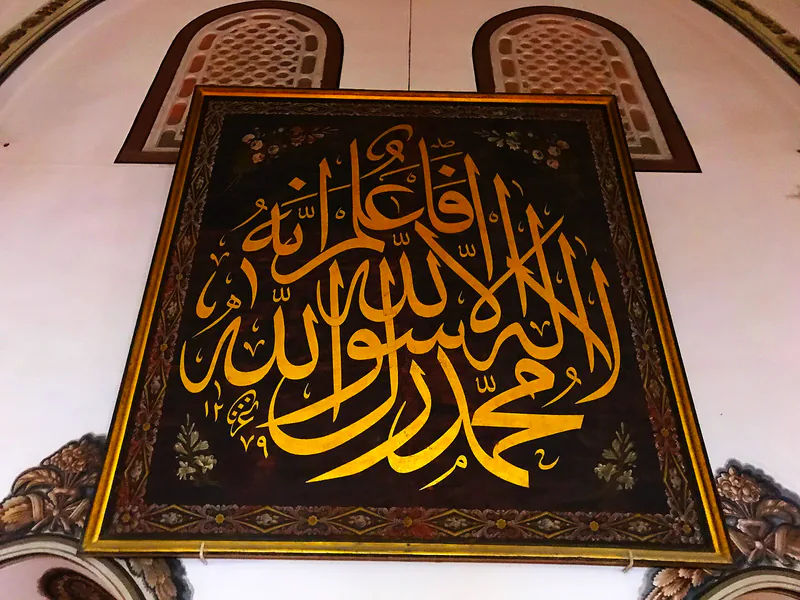
For Sufis the first half of the formula, lā ilāha illā Allāh, is the supreme formula of remembrance (dhikr), repeated in its thousands in their gatherings (see Sufism in Islam). In Shi'i practice the call to prayer often adds a testimony that 'Ali is the friend (walī) of God, which Shi'i jurists usually treat as a recommended addition rather than part of the obligatory formula.
Salat: The Five Daily Prayers§
Ṣalāt is the ritual prayer performed five times a day: at dawn (fajr), just after midday (ẓuhr), in the afternoon (ʿaṣr), at sunset (maghrib) and at nightfall (ʿishāʾ). Each prayer consists of a set number of cycles (rakʿa) of standing, recitation of the Qur'an (always including the opening sura, al-Fatiha), bowing, prostration and sitting. It is preceded by ablution (wuḍūʾ), the washing of hands, mouth, nose, face, arms, head and feet, and performed facing the qibla, the direction of the Ka'ba in Mecca, marked in mosques by a niche, the miḥrāb.
The call to prayer (adhān) is given from the mosque, traditionally from a minaret; the first muezzin is remembered as Bilal, a freed Abyssinian slave and companion of the Prophet. On Friday the noon prayer is replaced by a congregational prayer with a sermon (khuṭba). Twelver Shi'is often combine the noon and afternoon prayers, and the sunset and night prayers, so that they pray at three times of day, and many prostrate on a small tablet of clay.
Because prayer times depend on the position of the sun and the qibla on the geography of the earth, medieval Muslim astronomers developed sophisticated tables, sundials and instruments; many mosques employed a timekeeper (muwaqqit), and the astrolabe was refined in this context. The same astronomical learning fed into astrology, as described in Islamic Occult Sciences.
Zakat: Obligatory Almsgiving§
Zakāt, from a root meaning "purity" and "growth", is a compulsory annual payment that purifies a Muslim's wealth. For money and trade goods the standard rate is one-fortieth, or 2.5 per cent, of savings that have been held for a full lunar year above a minimum threshold (niṣāb); different rates apply to crops and livestock. The Qur'an names eight categories of recipients, including the poor, the needy, debtors, travellers and those whose hearts are to be reconciled (at-Tawba 9:60).
In the early caliphate zakat was collected by the state; today it is mostly paid voluntarily through mosques, charities or directly to those in need, though a few countries administer it by law. A separate small payment, zakāt al-fiṭr, is given before the prayer at the end of Ramadan so that the poor can share in the feast. Beyond these obligations Muslims are encouraged to give voluntary charity (ṣadaqa), and religious endowments (waqf) funded mosques, schools, hospitals and fountains throughout Islamic history.
Sawm: Fasting in Ramadan§
During Ramadan, the ninth month of the lunar calendar, adult Muslims abstain from food, drink and sexual relations from dawn until sunset, following the command of al-Baqara 2:183–185. The day begins with a meal before dawn (suḥūr) and ends with the breaking of the fast (ifṭār), traditionally with dates and water. The sick, travellers, the elderly, pregnant and nursing women and women who are menstruating are exempt, and either make up the missed days later or, if unable, feed a poor person for each day.
Ramadan is also a month of extra devotion. Many Muslims attend the special night prayers called tarāwīḥ, in which the whole Qur'an is often recited over the month, and seek the "Night of Power", in which the Qur'an's revelation began, among the last ten nights. Some withdraw into the mosque for spiritual retreat (iʿtikāf). Because the lunar year is shorter than the solar year, Ramadan moves through the seasons in a cycle of about thirty-three years; its beginning and end depend on sighting the new crescent moon, and communities sometimes differ by a day. The month ends with the festival of Eid al-Fitr.
Hajj: The Pilgrimage to Mecca§
The ḥajj is required once in a lifetime of every adult Muslim who is physically and financially able. It takes place between the eighth and the twelfth or thirteenth days of Dhu al-Hijja, the last month of the Islamic year, and Muslims trace its rites to Abraham and his son Ishmael, who are believed to have built the Ka'ba, and to the Farewell Pilgrimage of the Prophet Muhammad.
Pilgrims enter a state of consecration (iḥrām), men wearing two unstitched white cloths, and circle the Ka'ba seven times (ṭawāf). They walk seven times between the hills of Safa and Marwa, recalling Hagar's search for water for Ishmael, and drink from the well of Zamzam. The heart of the pilgrimage is the standing (wuqūf) on the plain of 'Arafat on the ninth day, a time of prayer and repentance from noon to sunset. Pilgrims then spend the night at Muzdalifa, throw pebbles at three pillars in Mina that represent the devil's temptations of Abraham, offer an animal sacrifice, cut or shave their hair and return to Mecca for a final circling. Muslims everywhere celebrate Eid al-Adha, the Feast of Sacrifice, on the tenth day. A shorter pilgrimage, the ʿumra, may be made at any time of year but does not replace the hajj. In recent years around two million pilgrims have attended annually under a system of national quotas.
Frequently asked questions§
Is jihad a sixth pillar of Islam?§
Not in mainstream Sunni teaching, which has five pillars. Some early groups called jihad a pillar, and Twelver Shi'i theology includes it among the "branches of religion". In Islamic thought the word means "striving" and covers moral and spiritual effort as well as regulated warfare.
What breaks the fast in Ramadan?§
Deliberately eating, drinking or having sexual relations during daylight hours breaks the fast. Eating or drinking by mistake through forgetfulness does not, according to the major schools of law.
Can non-Muslims go on the hajj?§
No. Entry to Mecca is restricted to Muslims, and Saudi authorities issue hajj visas only to Muslim pilgrims. Non-Muslims may visit other parts of the country.
Sources and further reading§
- Islam: The Straight Path — John L. Esposito, 1988
- Muslim Devotions: A Study of Prayer-Manuals in Common Use — Constance E. Padwick, 1961
- The Hajj: The Muslim Pilgrimage to Mecca and the Holy Places — F. E. Peters, 1994
- Islamic Spirituality: Foundations — Seyyed Hossein Nasr (ed.), 1987
- The Study Quran: A New Translation and Commentary — Seyyed Hossein Nasr (ed.), 2015