Liber XVII · Islam · Chapter II: Islamic Law & Theology
Islamic Law and Theology: Sharia, Fiqh and the Kalam Schools
Islamic law and theology explained: sharia and fiqh, the sources of law, the Sunni and Shi'i schools, and the kalam debates of Mu'tazilites and Ash'arites.

Islamic law (sharīʿa) is, in Muslim understanding, God's guidance for every area of human life, and jurisprudence (fiqh) is the scholarly discipline that derives concrete rulings from the Qur'an, the example of the Prophet and accepted methods of reasoning. Islamic theology (kalām) is the parallel science that defends and defines belief about God, revelation, free will and the afterlife. Both took their classical form between the eighth and eleventh centuries and produced schools that still shape Muslim life.
Sharia and Fiqh: God's Law and Human Understanding§
The Arabic sharīʿa originally means a path to a watering place, and by extension the way God has laid down for humanity. Muslims distinguish this ideal law, known perfectly only to God, from fiqh, literally "understanding", the body of rulings worked out by jurists. Because fiqh is human interpretation, the schools of law could disagree on many questions while recognising one another as legitimate; a frequently cited saying holds that the disagreement of scholars is a mercy.
Jurists classify every human act under one of five legal values: obligatory (wājib or farḍ), recommended (mandūb), permitted (mubāḥ), discouraged (makrūh) and forbidden (ḥarām). The law covers far more than what modern states call law. Manuals of fiqh begin with ritual purity, prayer, alms, fasting and pilgrimage (the Five Pillars) and then treat marriage, divorce, inheritance, commerce, contracts, criminal penalties, warfare and the conduct of judges. A muftī gives non-binding opinions (fatwā) on questions put to him, while a qāḍī judges cases in court.
The Sources of Islamic Law§
The science of the "roots of jurisprudence" (uṣūl al-fiqh) sets out how law is derived. Its classical formulation is usually credited to Muhammad ibn Idris al-Shafi'i (d. 820), whose Risāla argued for the binding authority of the Prophet's sunna as known through hadith. Sunni theory came to recognise four sources:

- The Qur'an, whose legal verses are relatively few, perhaps several hundred, but foundational.
- The sunna of the Prophet, known through hadith, which explains and supplements the Qur'an.
- Consensus (ijmāʿ) of the qualified scholars of the community.
- Analogy (qiyās), extending a ruling to a new case that shares its effective cause, as jurists extended the Qur'anic prohibition of wine to other intoxicants.
Further tools included juristic preference (istiḥsān), consideration of the public interest (maṣlaḥa) and local custom (ʿurf). Al-Ghazali and, later, the Andalusian jurist al-Shatibi (d. 1388) described the higher "objectives of the law" (maqāṣid al-sharīʿa) as the protection of religion, life, intellect, lineage and property, an idea much used by modern reformers. Independent reasoning by a qualified jurist is called ijtihād; following an established authority is taqlīd. The older Western view that "the gate of ijtihad" was closed around the tenth century has been widely revised since the 1980s, notably by Wael Hallaq, who showed that creative legal reasoning continued.
The Schools of Law: Hanafi, Maliki, Shafi'i, Hanbali and Ja'fari§
By the tenth century Sunni jurisprudence had consolidated into schools (madhhab, plural madhāhib), each named after an eponymous founder:
- The Hanafi school, from Abu Hanifa of Kufa (d. 767), known for its use of reasoned opinion. It was favoured by many Abbasid judges, became the official school of the Ottoman Empire, and predominates today in Turkey, the Balkans, Central Asia and South Asia.
- The Maliki school, from Malik ibn Anas of Medina (d. 795), which gives weight to the practice of the people of Medina. It prevails in North and West Africa.
- The Shafi'i school, from al-Shafi'i, strong in Egypt, Yemen, East Africa and Southeast Asia.
- The Hanbali school, from Ahmad ibn Hanbal (d. 855), the most attached to hadith and the most sceptical of speculative reasoning. It is the dominant school of Saudi Arabia.
Twelver Shi'is follow the Ja'fari school, named after the sixth Imam, Ja'far al-Sadiq (d. 765). Shi'i jurisprudence replaces analogy with reason (ʿaql) as a source and, since the victory of the Usuli school in the late eighteenth century, gives senior jurists (mujtahids) great authority; every believer is expected to follow a living "source of emulation" (marjaʿ al-taqlīd). Smaller traditions include the Zaydi school of Yemen and the Ibadi school of Oman. The relationship of these schools to the wider sectarian history is explained in Sunni and Shi'a Islam.
Kalam: The Rise of Islamic Theology§
Kalām, literally "speech" or "discussion", is the discipline of reasoned argument about matters of faith. It arose from political and religious controversies in the first Islamic century. The Kharijites, who broke with the caliph 'Ali in 657, held that a Muslim who committed a grave sin ceased to be a believer; the Murji'a, by contrast, postponed judgement of sinners to God. Debates over whether human beings create their own acts or whether God determines everything divided the Qadariyya, defenders of free will, from their predestinarian opponents.
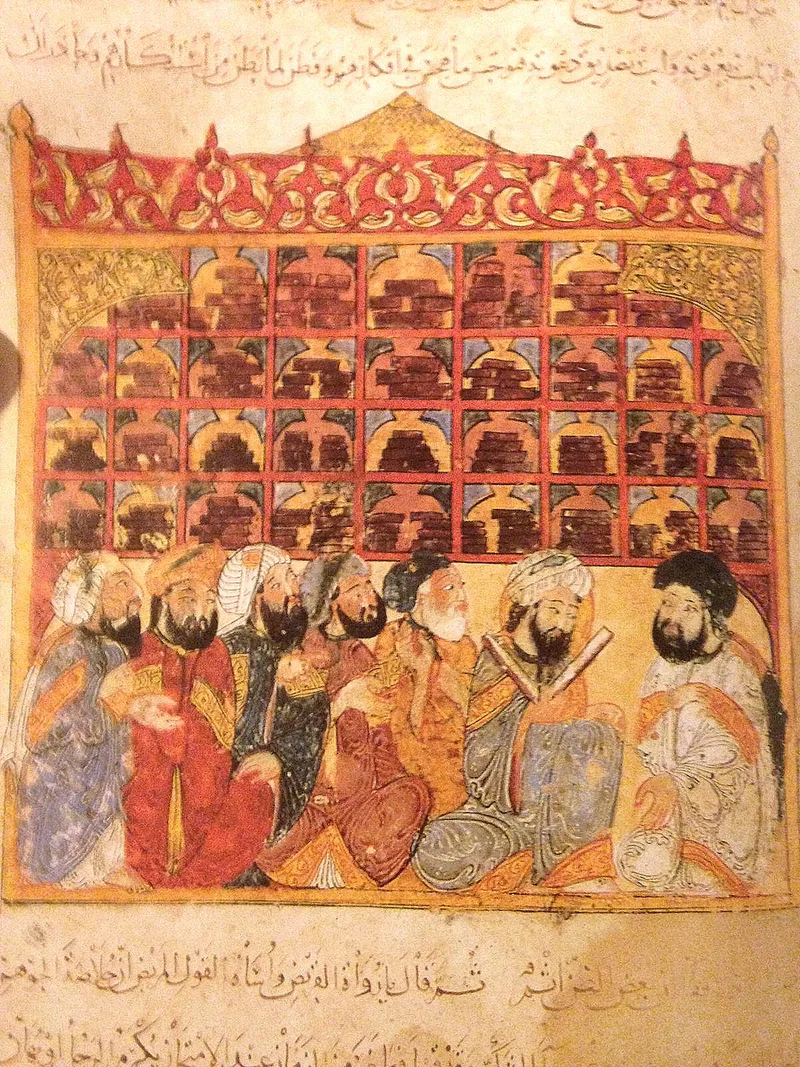
Contact with Christian, Jewish and Zoroastrian theologians, and later with Greek philosophy translated into Arabic, gave Muslim thinkers new tools and new questions: how God's attributes such as knowledge and power relate to His essence, whether the Qur'an is created, how anthropomorphic expressions in the Qur'an (God's "hand" or "throne") should be read, and how God's justice is compatible with human suffering.
Mu'tazilites, Ash'arites and Maturidis§
The Mu'tazila, whose origins are traced to Wasil ibn 'Ata' (d. 748) in Basra, made reason the measure of theology. They taught five principles: God's absolute unity, which led them to deny that His attributes were distinct from His essence; God's justice, which required that humans be the authors of their own acts; the certainty of God's promise and threat; an "intermediate position" for the grave sinner; and the duty to command good and forbid evil. Their doctrine that the Qur'an was created became state policy under the caliph al-Ma'mun, who in 833 began an inquisition (miḥna) of scholars. Ahmad ibn Hanbal's refusal to submit made him a hero of the traditionalists, and the policy was abandoned around 848.
Abu'l-Hasan al-Ash'ari (d. 935 or 936), a former Mu'tazili, founded the school that bears his name. The Ash'ariyya used rational argument to defend traditional beliefs: God's attributes are real and eternal, the Qur'an is His uncreated speech, and anthropomorphic verses are to be accepted "without asking how". Ash'arites taught that God creates every event directly from moment to moment, and that humans "acquire" (kasb) the acts God creates in them. The school was adopted by many Shafi'i and Maliki scholars and counted al-Ghazali and Fakhr al-Din al-Razi among its great figures. In Central Asia, Abu Mansur al-Maturidi (d. 944) founded the Maturidiyya, closely associated with the Hanafis, which gave somewhat more room to human free choice and to reason. Traditionalist Hanbalis, and later Ibn Taymiyya (d. 1328), rejected speculative kalam in favour of the plain sense of scripture.
Twelver Shi'i theology absorbed much Mu'tazili thought, especially its emphasis on divine justice. Kalam also had to face the philosophers, whose arguments for the eternity of the world al-Ghazali attacked, a debate followed in Islamic Philosophy.
Islamic Law and Theology in the Modern Era§
From the nineteenth century, reforms under the Ottoman Empire and European colonial rule transformed the place of fiqh. The Ottoman civil code known as the Mecelle (1869–1876) codified Hanafi law of contracts, and many states replaced Islamic criminal and commercial law with European-style codes, keeping Islamic law mainly for marriage, divorce and inheritance. In the twentieth century some states reintroduced elements of Islamic law, while reformist and modernist thinkers argued for fresh ijtihād based on the objectives of the law. Islamic finance, bioethics and the questions of Muslims living as minorities are active fields of contemporary jurisprudence. Theology too has seen revivals of Mu'tazili rationalism among some modernists and of Ash'ari and Maturidi teaching in traditional seminaries.
Frequently asked questions§
Is sharia a single written legal code?§
No. Sharia is the divine law in the ideal sense; what exists on paper is fiqh, a large and plural literature of rulings by jurists of different schools. Modern states that "apply sharia" do so by selecting and codifying parts of this tradition, and they differ widely.
What is a fatwa?§
A fatwā is a legal opinion given by a qualified scholar, the muftī, in answer to a question. It is not automatically binding, and a person may seek opinions from more than one scholar.
Which school of law do most Muslims follow?§
The Hanafi school is the largest by number of adherents, followed by the Shafi'i school. Many Muslims follow the school traditional in their region, and some modern Muslims do not adhere to a single school.
Sources and further reading§
- An Introduction to Islamic Law — Joseph Schacht, 1964
- A History of Islamic Legal Theories — Wael B. Hallaq, 1997
- Shari'a: Theory, Practice, Transformations — Wael B. Hallaq, 2009
- Principles of Islamic Jurisprudence — Mohammad Hashim Kamali, 1989
- The Formative Period of Islamic Thought — W. Montgomery Watt, 1973
- The Oxford Handbook of Islamic Theology — Sabine Schmidtke (ed.), 2016