What Is Islam? Beliefs, History and Practice of the Faith
What is Islam? An introduction to the faith of nearly two billion Muslims: God and the Qur'an, the Prophet Muhammad, the Five Pillars, law and Sufism.

Islam is a monotheistic religion centred on submission to one God (in Arabic, Allāh) as revealed to the Prophet Muhammad in the Qur'an between about 610 and 632 CE. Its followers, Muslims, number close to two billion people, roughly a quarter of humanity, and live on every continent. Islam teaches that God is one and unique, that He has sent prophets to every people, and that every human being will answer for his or her life on the Day of Judgement.
The Meaning of Islam and the Word "Muslim"§
The Arabic word islām comes from the root s-l-m, which carries the senses of wholeness, safety and peace, and in religious usage means the act of surrendering oneself to God. A muslim is a person who makes that surrender. In the Qur'an the word is used not only of the followers of Muhammad but also of earlier prophets: Abraham, for instance, is described as one who "submitted" to his Lord. Muslims therefore do not regard their religion as something founded in the seventh century so much as the restoration of the original monotheism taught by every prophet since Adam.
Older European books often called Muslims "Mohammedans". Muslims reject the term, because it suggests that they worship Muhammad, whereas Islamic teaching insists that Muhammad was a human messenger and that worship belongs to God alone. Modern scholarship uses "Islam" and "Muslim".
Although the religion arose in Arabia and its scripture is in Arabic, only about a fifth of Muslims today are Arabs. The countries with the largest Muslim populations are Indonesia, Pakistan, India and Bangladesh, and there are long-established Muslim communities in Africa, Central Asia, China, the Balkans and, more recently, Western Europe and the Americas.
Core Beliefs: God, Angels, Scripture and the Last Day§
Islamic theology sums up faith (īmān) in six articles, drawn from the Qur'an and from a famous hadith in which the angel Gabriel questions the Prophet:
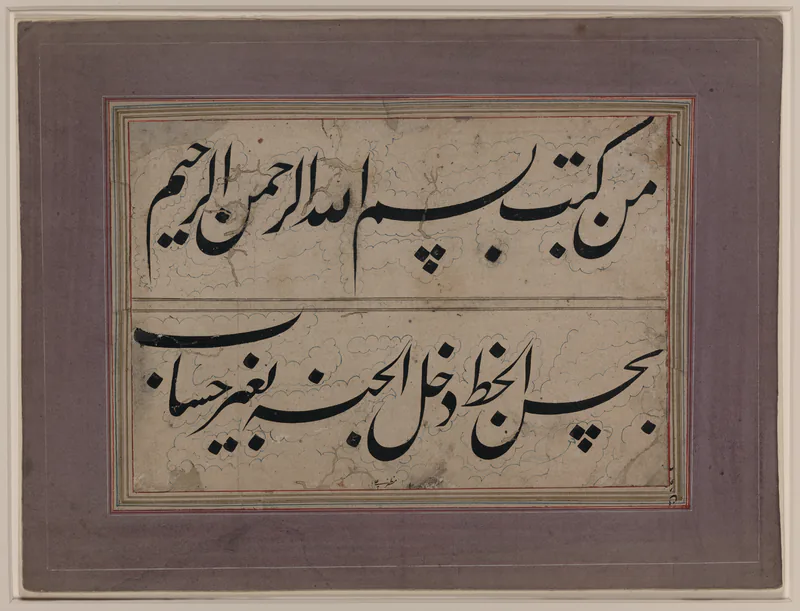
- God. Belief in one God, without partner, child or equal. The central doctrine is tawḥīd, God's absolute oneness, and the gravest sin is shirk, associating anything with Him. The short chapter of the Qur'an called al-Ikhlas expresses it in four lines: "Say: He is Allah, the One".
- Angels. Beings of light who serve God, among them Gabriel (Jibrīl), bearer of revelation. Beside them the Qur'an speaks of the jinn, beings created from fire.
- Revealed books. The Torah given to Moses, the Psalms to David, the Gospel to Jesus and the Qur'an to Muhammad. Muslims hold that the Qur'an confirms and completes the earlier scriptures.
- Prophets and messengers. From Adam through Noah, Abraham, Moses and Jesus to Muhammad, whom the Qur'an calls the "Seal of the Prophets" (al-Ahzab 33:40). Jesus (ʿĪsā) is honoured as a prophet and the Messiah, born of the Virgin Mary, but not as divine.
- The Last Day. The resurrection of the dead, the judgement and the eternal destinations of paradise and hell.
- Divine decree (qadar). God's knowledge and determination of all that happens, a doctrine whose relation to human free will was debated at length by the theologians.
The same hadith of Gabriel names a third dimension beside submission and faith: iḥsān, "excellence" or "doing what is beautiful", defined as worshipping God as though one sees Him. Mystics took this as the charter of Sufism.
The Prophet Muhammad and the Rise of Islam§
Muhammad ibn 'Abdallah was born in Mecca around 570, into the Hashim clan of the tribe of Quraysh. Mecca was a trading town and a pilgrimage centre whose shrine, the Ka'ba, then housed many idols. According to Muslim tradition, in about 610, while he was meditating in a cave on Mount Hira, the angel Gabriel brought him the first words of the Qur'an, beginning "Read: In the name of thy Lord" (al-Alaq 96:1). He preached in Mecca for about twelve years, gathering a small community and meeting growing hostility.
In 622 he and his followers emigrated to the oasis of Yathrib, later called Medina, "the city". This migration, the hijra, marks the first year of the Islamic lunar calendar. In Medina Muhammad became the leader of a community that was at once religious and political. After years of conflict with Mecca, he entered the city in 630, cleared the Ka'ba of idols and rededicated it to the worship of the one God. He died in Medina in 632. His life is treated in detail in The Prophet Muhammad: Life, Mission and Legacy.
Within a century of his death Arab armies had created an empire reaching from Spain to Central Asia. The first four caliphs ("successors") were followed by the Umayyad dynasty of Damascus (661–750) and the Abbasids of Baghdad (750–1258), under whom Islamic law, theology, philosophy and science reached their classical forms. Conversion of the conquered populations was gradual and took several centuries. Later Muslim empires, the Ottoman, Safavid and Mughal among them, dominated much of the Old World into the modern period, while merchants and Sufi teachers carried Islam across the Indian Ocean to East Africa and Southeast Asia.
Worship and the Five Pillars§
Islamic practice is organised around the Five Pillars:
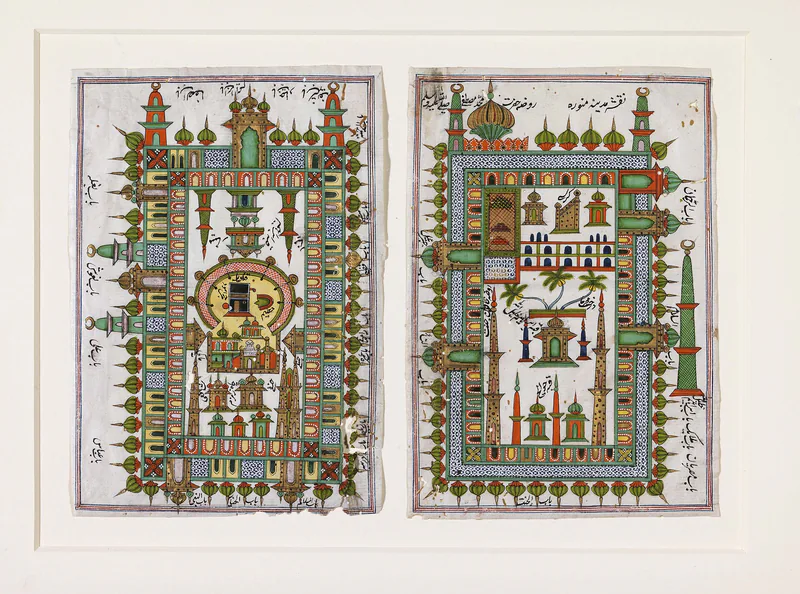
- Shahāda, the testimony that there is no god but God and that Muhammad is His messenger.
- Ṣalāt, the ritual prayer performed five times a day facing Mecca.
- Zakāt, the obligatory annual alms, a fixed share of wealth given to the poor and other categories of recipients.
- Ṣawm, fasting from dawn to sunset during the month of Ramadan.
- Ḥajj, the pilgrimage to Mecca, required once in a lifetime of those able to make it.
The mosque (masjid, "place of prostration") is the centre of communal worship, especially at the Friday noon prayer. The two great festivals are Eid al-Fitr at the end of Ramadan and Eid al-Adha during the pilgrimage season, which commemorates Abraham's willingness to sacrifice his son. Daily life is shaped by further practices: ablution before prayer, dietary rules that forbid pork and alcohol, the recitation of the Qur'an, and the invocation of God's name at the beginning of actions.
Law, Theology and the Schools of Islam§
Islam has been called a religion of law in the way that Judaism is, rather than one in which creed is the main boundary. The sharīʿa, "the way", is God's guidance for human life; fiqh, "understanding", is the human science by which jurists derive rulings from the Qur'an, the example of the Prophet (sunna), consensus and analogy. Four Sunni schools of law (Hanafi, Maliki, Shafi'i and Hanbali) and the Shi'i Ja'fari school survive today. Theology (kalām) produced its own schools, notably the Mu'tazila, the Ash'ariyya and the Maturidiyya. These developments are explained in Islamic Law and Theology.
The great division of the community arose over who should lead it after Muhammad. The majority, later called Sunnis, accepted the caliphs chosen from among the Prophet's companions; the Shi'a ("partisans") held that leadership belonged to his cousin and son-in-law 'Ali and his descendants, the Imams. Sunnis make up perhaps 85 to 90 per cent of Muslims today. See Sunni and Shi'a Islam.
Mysticism, Philosophy and the Esoteric Sciences§
Beside law and theology, Islamic civilisation produced a rich inward and speculative tradition. Sufism (taṣawwuf) cultivated the remembrance and love of God and gave rise to brotherhoods, saints' shrines and some of the world's great religious poetry; its history is surveyed in Sufism: History, Masters and Practices and its organised forms in Sufi Orders and Saints. Philosophy (falsafa), building on Greek thought translated into Arabic, produced al-Farabi, Avicenna and Averroes, whose works later shaped Latin scholasticism (Islamic Philosophy).
The Islamic world was also, for several centuries, the main home of astrology, alchemy, the science of letters and talismanic magic, which passed to medieval Europe through Arabic texts such as the Ghāyat al-ḥakīm, the Picatrix. Muslim scholars argued fiercely about which of these arts were permissible. The subject is treated in Islamic Occult Sciences; the figure of Solomon as master of the jinn appears in Sulayman in Islamic tradition.
Islam in the Modern World§
From the eighteenth century onward, Muslim societies faced European colonial rule, the collapse of the Ottoman Empire in 1922 and the creation of modern nation-states. Responses ranged widely: reform movements calling for a return to the Qur'an and sunna, modernists who sought to reconcile Islam with science and constitutional government, Islamist movements that made Islam the basis of political programmes, and continuing traditional scholarship and Sufi devotion. Today Muslims live under secular, Islamic and mixed legal systems, and debates about authority, gender, law and pluralism are carried on within Muslim communities themselves. Scholars stress that "Islam" is lived in many cultural forms, from Senegalese Sufi brotherhoods to Iranian Shi'ism and Indonesian village piety, all sharing the Qur'an, the Prophet and the pillars of worship.
Frequently asked questions§
Do Muslims worship the same God as Jews and Christians?§
The Qur'an presents itself as revelation from the God of Abraham, Moses and Jesus, and Arabic-speaking Christians and Jews also call God Allāh. Muslims understand God in strictly unitarian terms and reject the Christian doctrine of the Trinity, so theologians of all three faiths continue to discuss how far their conceptions coincide.
What is the difference between Islam and Muslim?§
Islam is the name of the religion, meaning submission to God. A Muslim is a person who follows it. The adjective for things relating to the religion and its civilisation is "Islamic".
How many Muslims are there?§
Estimates for the mid-2020s place the global Muslim population at roughly 1.9 to 2 billion, making Islam the world's second-largest religion after Christianity. Demographers expect the share to grow because of a young age profile.
Is Sufism a separate religion?§
No. Sufism is the mystical dimension of Islam practised by Sunni and, in different forms, Shi'i Muslims. Most historical Sufis were also scholars of law and the Qur'an.
Sources and further reading§
- The Venture of Islam — Marshall G. S. Hodgson, 1974
- Islam: The Straight Path — John L. Esposito, 1988
- A History of Islamic Societies — Ira M. Lapidus, 1988
- What Is Islam? The Importance of Being Islamic — Shahab Ahmed, 2016
- The Study Quran: A New Translation and Commentary — Seyyed Hossein Nasr (ed.), 2015
- Mystical Dimensions of Islam — Annemarie Schimmel, 1975