Liber VIII · Eastern Mysticism · Chapter VII: Sufism
Sufism: History, Masters and Practices of Mystical Islam
Sufism, the mystical path of Islam: its origins, Rabi'a, al-Junayd, al-Hallaj, al-Ghazali, Ibn Arabi, Rumi, the orders, dhikr, sama and spiritual stations.

Sufism (Arabic taṣawwuf) is the mystical and ascetic dimension of Islam: a path of inner purification, remembrance of God and love through which Muslims seek direct, experiential knowledge of the divine. Emerging from early Muslim piety in the eighth and ninth centuries, it produced great saints, poets and philosophers, such as Rabi'a, al-Junayd, al-Ghazali, Ibn Arabi and Rumi, and was organised from the twelfth century onward into the brotherhoods (ṭarīqa) that still shape Muslim life from West Africa to Indonesia.
The origins of Sufism§
The origin of the word ṣūfī is debated, but most scholars derive it from ṣūf, wool, the coarse garment worn by early ascetics. Sufis themselves trace their path to the Qur'an and to the Prophet Muhammad, pointing to his practice of retreat and night prayer, to verses describing God as "nearer than the jugular vein" (Q 50:16), and to the hadith of iḥsān, which defines spiritual excellence as worshipping God as though one sees Him.
In the first Islamic centuries, renunciants (zuhhād) in Basra, Kufa and Khurasan reacted against the worldliness of the expanding empire with fasting, vigils, weeping for sin and fear of judgement. Figures such as Hasan al-Basri (d. 728), though not a Sufi in the later sense, were remembered as forerunners. In the ninth century, especially in Baghdad, this ascetic piety developed into a recognisable mystical movement with its own vocabulary, analysis of the soul and circles of masters and disciples. Earlier Western scholarship sometimes attributed Sufism to Christian, Neoplatonic or Indian influences; most current historians, while acknowledging interactions, emphasise its Islamic roots. Readers interested in parallels may compare Christian mysticism and Pseudo-Dionysius and the Jewish mystical tradition of Kabbalah.
Early Sufi figures: Rabi'a, al-Junayd and al-Hallaj§
Rabi'a al-'Adawiyya§
Rabi'a of Basra (d. 801) is the most famous woman in Sufi history. Much of what is told about her is hagiography written centuries later, but she became the emblem of pure love (maḥabba) of God, worshipping neither from fear of hell nor hope of paradise but for God alone. A well-known story has her carrying a torch and a bucket of water to burn paradise and quench hell, so that people would love God for His own sake.

Al-Junayd of Baghdad§
Abu'l-Qasim al-Junayd (d. 910) became the model of "sober" Sufism. He taught that the mystic passes away (fanāʾ) from self in God, but then returns to "subsistence" (baqāʾ), living in the world with awareness restored and grounded in the religious law. Most later Sufi chains of transmission run through him, and his careful, guarded style shaped the orthodox mainstream.
Al-Hallaj and the ecstatic utterance§
Husayn ibn Mansur al-Hallaj (c. 858–922) represents the "intoxicated" current. He preached publicly and travelled widely, and is famous for the ecstatic utterance anā al-ḥaqq, "I am the Truth" (one of God's names). Accused of heresy and political subversion, he was imprisoned for years and executed in Baghdad in 922. Later Sufis debated whether he had erred by revealing secrets or had been a martyr of love. The French scholar Louis Massignon devoted his life's work to him. Bayazid Bistami (d. c. 874 or 848) is likewise known for daring "ecstatic sayings" (shaṭaḥāt).
Al-Ghazali and the integration of Sufism§
By the eleventh century, writers such as al-Qushayri (d. 1072), whose Risāla became a standard handbook, had worked to show that Sufism was consistent with Sunni law and theology. The decisive figure was Abu Hamid al-Ghazali (1058–1111), a leading jurist and theologian in Baghdad who, in a personal crisis around 1095, abandoned his professorship to live as a Sufi. His autobiographical Deliverance from Error (al-Munqidh min al-ḍalāl) describes concluding that certainty is found not in argument alone but in "tasting" (dhawq), direct experience.
His monumental Revival of the Religious Sciences (Iḥyāʾ ʿulūm al-dīn) integrated law, ritual, ethics and mystical psychology into a single programme of spiritual life. Al-Ghazali's authority helped secure Sufism's place in mainstream Sunni Islam for centuries.
Ibn Arabi and the metaphysics of the Unity of Being§
Muhyi al-Din Ibn Arabi (1165–1240), born in Murcia in al-Andalus and dying in Damascus, is often called al-Shaykh al-Akbar, "the Greatest Master." His enormous output includes al-Futūḥāt al-Makkiyya ("The Meccan Openings") and the compact Fuṣūṣ al-ḥikam ("Bezels of Wisdom"), which treats the wisdom of twenty-seven prophets from Adam to Muhammad, including Solomon, a figure explored further in Sulayman in Islamic tradition.
Ibn Arabi taught that only God truly is; the cosmos consists of the self-disclosures (tajalliyāt) of the divine names, and every created thing is a locus in which God manifests Himself. His followers summarised this as waḥdat al-wujūd, "the Unity of Being," a phrase he did not himself use as a slogan. Central to his thought is the "Perfect Human" (al-insān al-kāmil), who mirrors all the divine names. His ideas were systematised by his stepson Sadr al-Din al-Qunawi and spread across the Islamic world, while also drawing criticism from scholars such as Ibn Taymiyya (d. 1328). William Chittick's studies are the standard English guide.
Rumi and the poetry of love§
Jalal al-Din Rumi (1207–1273), born in Balkh and settled in Konya in Anatolia, was a respected scholar until his meeting in 1244 with the wandering dervish Shams of Tabriz transformed him. Shams's later disappearance inspired an outpouring of poetry. Rumi's Dīwān-i Shams collects thousands of lyric poems, and the Mathnawī, in six books of rhyming couplets, is a vast teaching poem of stories, commentary and Qur'anic reflection, sometimes called "the Qur'an in Persian."
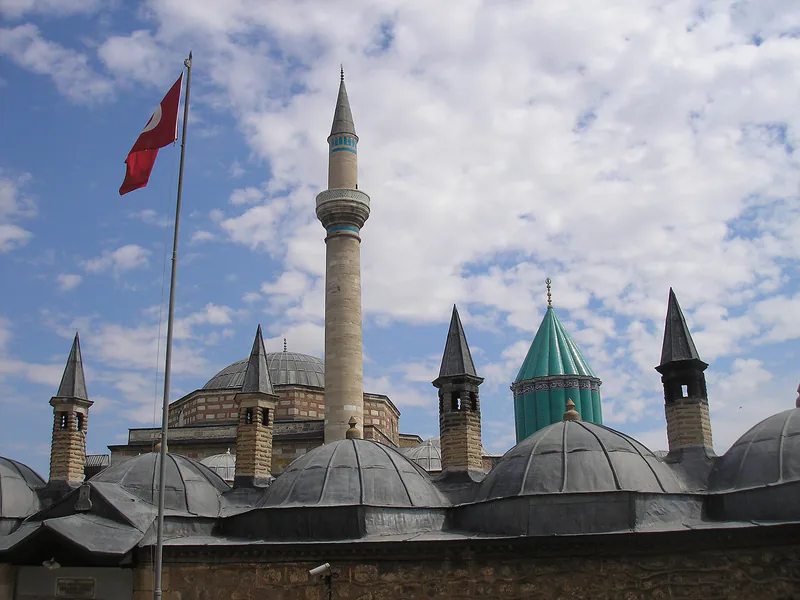
His son Sultan Walad organised his followers into the Mevlevi order, known in the West as the "whirling dervishes" for their ceremony of turning, the semā. Rumi is today among the best-selling poets in the United States, though many popular versions are loose paraphrases that downplay his Islamic content, a point emphasised by Franklin Lewis's scholarly biography.
Attar's Conference of the Birds§
Farid al-Din Attar of Nishapur (d. c. 1221) wrote the Manṭiq al-ṭayr, The Conference of the Birds, one of the masterpieces of Persian literature. The birds of the world, led by the hoopoe, set out to find their king, the Simurgh. One by one they make excuses, and the hoopoe answers each with stories. The journey crosses seven valleys: quest, love, knowledge, detachment, unity, bewilderment, and poverty and annihilation. Of the thousands who set out, only thirty birds arrive, and they discover that the Simurgh is themselves, a pun on the Persian sī murgh, "thirty birds." The allegory dramatises the Sufi teaching that the seeker's self must be emptied for the divine to be found.
Stations, states and the Sufi path§
Sufi manuals map the path (ṭarīqa) as a series of stations (maqāmāt), stable virtues achieved by effort, and states (aḥwāl), transient gifts of grace. Lists vary, but typical stations include repentance, scrupulousness, renunciation, poverty, patience, trust in God and contentment, while states include nearness, love, fear, hope, intimacy and certainty. The goal is fanāʾ, the passing away of the ego in God, followed by baqāʾ, subsistence through God. Sufi psychology analyses the lower self (nafs) and its stages from the commanding self toward the self at peace.
Sufi orders, dhikr and sama§
From the twelfth century, Sufism became institutionalised in orders, each tracing a silsila, a chain of masters back to the Prophet. Among the most important are the Qadiriyya (from 'Abd al-Qadir al-Jilani, d. 1166), the Suhrawardiyya, the Chishtiyya in South Asia, the Naqshbandiyya, known for silent remembrance, the Shadhiliyya in North Africa, the Mevlevi in Anatolia, and later the Tijaniyya in West Africa. A disciple (murīd) takes an oath of allegiance to a shaykh, and lodges (khānqāh, zāwiya, tekke) serve as centres of teaching and hospitality. The tombs of saints became sites of pilgrimage.
Dhikr, "remembrance," is the central practice: the repetition of divine names or formulas such as lā ilāha illā Allāh, aloud or silently, alone or in groups, sometimes with breath control and movement. Outwardly it resembles the mantra repetition of Indian tantra, though its theology of remembrance is thoroughly Qur'anic. Samāʿ, "listening," refers to gatherings in which music and poetry are heard to induce spiritual states, from the Mevlevi turning ceremony to South Asian qawwali. Its legitimacy has long been debated among Muslim scholars. In the modern era Sufism has faced criticism from reformist and Salafi movements while also enjoying revivals and a wide following in the West.
Frequently asked questions§
Is Sufism a separate sect of Islam?§
No. Sufism is a mystical dimension practised within Islam by both Sunni and, in some forms, Shi'i Muslims. Most historical Sufis were observant Muslims and often legal scholars, and they understood their path as the inner reality of the religion.
What is dhikr?§
Dhikr means "remembrance" and refers to repeating names of God or sacred formulas, silently or aloud, individually or in groups. It is the core devotional practice of nearly all Sufi orders.
Why was al-Hallaj executed?§
Al-Hallaj was executed in Baghdad in 922 after a long trial. He was associated with the ecstatic saying "I am the Truth," but historians stress that political accusations and court rivalries also played a major role.
What is the Conference of the Birds about?§
Attar's poem tells of birds journeying through seven valleys to find their king, the Simurgh. Only thirty survive, and they discover that the Simurgh, "thirty birds" in Persian, is a reflection of themselves, an allegory of the soul's annihilation in God.
Sources and further reading§
- Mystical Dimensions of Islam — Annemarie Schimmel, 1975
- Sufism: A Short Introduction — William C. Chittick, 2000
- The Sufi Path of Knowledge: Ibn al-Arabi's Metaphysics of Imagination — William C. Chittick, 1989
- Sufism: The Formative Period — Ahmet T. Karamustafa, 2007
- The Passion of al-Hallaj — Louis Massignon, 1922 (English translation 1982)
- Rumi: Past and Present, East and West — Franklin D. Lewis, 2000
- Deliverance from Error — al-Ghazali, eleventh–twelfth century (various translations)
- The Conference of the Birds — Farid al-Din Attar, c. 1177 (various translations)