Liber VIII · Eastern Mysticism · Chapter VIII: Tantra
Tantra: History and Practice of Hindu and Buddhist Tantra
Tantra's history and practice: Shaiva, Shakta and Buddhist tantra, Abhinavagupta, right- and left-hand paths, the five Ms, mantra, mandala and neo-tantra.

Tantra is a broad family of Indian religious traditions, Hindu, Buddhist and Jain, that emerged in the middle of the first millennium CE and are based on revealed scriptures called tantras. These traditions teach that liberation and worldly power can be attained through initiation by a guru and through ritual techniques such as mantra recitation, the worship of deities in diagrams (maṇḍala, yantra), visualisation and subtle-body yoga; they are not, as popular Western usage suggests, primarily about sex.
What the word tantra means§
The Sanskrit tantra derives from a root meaning "to stretch" or "to weave," and originally referred to a loom or warp. By extension it came to mean a system, a doctrine or a treatise; a medical or political manual could also be called a tantra. In the religious sense it designates a class of texts claiming to be revealed by a deity, usually Śiva or the Goddess in Hindu traditions, or a Buddha in Buddhist ones, and the practices those texts teach.
Tantric scriptures typically present themselves as superior to, or as a fulfilment of, the older Vedic revelation. They share several features: initiation (dīkṣā) as the essential gateway; the guru as embodiment of the deity; mantras as the sound-bodies of gods; elaborate ritual worship (pūjā) using diagrams; the visualisation of the practitioner's body as divine; and the twin goals of liberation (mukti) and supernatural accomplishment or enjoyment (bhukti, siddhi).
Origins and spread of Shaiva and Shakta tantra§
The earliest surviving tantric scriptures are Shaiva. The Niśvāsatattvasaṃhitā, studied by Alexis Sanderson, Dominic Goodall and others, has been dated in its oldest layers to roughly the fifth to sixth centuries CE and is considered the earliest known Shaiva tantra. From this base an enormous literature grew between the sixth and twelfth centuries, much of it now surviving only in Nepalese manuscripts.

Sanderson's research has shown that Shaiva tantra became, for several centuries, the dominant religious idiom of royal courts across South and Southeast Asia, supplying rituals of kingship and initiation. The orthodox Śaiva Siddhānta school emphasised ritual and dualist theology; more radical currents, centred on goddesses and fierce forms of Śiva such as Bhairava, practised in cremation grounds and worshipped yoginīs, female divinities sometimes understood as gathering in circles. The Kaula reform, associated with the semi-legendary Matsyendranātha, domesticated some of this cremation-ground practice into a householder's ritual centred on the clan (kula) of deities and on ecstatic experience.
Shakta tantra, devoted to the Goddess as supreme, developed out of these streams. The cult of the goddess Tripurasundarī, known as Śrīvidyā, with its famous diagram the śrīcakra, became especially important and survives in South India today. The Goddess's power as Śakti, latent in the body as kundalini, is a characteristically tantric idea.
Kashmir Shaivism and Abhinavagupta§
"Kashmir Shaivism" is a modern umbrella term for several non-dual Shaiva schools that flourished in Kashmir between the ninth and twelfth centuries, notably the Trika and the Krama, and the philosophical school of Recognition (Pratyabhijñā) founded by Utpaladeva on foundations laid by Somānanda.
The towering figure is Abhinavagupta (c. 950–1016), philosopher, ritualist, aesthetician and theologian. His Tantrāloka ("Light on the Tantras") is a vast synthesis of Trika ritual and doctrine, and his shorter Tantrasāra condenses it. Abhinavagupta taught that reality is a single, self-aware consciousness (Śiva) whose freedom and creative power (Śakti) manifest as the world. Bondage is a contraction of that awareness; liberation is the recognition that one's own consciousness is Śiva. He ranked methods of realisation from ritual and meditation down to sudden, effortless recognition, and he gave transgressive Kaula rites a contemplative interpretation, treating ecstatic experience as a doorway into the expansiveness of consciousness. His aesthetic theory of rasa, developed in commentaries on drama and poetry, remains central to Indian literary criticism. His follower Kṣemarāja wrote the short and widely read Pratyabhijñāhṛdaya.
Right-hand and left-hand paths§
Later Hindu tantra distinguished between a "right-hand" path (dakṣiṇācāra) and a "left-hand" path (vāmācāra). The distinction concerns the extent to which practitioners break orthodox purity rules. Right-hand practitioners keep to conventional brahmanical norms and use substitutes or internalised meditations; left-hand practitioners use substances and acts normally forbidden to high-caste Hindus, on the principle that the enlightened person transcends the duality of pure and impure. The language of "left" and "right" was adopted much later in Western occultism, where it took on different meanings; see the article on the Temple of Set and the left-hand path.
The five Ms (pañcamakāra)§
The best-known left-hand ritual involves the "five Ms," five items whose Sanskrit names begin with m: madya (wine), māṃsa (meat), matsya (fish), mudrā (usually parched grain, though the term is debated) and maithuna (sexual union). In the ritual these were consecrated and offered to the deity, then consumed, in a controlled setting among initiates. Right-hand interpreters replaced them with substitutes such as milk, ginger or sesame, or read them as yogic metaphors: wine as the nectar flowing from the crown, maithuna as the inner union of Śakti and Śiva. Scholars such as Hugh Urban have emphasised that the five Ms were historically a small part of a large ritual repertoire, and that British colonial and Indian reformist writers gave them disproportionate attention, contributing to tantra's notoriety.
Mantra, mandala and the tantric ritual body§
Whatever its school, tantric practice relies on a common toolkit.
Mantra§
Mantras are sacred formulas, often built around one-syllable "seed" sounds (bīja) such as hrīṃ or hūṃ, that are understood to be the deity in sonic form. They are received in initiation, recited (japa) a prescribed number of times, and installed on the body. The Buddhist name Mantrayāna, "Mantra Vehicle," reflects their centrality.
Mandala and yantra§
A maṇḍala is a circular diagram representing the palace of a deity and its retinue; a yantra is a geometric diagram serving as the deity's seat. They may be drawn in coloured powder for an initiation and then dismantled, painted on cloth, or built as temples. The practitioner enters the maṇḍala ritually and mentally, moving toward its centre.
Nyāsa and the divine body§
In nyāsa the practitioner touches parts of the body while reciting mantras, transforming the body into the deity's. This logic underlies the systems of internal centres described in the history of the chakras. A common tantric maxim holds that only one who has become divine can worship the divine.
Buddhist tantra and deity yoga§
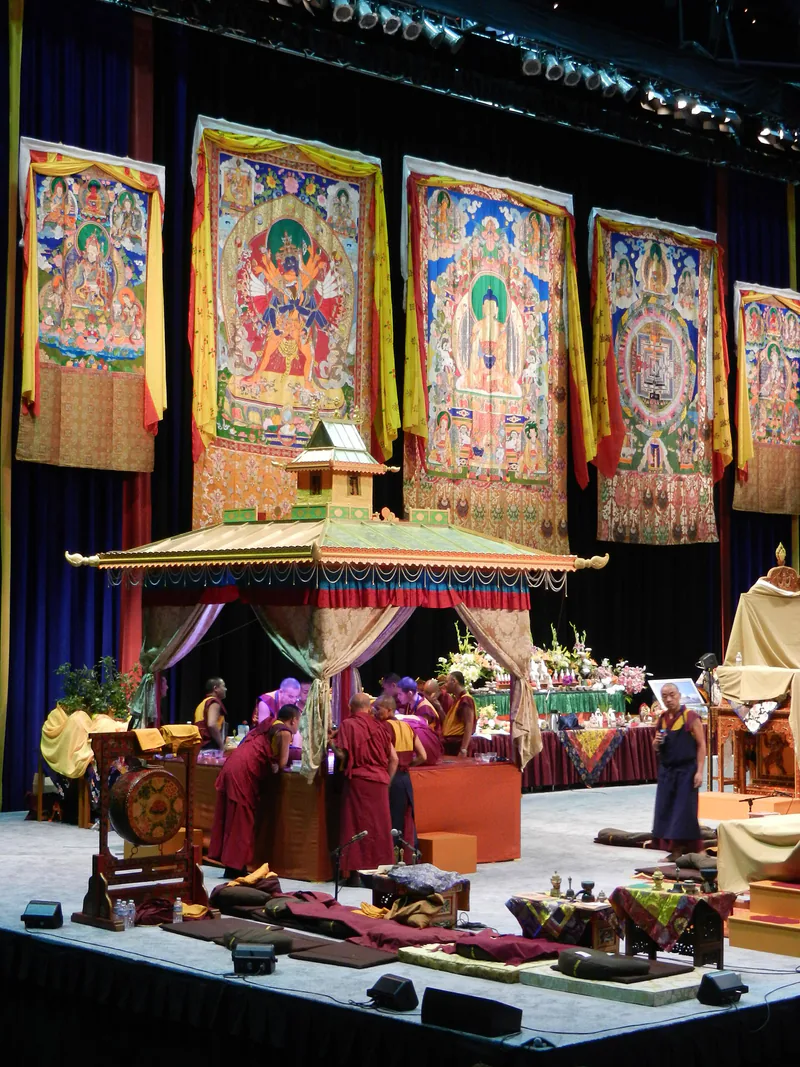
Buddhist tantra, known as Vajrayāna or Mantrayāna, developed in India from about the seventh century, with influential scriptures including the Guhyasamāja, Hevajra, Cakrasaṃvara and Kālacakra tantras. Its masters, the mahāsiddhas ("great adepts"), were remembered as eccentric yogis who reached awakening through unconventional methods. Ronald Davidson has argued that Buddhist tantra took shape in a feudal political world and borrowed heavily from Shaiva models.
The signature practice of Buddhist tantra is deity yoga. The meditator dissolves ordinary appearances into emptiness, then generates the form of an enlightened deity, its maṇḍala and retinue, identifying with it completely while understanding it to be empty of inherent existence. This "generation stage" is followed by a "completion stage" working with the subtle body's channels, winds and drops. Buddhist tantra was carried to Tibet from the eighth century, where it became the basis of all major schools, and to East Asia, where the Shingon school in Japan, founded by Kūkai (774–835), preserves an esoteric Buddhism based on two great maṇḍalas.
Neo-tantra versus historical tantra§
In the Western popular imagination, tantra often means a spiritual approach to sex. This "neo-tantra" has a separate history. Pierre Bernard, who styled himself "Oom the Omnipotent," founded a Tantrik Order in the United States in the early twentieth century; Western occultists, including Aleister Crowley, absorbed elements of Indian sexual yoga into sex magic; and from the 1970s the teachings of Bhagwan Shree Rajneesh (Osho), combined with the human potential movement, created workshops focused on intimacy, breath and orgasm.
Historians such as Hugh Urban, in Tantra: Sex, Secrecy, Politics, and Power in the Study of Religion, have traced how tantra was constructed in the Western imagination as exotic and sexual. Historical tantra was overwhelmingly concerned with initiation, mantra, ritual worship, deity visualisation and philosophy; sexual rites, where they existed, were restricted, ritualised and often understood symbolically. Neo-tantra may be valuable to its practitioners, but it is best understood as a modern Western spirituality that has borrowed a Sanskrit name.
Frequently asked questions§
Is tantra mainly about sex?§
No. Historical tantra was a large system of initiation, mantra, ritual, yoga and philosophy. Sexual rites existed in some left-hand lineages, often in highly controlled forms or interpreted symbolically, but they were a small part of the whole. The sexual emphasis comes chiefly from modern Western neo-tantra.
What is the difference between right-hand and left-hand tantra?§
Right-hand (dakṣiṇa) practitioners observe conventional purity rules and use substitutes or inner meditations. Left-hand (vāma) practitioners ritually use normally forbidden substances, such as the five Ms, holding that the realised person transcends pure and impure.
Who was Abhinavagupta?§
Abhinavagupta (c. 950–1016) was a Kashmiri philosopher and tantric master who synthesised the non-dual Shaiva traditions in works such as the Tantrāloka. He taught that reality is one free consciousness, Śiva, and that liberation is recognising one's own awareness as that consciousness.
Is Tibetan Buddhism tantric?§
Yes. Tibetan Buddhism is built on the Indian Vajrayāna, whose tantras, deity yoga and subtle-body practices were transmitted to Tibet from the eighth century onward and remain central to all its major schools.
Sources and further reading§
- Tantrāloka — Abhinavagupta, c. eleventh century
- Tantra: Sex, Secrecy, Politics, and Power in the Study of Religion — Hugh B. Urban, 2003
- Indian Esoteric Buddhism: A Social History of the Tantric Movement — Ronald M. Davidson, 2002
- Tantra Illuminated — Christopher D. Wallis, 2012
- The Tantric Body: The Secret Tradition of Hindu Religion — Gavin Flood, 2006
- Tantra in Practice — David Gordon White (ed.), 2000
- Kiss of the Yoginī: "Tantric Sex" in its South Asian Contexts — David Gordon White, 2003
- The Serpent Power — Arthur Avalon (Sir John Woodroffe), 1919