Liber VIII · Eastern Mysticism · Chapter VIII: Tantra
Vijnana Bhairava Tantra: The 112 Meditations of Shaiva Tantra
The Vijnana Bhairava Tantra explained: its date and Kashmir Shaiva setting, the dialogue of Bhairava and the Goddess, its 112 meditations and modern versions.

The Vijnana Bhairava Tantra is a short Sanskrit scripture of about 163 verses, probably composed in Kashmir between the seventh and ninth centuries, in which the god Bhairava teaches the Goddess some 112 methods of "centring" (dharana) by which awareness recognises its own divine nature. Treasured by the Kashmir Shaiva tradition and widely translated in the twentieth century, it has become one of the most popular tantric texts in the world precisely because its techniques use breath, sound, the senses and everyday experience rather than elaborate ritual.
What the Vijnana Bhairava Tantra Is: Text, Date and Setting§
The title combines vijnana, "consciousness" or "awareness", with Bhairava, "the terrifying one", a name of Shiva in his transcendent aspect. A tantra in this sense is a revealed scripture, and the Bhairava tantras formed a large class of Shaiva revelation in which Shiva as Bhairava instructs the Goddess. The text claims to be drawn from the Rudrayamala Tantra, a vast and partly lost scripture, a common way for shorter tantras to give themselves authority.
Its date is uncertain. The Kashmiri philosopher Abhinavagupta (c. 950–1016) and his disciple Kshemaraja quote it, so it existed by the tenth century, and its language and doctrines suggest a setting in the Trika and Kula traditions of the preceding centuries. Most scholars place it somewhere between the seventh and ninth centuries. Its ideas fit the non-dual Shaiva philosophy later systematised in Kashmir Shaivism: reality is a single consciousness, Shiva, whose inseparable power, Shakti, manifests the world, and liberation is the recognition of that consciousness as one's own self. The wider history of these schools is outlined in the article on tantra in Hinduism.
The Dialogue of Bhairava and Bhairavi§
The text opens with the Goddess asking Bhairava a series of searching questions. What is his true nature? Is it the sound-form of the mantras, the Trika triad of goddesses, the subtle vibration of nada and bindu, the ascent through the centres of the subtle body, or the power of the syllables? Each of these was an established doctrine of the tantric schools.
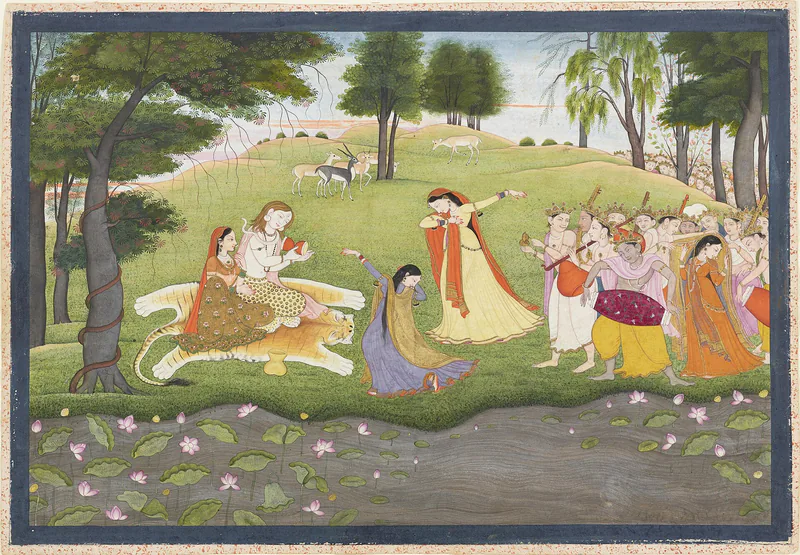
Bhairava's reply is striking. All these forms, he says, are taught to encourage those whose understanding is immature, as a mother frightens or coaxes a child. His real nature is beyond space, time and every description; it is pure awareness, full and free. The Goddess is the gateway to that state, as the light of a lamp reveals the lamp. Asked how this state may be reached, Bhairava answers with the long series of contemplative methods that forms the body of the text.
At the close, Bhairava reinterprets the outer acts of religion in inward terms. True recitation (japa) is the spontaneous sound of the breath; true meditation is the mind free of support; true worship is not offering flowers but resting in the supreme void; true pilgrimage, sacrifice and bathing are steadiness in consciousness. Satisfied, the Goddess embraces Bhairava, and the dialogue ends in union. The inward turn is typical of the more contemplative streams of tantra, which coexisted with elaborate ritual and transgressive practice.
The 112 Dharanas: Breath, Sound, Space and Emptiness§
The text itself speaks of 112 dharanas, and that number has become traditional, though commentators group and count the verses in slightly different ways. A dharana here is not effortful concentration in the sense of Patanjali's Yoga Sutras but a "holding" or placing of awareness that opens onto the vast, objectless state.
The first methods concern the breath. The vital breath goes out and the counter-breath comes in; the text directs attention to the points where each movement ends and the next has not begun, inside at the heart and outside at a point beyond the body, and declares that in these gaps the fullness of Bhairava is revealed. Other techniques work with the subtle body, picturing energy rising through the central channel like a streak of lightning, or resting attention at the "end of twelve" (dvadashanta) above the head, a point discussed in the article on Sahasrara.
Many methods use sound. One may listen to the long sound of a stringed or struck instrument until it fades into silence, or recite a syllable such as Om and follow its resonance into the void at its end. Others use space and emptiness: contemplating the body as empty within, like a hollow vessel; gazing into the clear sky, or into a deep well, until the mind becomes as boundless as the space it beholds; or imagining the universe consumed by the fire of time until only awareness remains. Some methods turn on the point between two thoughts or two perceptions, the instant when one has ended and the next has not arisen.
Ordinary Life as a Doorway: Senses, Emotion and Desire§
What makes the text unusual is its conviction that any intense or transitional moment of ordinary life can open into awareness. It mentions the expansion felt on seeing a dear friend after long absence, the delight of tasting food or drink, the absorption of listening to music, the moment of falling asleep, the start of a sneeze, and moments of fear, grief, hunger or confusion. If attention rests in such a state without following its object, the text says, the underlying fullness of consciousness shines out.
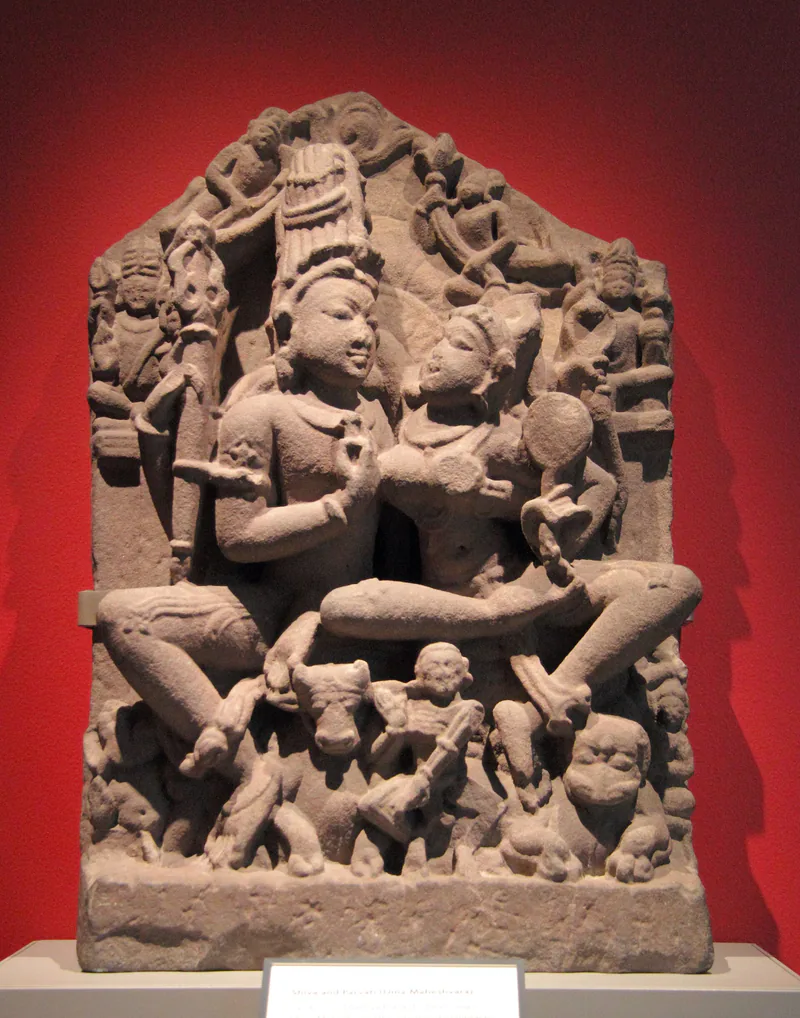
A few verses describe the bliss of sexual union, and even its memory, as a doorway, consistent with tantric teaching that pleasure is a form of the Goddess's power. These verses are brief and contemplative rather than ritual instructions, and they form a small part of a text whose emphasis lies elsewhere. Another verse teaches that wherever the mind goes, outward or inward, that very place is the state of Shiva, since nothing lies outside consciousness.
The cumulative effect is a teaching of radical inclusiveness. Where earlier yoga often sought to withdraw from the senses, the Vijnana Bhairava uses them, treating each sensation as a wave of the same awareness. This affinity with direct, everyday attention is one reason modern readers have compared it with Zen and with Buddhist insight practice, described in the guide to meditation in Eastern traditions, though its theology of Shiva and Shakti is distinct.
Commentaries, Kashmir Shaivism and Modern Translations§
Kshemaraja wrote a commentary on the opening portion of the text, which breaks off early; a full commentary, the Vivriti, was supplied in the eighteenth century by Shivopadhyaya, and other Sanskrit explanations followed. Within Kashmir the text remained part of the living Shaiva tradition, and in the twentieth century its great exponent was Swami Lakshmanjoo (1907–1991), the last major teacher of the Kashmir Shaiva lineage, whose oral explanations were later edited as Vijnana Bhairava: The Practice of Centring Awareness (2002).
Two very different routes carried the text to the West. The scholar Jaideva Singh, who studied with Lakshmanjoo, published a careful Sanskrit edition, translation and commentary, Vijnanabhairava or Divine Consciousness, in 1979. Much earlier, the American writer Paul Reps, who had met Lakshmanjoo in Kashmir, published a free and brief rendering of the methods under the title "Centering", included in the popular collection Zen Flesh, Zen Bones (1957); stripped of Shaiva terms, it introduced the techniques to a generation of Western readers as if they were Zen. In the early 1970s the Indian teacher Rajneesh (later Osho) gave a long series of talks on the 112 methods, published as The Book of Secrets, and later poetic versions, such as Lorin Roche's The Radiance Sutras (2014), continued the trend. Scholars such as Christopher Wallis have since emphasised reading the text within its Shaiva context.
Practising a Dharana Today: A Simple and Safe Example§
The text was originally taught within initiation and a teacher's guidance, but some of its methods are gentle enough to be described simply. One example uses sound. Sitting comfortably with the back upright and the breath natural, one strikes a bell or singing bowl once and listens to the tone as it slowly fades. Attention follows the sound to its very end and then rests in the silence that remains for a few breaths, without trying to produce any experience. The practice can be repeated several times.
A breath-based version is equally simple: one notices, without controlling or holding the breath in any way, the natural pause where the out-breath turns into the in-breath, and lets attention rest there lightly. Such exercises are usually calming. If they produce anxiety or disorientation, it is sensible to stop, and people with a history of serious mental illness should practise any meditation under appropriate guidance. Related practices are described in the article on chakra meditation.
Frequently asked questions§
What is the Vijnana Bhairava Tantra about?§
It is a dialogue in which Bhairava (Shiva) teaches the Goddess that his true nature is pure, boundless awareness, and gives about 112 methods for realising it. The methods use breath, sound, space, the senses and moments of ordinary experience.
How old is the Vijnana Bhairava Tantra?§
It was known to Abhinavagupta and Kshemaraja in the tenth and eleventh centuries, and most scholars date it between the seventh and ninth centuries. Its exact date and author are unknown, as with most tantric scriptures.
Is the Vijnana Bhairava Tantra about sex?§
Only a few verses mention sexual pleasure, as one of many intense experiences that can open into awareness. The great majority of its methods concern breath, sound, space, emptiness and everyday perception.
Who translated the Vijnana Bhairava Tantra?§
Important translations include Jaideva Singh's annotated edition (1979) and Swami Lakshmanjoo's teachings (2002). Paul Reps's free version "Centering" (1957) and Rajneesh's talks popularised it more loosely.
Sources and further reading§
- Vijñānabhairava or Divine Consciousness — Jaideva Singh, 1979
- Vijnana Bhairava: The Practice of Centring Awareness — Swami Lakshmanjoo, 2002
- Zen Flesh, Zen Bones — Paul Reps & Nyogen Senzaki, 1957
- Tantra Illuminated — Christopher D. Wallis, 2012
- The Doctrine of Vibration — Mark S. G. Dyczkowski, 1987
- The Radiance Sutras — Lorin Roche, 2014