Liber VIII · Eastern Mysticism · Chapter XII: Yoga Philosophy & Samadhi
The Yoga Sutras of Patanjali: History, Contents and Meaning
The Yoga Sutras of Patanjali explained: date and authorship, the four books, the eight limbs, the siddhis and kaivalya, commentaries and the modern revival.

The Yoga Sutras of Patanjali is a Sanskrit text of about 195 short aphorisms, usually dated to around the fourth or early fifth century CE, that defines yoga as the stilling of the movements of the mind and sets out a path of ethical discipline, meditation and absorption leading to liberation. It became the foundational text of the Yoga school of Indian philosophy and, after a long period of relative neglect, the most cited scripture of modern global yoga.
What the Yoga Sutras Are: Form, Title and Date§
A sutra is literally a "thread", and the sutra genre strings together terse statements meant to be memorised and unpacked by a teacher or a commentary. Many of Patanjali's sutras are only a few words long and need a commentary to be understood. The standard division gives 51 sutras in the first book, 55 in the second, 55 (or 56) in the third and 34 in the fourth, for a total of 195 or 196 depending on the edition.
Dating rests on internal evidence: the vocabulary, the philosophical debates the text seems to address and its relation to Buddhist literature. The Indologist Philipp Maas, who prepared a critical edition of the first book, argues for roughly 325–425 CE, and this window is widely accepted today, though it remains an estimate.
The text belongs to the Yoga darshana, one of the six schools of Hindu philosophy, and it shares most of its metaphysics with Samkhya: a plurality of pure conscious selves (purusha) set over against active, unconscious matter (prakriti) made of the three gunas. The guide to yoga philosophy and samadhi sets out that background; this article concentrates on the text itself, its contents and its history.
Who Was Patanjali? Legend and Scholarship§
Almost nothing is known of the author as a person. Indian tradition from about the eleventh century identified him with Patanjali the grammarian, author of the Mahabhashya on Panini's grammar (second century BCE), and a popular verse praises one Patanjali for purifying speech by grammar, mind by yoga and body by medicine. Most modern scholars think the grammarian and the yoga author were different people separated by several centuries. Devotional tradition also made Patanjali an incarnation of Adishesha, the cosmic serpent on which Vishnu rests, which is why temple images show him with a human torso, a serpent tail and a hood of cobra heads.
The authorship question has a second layer. Manuscripts transmit the sutras together with a commentary (bhashya) traditionally ascribed to Vyasa, the legendary compiler of the Vedas. Colophons, however, often call the whole the Pātañjala Yogaśāstra, and Maas and others argue that Patanjali compiled sutras and explanation together as a single work, weaving older aphorisms into a new synthesis.
Book One, Samadhi Pada: Stilling the Mind§
The first book opens with "now, the teaching of yoga" and at once gives the definition: yoga is the cessation of the fluctuations (vṛtti) of the mind (citta). When that happens, sutra 1.3 says, the seer abides in its own nature; otherwise it identifies with the fluctuations. Five kinds of fluctuation are named: valid knowledge, error, conceptualisation, sleep and memory. They are stilled by two means that run through the whole text: steady practice (abhyasa) and dispassion (vairagya).
The book then classifies states of absorption. Samadhi "with support" still has an object and passes through stages of gross and subtle reflection, bliss and the bare sense of "I am"; the higher, "seedless" absorption leaves no object at all. Other paths are allowed. Sutra 1.23 says the goal may also be reached by devotion to Ishvara, the Lord, defined as a special purusha untouched by afflictions, actions and their results, whose verbal expression is the syllable Om. Repeating Om while contemplating its meaning is offered as a practice. This theistic element distinguishes Yoga from the classical Samkhya of Ishvarakrishna.
Book One also lists the obstacles to practice, such as illness, doubt, laziness and instability, and recommends cultivating friendliness, compassion, gladness and equanimity toward others. That fourfold list is identical to the Buddhist "divine abidings", one of several points where Patanjali's vocabulary overlaps with Buddhist Sanskrit literature. Scholars debate how much is borrowing and how much a shared ascetic culture.
Book Two, Sadhana Pada: Afflictions, Kriya Yoga and the Eight Limbs§
The second book addresses people not yet capable of the higher absorptions. It begins with kriya yoga, the "yoga of action", made up of austerity (tapas), self-study or recitation (svadhyaya) and devotion to Ishvara. Its aim is to weaken the five afflictions (klesha): ignorance, the sense of "I-am-ness", attachment, aversion and the clinging to life. Ignorance is the root of the rest, defined as taking the impermanent, impure, painful and non-self for the permanent, pure, pleasant and self. Suffering yet to come, the text says, is what is to be avoided, and its cause is the conjunction of the seer with the seen.
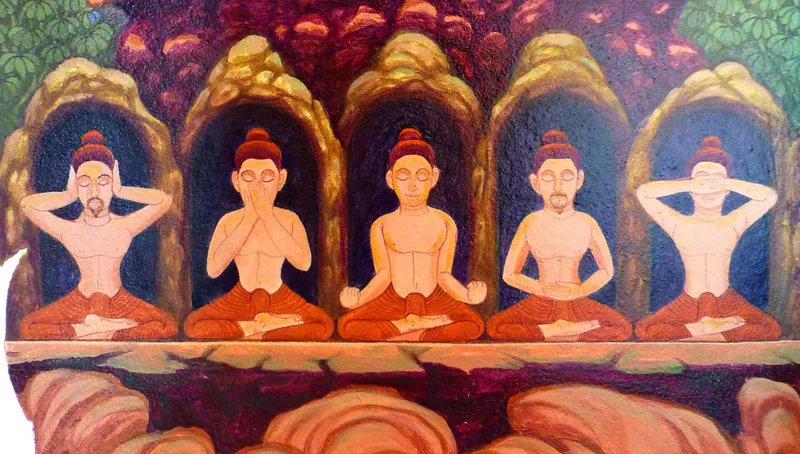
From sutra 2.29 Patanjali gives the scheme for which the text is now best known, the eight limbs (aṣṭāṅga): ethical restraints (yama), observances (niyama), posture (asana), regulation of breath (pranayama), withdrawal of the senses (pratyahara), concentration (dharana), meditation (dhyana) and absorption (samadhi). The restraints are non-violence, truthfulness, not stealing, sexual continence and non-possessiveness; the observances are purity, contentment and the three elements of kriya yoga.
The text says surprisingly little about the body. Posture receives three sutras: it should be steady and comfortable, mastered by relaxing effort, after which one is no longer troubled by opposites such as heat and cold. Breath regulation receives a handful more. The elaborate postures and breath techniques of later hatha yoga belong to a different, medieval body of literature.
Books Three and Four: Powers, Samyama and Kaivalya§
The third book, the Vibhuti Pada or "chapter on manifestations", begins with the last three limbs. Concentration fixes the mind on a place; meditation is the unbroken flow of awareness toward that object; absorption is meditation in which only the object shines, as if empty of its own form. Practised together on one object, the three are called samyama, and the rest of the book describes what samyama on various objects is said to produce.
The list includes knowledge of past and future, of previous births and of other minds; becoming invisible; the strength of an elephant; knowledge of the cosmic regions through samyama on the sun, of the arrangement of the stars through the moon, and of the body's arrangement through the "navel wheel" (nabhi-cakra), one of the earliest uses of the word cakra in this sense. Yet sutra 3.37 adds a significant qualification: such attainments are obstacles to the highest absorption, even though they count as powers in ordinary life. The book ends with the insight that discriminates between the purest state of the mind and the self, from which liberation follows. Claims about inner vision and the brow centre have their own long history, traced in the article on the third eye.
The fourth and shortest book, the Kaivalya Pada, opens by naming five sources of powers: birth, herbs, mantra, austerity and absorption. It then turns philosophical, discussing how karma and latent impressions (samskara, vasana) carry over between lives, and arguing that an object does not depend on a single mind, a position often read as a reply to Buddhist idealist philosophy of the Yogacara school. The work culminates in kaivalya, "isolation" or "aloneness": the self, freed from false identification with the mind, abides in its own nature, and the gunas, their purpose fulfilled, return to their source.
Commentaries, Eclipse and Modern Revival§
A rich commentarial tradition grew around the text. Vacaspati Mishra's Tattvavaisharadi (ninth or tenth century) became the standard sub-commentary on the bhashya. A Vivarana ascribed to the Advaita philosopher Shankara survives, though its authenticity is debated. King Bhoja of Dhara wrote the Rajamartanda in the eleventh century, and Vijnanabhikshu's Yogavarttika in the sixteenth century reconciled Yoga with Vedanta. The Persian scholar al-Biruni produced an Arabic adaptation, the Kitab Patanjal, in the early eleventh century.
In The Yoga Sutra of Patanjali: A Biography (2014) David Gordon White argues that by the early modern period the work had largely fallen out of active study, eclipsed by hatha yoga, devotional movements and Vedanta, so that its present status is a recent creation. European scholars translated it in the nineteenth century, but the decisive turn came with Swami Vivekananda, whose Raja Yoga (1896) presented the sutras to Western audiences as a universal science of mind. James Haughton Woods's 1914 translation in the Harvard Oriental Series gave the text and both major commentaries in English. In the twentieth century teachers such as B. K. S. Iyengar placed the eight limbs at the heart of postural yoga, and the sutras became, in effect, the scripture that modern yoga chose for itself.
Today the text is read at once as a classical treatise, a practical manual within Hindu traditions and a guide for practitioners worldwide. Its methods connect it to the wider history of meditation in Eastern traditions, while its few lines on posture and breath were later expanded in works such as the Hatha Yoga Pradipika.
Frequently asked questions§
How many sutras are in Patanjali's Yoga Sutras?§
Most editions count 195 sutras across four chapters: 51, 55, 55 and 34. Some count 196 because one sutra in the third chapter is divided or added. The sutras are very short and are normally read with a commentary.
When were the Yoga Sutras written?§
Most scholars now date the text to roughly 325–425 CE, though estimates have ranged from the second century BCE to the fifth century CE. The date is inferred from language and content, since no external record names the author or the year.
What does "yoga citta vritti nirodha" mean?§
It is sutra 1.2, Patanjali's definition of yoga: the cessation or restraint of the fluctuations of the mind. When the mind's movements are stilled, the next sutra says, the seer rests in its own nature.
Is the Yoga Sutras a religious text?§
It is a philosophical and practical treatise within Hindu tradition. It accepts karma and rebirth, recommends devotion to Ishvara and the syllable Om, and aims at liberation, but it does not centre on any one deity or ritual, which is part of why it has been read so widely.
Sources and further reading§
- The Yoga Sutras of Patanjali — Edwin F. Bryant, 2009
- The Yoga Sutra of Patanjali: A Biography — David Gordon White, 2014
- The Yoga-System of Patañjali — James Haughton Woods, 1914
- Raja Yoga — Swami Vivekananda, 1896
- Light on the Yoga Sutras of Patanjali — B. K. S. Iyengar, 1993
- Yoga: Immortality and Freedom — Mircea Eliade, 1958
- The Integrity of the Yoga Darsana — Ian Whicher, 1998