Liber XIV · Hinduism · Chapter VIII: The Six Schools of Philosophy
The Six Schools of Hindu Philosophy: The Darshanas Explained
The six schools of Hindu philosophy explained: Nyaya, Vaisheshika, Samkhya, Yoga, Mimamsa and Vedanta, their founders, texts and theories of knowledge.

The six schools of Hindu philosophy, or darshanas, are the classical systems that accept the authority of the Veda: Nyaya, Vaisheshika, Samkhya, Yoga, Mimamsa and Vedanta. Traditionally grouped in three pairs, they offer different accounts of knowledge, reality, the self and liberation, and for some two thousand years they argued with one another and with Buddhist, Jain and materialist thinkers in one of the world's great philosophical traditions.
What Are the Darshanas? Astika and Nastika§
Indian thinkers did not separate philosophy from the pursuit of liberation as sharply as modern Western universities do. A darshana is a systematic "view" of reality that is meant both to be argued for and to be lived. Medieval doxographers sorted these views into astika schools, which affirm the authority of the Veda, and nastika schools, which do not: Buddhism, Jainism, the Ajivikas and the materialists known as Charvaka or Lokayata, who accepted only perception as a means of knowledge and denied any afterlife.
The canonical list of six Hindu schools is itself a later scholastic convention. Earlier surveys counted differently; the Jain scholar Haribhadra, around the eighth century, included Buddhism and Jainism among six views, and the fourteenth-century Sarvadarshanasangraha reviewed sixteen systems. The "six schools" also say little about Shaiva, Vaishnava and tantric philosophies, which were among the most creative of the medieval period, discussed in Shaivism and Tantra in Hinduism.
Sutras, Commentaries and the Means of Knowledge§
Each school traces itself to a founding sage and a root text of terse aphorisms (sutras), which later commentators (bhashyakaras) unpacked and defended. Common to all is the theory of pramanas, the valid means of knowledge. Nyaya accepts four: perception, inference, comparison and reliable testimony, which includes scripture. Mimamsa and Vedanta add postulation (inferring what must be the case to explain a fact) and non-apprehension (knowing an absence). Much classical debate turns on which pramanas are valid and what they can establish.
Nyaya: Logic, Debate and Proof§
Nyaya, "method" or "rule," traces itself to Gautama, also called Akshapada, to whom the Nyaya Sutra is attributed; its date is uncertain, probably somewhere between the second century BCE and the second century CE. Its first commentator was Vatsyayana. Nyaya analysed the structure of valid argument, the varieties of fallacy and the rules of debate. Its standard inference has five members, illustrated by the classic example: the hill has fire; because it has smoke; wherever there is smoke there is fire, as in a kitchen; the hill has smoke of that kind; therefore the hill has fire.
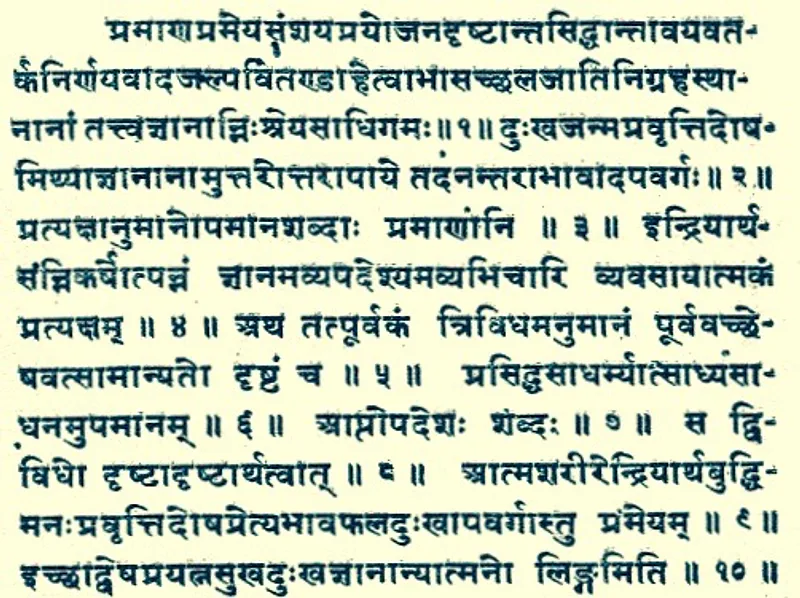
Nyaya thinkers defended the reality of the self, the external world and God against Buddhist critics. Udayana (around the tenth or eleventh century) composed influential arguments for the existence of a creator God. In the fourteenth century Gangesha founded "New Nyaya" (Navya-Nyaya), a highly technical language of logical analysis that later became the common idiom of Indian scholarship in many fields, flourishing at centres such as Mithila and Navadvipa.
Vaisheshika: Categories and Atoms§
Vaisheshika, "the school of distinctions," is attributed to the sage Kanada and his Vaisheshika Sutra. It offers an ontology, an inventory of everything that exists, under six categories (padarthas): substance, quality, motion, universal, particularity and inherence, to which non-existence was later added. Physical substances are composed of indivisible, eternal atoms (paramanu) of earth, water, fire and air, combined into dyads and triads to form visible things; space, time, the self and mind are further substances. Prashastapada's commentary, perhaps of the sixth century, systematised the school. Over time Nyaya and Vaisheshika merged into a single realist system, with Nyaya supplying the theory of knowledge and Vaisheshika the account of reality.
Samkhya and Yoga: Spirit, Matter and Discipline§
Samkhya, "enumeration," is attributed to the legendary sage Kapila, but its earliest surviving systematic text is the Samkhyakarika of Ishvarakrishna, usually dated to about the fourth or fifth century CE. It is a dualism of two eternal principles: pure consciousness (purusha), of which there are many, inactive witnesses, and primal matter (prakriti), composed of three qualities (gunas), luminosity (sattva), activity (rajas) and inertia (tamas). From prakriti evolve twenty-three principles, including intellect, ego, mind, senses and elements, making twenty-five in all with purusha. Bondage arises from confusing consciousness with the workings of matter; liberation comes through discriminating knowledge.
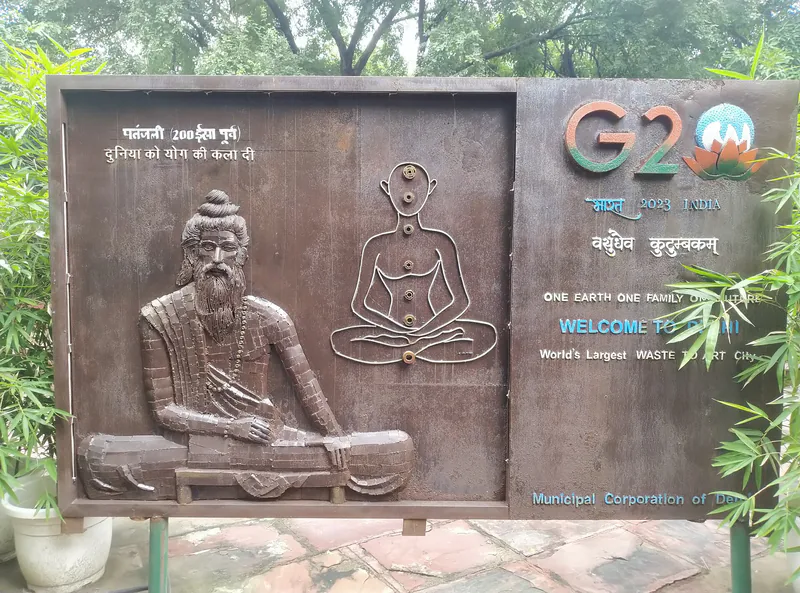
The Yoga school, based on the Yoga Sutras attributed to Patanjali, adopts this metaphysics, adds a supreme Lord (Ishvara) as a special purusha, and prescribes the eight-limbed discipline of ethical restraint, posture, breath, withdrawal of the senses and meditation that culminates in samadhi. Both schools are treated in detail in Yoga Philosophy and Samadhi. Samkhya's categories, especially the three gunas, became part of the common language of Hindu thought, from the Bhagavad Gita to Ayurvedic medicine.
Mimamsa: The Philosophy of Vedic Ritual§
Purva Mimamsa, the "prior inquiry," began as the science of interpreting the ritual portions of the Veda. Its root text is the Mimamsa Sutra attributed to Jaimini, usually dated to the last centuries BCE, with the commentary of Shabara; in the seventh century it divided into the schools of Kumarila Bhatta and Prabhakara. Mimamsa holds that dharma can be known only through the injunctions of the Veda, which is eternal, authorless and self-validating. A ritual act produces an unseen potency (apurva) that later yields its result, such as heaven, without any need for a God to dispense rewards; most early Mimamsakas indeed argued against a creator God.
Mimamsa's rules for interpreting texts, resolving contradictions and determining which sentence governs another were adopted by Hindu law and by Vedanta, and Kumarila's defence of Vedic authority was a major intellectual answer to Buddhism. On the Veda and its ritual, see The Vedas and Upanishads.
Vedanta: The End of the Veda§
Uttara Mimamsa, "the later inquiry," better known as Vedanta, interprets the Upanishads, the Bhagavad Gita and the Brahma Sutras attributed to Badarayana. Its central question is the relation between brahman, the absolute, and the self and world. Shankara's Advaita (non-dualism), Ramanuja's Vishishtadvaita (qualified non-dualism), Madhva's Dvaita (dualism) and the "difference and non-difference" schools of Nimbarka, Vallabha and Chaitanya's followers give very different answers, from strict identity to eternal distinction. Vedanta became the dominant Hindu philosophy from the medieval period onward and, through Swami Vivekananda and others, the most widely known abroad. Its schools are explained in Hinduism and Vedanta, and their understanding of liberation in Dharma, Karma, Samsara and Moksha.
Debate Between the Schools§
The schools developed through debate. Nyaya logicians defended a lasting self against Buddhist philosophers such as Dignaga and Dharmakirti; Mimamsakas defended the eternity of the Veda against both Buddhists and Naiyayikas; Vedantins criticised Samkhya's independent matter and Nyaya's arguments for God. A classical philosophical text typically states the opponent's view (purvapaksha) at length before refuting it, which is why the works of one school are often the best record of what its rivals thought.
Frequently asked questions§
What are the six schools of Indian philosophy?§
They are Nyaya, Vaisheshika, Samkhya, Yoga, Mimamsa and Vedanta, usually grouped in the pairs Nyaya–Vaisheshika, Samkhya–Yoga and Mimamsa–Vedanta. All accept the authority of the Veda, which distinguishes them from Buddhist, Jain and materialist philosophy.
Which of the six schools is the most important today?§
Vedanta is by far the most influential in modern Hinduism, especially Advaita and the devotional Vedanta schools. Yoga is also widely known, although modern yoga practice differs considerably from the classical philosophical school.
Do all six schools believe in God?§
No. Classical Samkhya is generally non-theistic, and early Mimamsa argued against a creator God. Nyaya, Vaisheshika in its later form, Yoga and most of Vedanta affirm God, though they understand God's nature and role differently.
Sources and further reading§
- A History of Indian Philosophy — Surendranath Dasgupta, 1922
- Outlines of Indian Philosophy — M. Hiriyanna, 1932
- Indian Philosophy — Sarvepalli Radhakrishnan, 1923
- The Six Systems of Indian Philosophy — F. Max Müller, 1899
- Perception: An Essay on Classical Indian Theories of Knowledge — Bimal Krishna Matilal, 1986
- Classical Indian Philosophy — Peter Adamson & Jonardon Ganeri, 2020