Liber VIII · Eastern Mysticism · Chapter III: Hinduism & Vedanta
Hinduism and Vedanta: Vedas, Upanishads, Gita and Brahman
A guide to Hinduism and Vedanta: the Vedas, the Upanishads on atman and brahman, the Bhagavad Gita, Shankara's Advaita, Ramanuja, Madhva and modern Vedanta.

Vedanta, "the end of the Veda," is the family of Hindu philosophical schools that interpret the Upanishads, the Bhagavad Gita and the Brahma Sutras. Its central question is the relation between the individual self (atman) and the absolute reality (brahman), answered as strict identity by Shankara's Advaita, as an inseparable but distinct unity by Ramanuja, and as an eternal difference by Madhva.
The Veda and the Ritual Foundations of Hinduism§
"Hinduism" is a modern umbrella term, popularised in the colonial era, for a vast range of Indian traditions; many adherents prefer sanatana dharma, "the eternal order." A general introduction to the religion as a whole is given in what is Hinduism?; this guide concentrates on its scriptural and philosophical core. At its scriptural core stands the Veda, a body of Sanskrit texts held to be shruti, "what was heard": revealed, authorless knowledge transmitted orally with extraordinary precision. There are four Vedas, the Rig, Sama, Yajur and Atharva, each comprising hymns (samhitas), ritual manuals (brahmanas), "forest books" (aranyakas) and, at the end, the Upanishads. The Rigveda, the oldest, is usually dated to roughly 1500–1200 BCE.
Vedic religion centred on fire sacrifice, offered to gods such as Agni, Indra and Soma to maintain cosmic order (rita). The ritual specialists who interpreted these rites developed sophisticated theories of correspondence between the sacrifice, the human body and the cosmos. That habit of thought, seeking the hidden equivalences that make ritual effective, prepared the ground for the inward turn of the Upanishads.
The Upanishads: Atman, Brahman and Liberation§
The earliest Upanishads, notably the Brihadaranyaka and Chandogya, are generally placed in the mid-first millennium BCE, with others composed over the following centuries. In dialogues between sages, kings, wives and students, they ask what lies behind the sacrifice, the breath and consciousness itself. Their answer is that the innermost self, atman, is grounded in or identical with brahman, the single reality underlying all things. Knowing this frees one from samsara, the cycle of death and rebirth driven by action (karma).
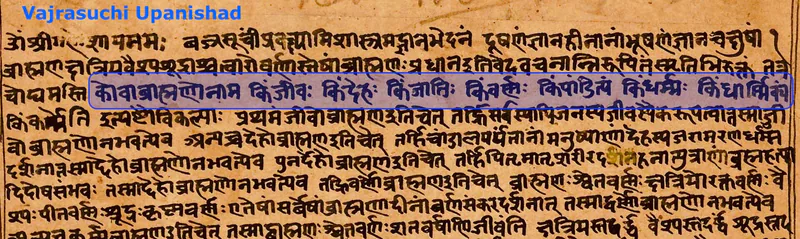
Later tradition distilled the teaching into four "great sayings" (mahavakyas), among them "you are that" (tat tvam asi) from the Chandogya and "I am brahman" (aham brahmasmi) from the Brihadaranyaka. The short Mandukya Upanishad analyses the sacred syllable Om into waking, dreaming and dreamless sleep, with a fourth state (turiya) that is pure consciousness beyond all three. These texts are a cornerstone of Indian contemplative practice; the meditation guide shows how they shaped later techniques.
The Bhagavad Gita and the Three Paths§
The Bhagavad Gita, "Song of the Lord," is a 700-verse dialogue embedded in the Mahabharata epic and usually dated between about the second century BCE and the second century CE. On the eve of battle, the warrior Arjuna despairs at having to fight his kinsmen; his charioteer Krishna, revealed as the supreme God, teaches him how to act rightly. The Gita presents three disciplines, later called paths or yogas: karma yoga, action performed without attachment to its fruits; jnana yoga, liberating knowledge of the self; and bhakti yoga, loving devotion to God.
By uniting Upanishadic metaphysics with a personal God and an ethic of engaged action, the Gita became the most widely read Hindu scripture. With the Upanishads and the Brahma Sutras, a terse summary of Upanishadic teaching attributed to Badarayana, it forms the prasthana-traya, the "triple foundation" on which every Vedanta teacher was expected to comment.
Advaita Vedanta: Shankara and Non-Dualism§
The most famous school is Advaita, "non-dual," Vedanta. Its foundations appear in the Mandukya Karika attributed to Gaudapada, but its classic exponent is Shankara, traditionally dated 788–820 CE, though many scholars place him somewhat earlier, in the late seventh or early eighth century. In commentaries on the Upanishads, the Gita and the Brahma Sutras, Shankara taught that brahman alone is real, that it is without attributes (nirguna), and that the individual self is not a part or product of brahman but identical with it.

The world of multiplicity, for Advaita, is not simply nonexistent but is an appearance projected by ignorance (avidya) or maya, like a rope mistaken for a snake in dim light. Ritual and devotion have a place at the level of conventional truth, but liberation comes only through knowledge, gained by hearing the scriptures, reflecting on them and meditating on their meaning. Tradition credits Shankara with founding monastic centres (mathas) and organising the Dashanami order of renunciants, though the historical details are debated.
Ramanuja, Madhva and Devotional Vedanta§
Not all Vedantins accepted Shankara's conclusions. Ramanuja, traditionally dated 1017–1137, the great teacher of the Sri Vaishnava tradition in south India, developed Vishishtadvaita, "qualified non-dualism." For him, brahman is the personal God Vishnu-Narayana, possessed of infinite good qualities, and souls and the world are real, forming God's "body" while remaining dependent on him. Liberation is attained through devotion and divine grace, and the liberated soul enjoys God rather than dissolving into him.
Madhva (thirteenth century), based at Udupi on the west coast, went further and taught Dvaita, "dualism": God, souls and matter are eternally distinct. Later teachers, among them Nimbarka, Vallabha and the followers of Chaitanya in Bengal, proposed further positions between identity and difference. These devotional Vedantas shaped Hindu religious life as deeply as Advaita did, and their emphasis on love of God connects them to wider currents of bhakti and to the ritual worlds of tantra.
Modern Vedanta and Its Western Reception§
In the nineteenth century, Vedanta became the intellectual centre of Hindu reform. Rammohan Roy's Brahmo Samaj (1828) championed a rational monotheism drawn from the Upanishads, and Swami Vivekananda, disciple of the Bengali mystic Ramakrishna, presented Advaita at the World's Parliament of Religions in Chicago in 1893 as a universal religion compatible with science. The Vedanta Societies he founded in the United States and the Ramakrishna Mission (1897) carried this message abroad. In the twentieth century, Ramana Maharshi (1879–1950) of Tiruvannamalai taught a simple method of self-enquiry, asking "Who am I?", that made Advaita accessible to seekers worldwide.
Western writers from Schopenhauer and Emerson to Aldous Huxley, whose The Perennial Philosophy appeared in 1945, saw in Vedanta a universal mystical core. Scholars today note that "Neo-Vedanta" often blends Shankara with modern ideas of experience and universalism. For Vedanta's partner school, the dualist yoga of Patanjali and Samkhya, see yoga philosophy and samadhi, and for the wider setting, what is Eastern mysticism?.
Frequently asked questions§
What does Vedanta mean?§
Vedanta means "the end of the Veda." It refers both to the Upanishads, which come at the end of the Vedic corpus, and to the philosophical schools that interpret them as the culmination of Vedic wisdom.
What is the difference between Advaita and Dvaita Vedanta?§
Advaita (non-dualism) teaches that the self is identical with brahman and that plurality is an appearance. Dvaita (dualism), taught by Madhva, holds that God, souls and the world are eternally distinct, with liberation granted through devotion and grace.
Is the Bhagavad Gita part of the Vedas?§
No. Strictly it belongs to the Mahabharata and is classed as smriti, "remembered" tradition, rather than revealed shruti. In practice it is treated with scriptural authority and is one of Vedanta's three foundational texts.
Is Vedanta the same as Hinduism?§
No. Vedanta is one group of philosophical schools within Hinduism, though an influential one. Hinduism also includes ritual traditions, temple worship, tantra, Shaiva and Shakta theologies and many regional practices that are not primarily Vedantic.
Sources and further reading§
- The Upanishads — Patrick Olivelle (trans.), 1996
- The Bhagavad-Gita: Krishna's Counsel in Time of War — Barbara Stoler Miller (trans.), 1986
- An Introduction to Hinduism — Gavin Flood, 1996
- Advaita Vedanta: A Philosophical Reconstruction — Eliot Deutsch, 1969
- The Theology of Ramanuja — John Braisted Carman, 1974
- The Philosophy of the Upanishads — Paul Deussen, 1906
- The Perennial Philosophy — Aldous Huxley, 1945