What Is Hinduism? History, Beliefs, Scriptures and Practice
What is Hinduism? An introduction to its history from the Vedas to today, its gods, scriptures, key beliefs in dharma, karma and moksha, and its worship.

Hinduism is the family of religious traditions that developed in the Indian subcontinent over more than three thousand years, from the hymns of the Vedas to the temple worship, devotional movements and global communities of today. It has no single founder, creed or church; what holds it together is a shared body of scripture, a shared vocabulary of ideas such as dharma, karma, rebirth and liberation, and overlapping traditions of worship centred on deities such as Vishnu, Shiva and the Goddess. With roughly 1.2 billion adherents, it is the world's third-largest religion.
The Name Hinduism and the Problem of Definition§
The word "Hindu" derives from the Persian form of Sindhu, the river Indus, and was used for centuries by Persians, Greeks and Arabs as a geographical term for the people living beyond that river. Medieval Muslim rulers and chroniclers increasingly used it for the non-Muslim population of India, and by the fifteenth and sixteenth centuries some Indian authors were using it of themselves. The abstract noun "Hinduism" appears in English only in the early nineteenth century, when British administrators, missionaries and Indian reformers sought a single name for the religion of the majority.
Scholars still debate whether Hinduism is best described as one religion or as a family of religions. Its traditions differ on almost every point: some worship a personal God, others an impersonal absolute; some treat the Vedas as the centre of authority, others a regional saint's songs. Many Hindus prefer the phrase sanatana dharma, the timeless order of things. A useful working definition is that Hindus are those who acknowledge, at least nominally, the authority of the Veda and participate in the network of deities, rites, places and ideas that grew around it.
A Short History of Hinduism§
From the Indus Valley to the Vedic Age§
The Indus or Harappan civilisation flourished in the north-west of the subcontinent in its mature phase from about 2600 to 1900 BCE. Its script is undeciphered, and claims that its seals show an early form of Shiva or of yoga remain speculative. The oldest Hindu texts belong instead to the Vedic period. The Rigveda, a collection of hymns in an archaic form of Sanskrit, is usually dated to roughly 1500–1200 BCE, although dating is debated and some writers argue for earlier dates. Most historians connect it with Indo-Aryan-speaking peoples who entered the north-west and fused with existing populations; this, too, remains a politically sensitive question in India.
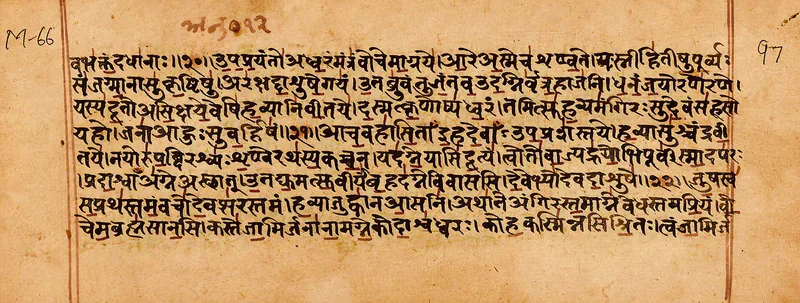
Vedic religion centred on the fire sacrifice (yajna) offered to gods such as Agni, Indra, Varuna and Soma. From about the eighth to the fifth centuries BCE the Upanishads turned inward, asking what lay behind the ritual and identifying the self (atman) with the ground of all being (brahman). The same centuries saw the rise of renouncer movements, among them Buddhism and Jainism, which rejected Vedic authority but shared many of the same questions about karma and liberation; see The Vedas and Upanishads for this formative period.
Epics, Puranas and Temples§
Between about 400 BCE and 400 CE the great epics, the Mahabharata and the Ramayana, took shape, together with the law books (dharmashastras) such as the Laws of Manu. The epics introduced deities who would dominate later Hinduism, above all Vishnu in his descents (avatara) as Rama and Krishna. Under the Gupta dynasty (fourth to sixth centuries CE) and its successors, stone temples, image worship (puja) and the encyclopaedic Puranas gave classical Hinduism much of its recognisable shape.
Devotion, Tantra and Philosophy§
From about the sixth century, Tamil poet-saints in south India sang passionate songs to Vishnu and Shiva, launching the devotional (bhakti) movements that spread across India over the following thousand years. In the same period tantric scriptures shaped temple ritual and esoteric practice, and philosophers such as Shankara (traditionally dated 788–820, though perhaps earlier), Ramanuja and Madhva developed the schools of Vedanta. The arrival of Islam from the eighth century onward brought conflict, but also deep cultural exchange, visible in figures such as Kabir, one of the poet-saints described in The Bhakti Movement.
Reform and Global Hinduism§
Under British rule, reformers such as Rammohun Roy, who founded the Brahmo Samaj in 1828, and Dayananda Sarasvati, who founded the Arya Samaj in 1875, sought to purify Hinduism of practices they considered later corruptions. Swami Vivekananda's address to the World's Parliament of Religions in Chicago in 1893 presented Vedanta to a Western audience, and Mohandas Gandhi made Hindu ideals of non-violence and truth central to the independence movement. Today large Hindu communities live in Nepal, Bangladesh, Sri Lanka, Bali, Mauritius, Fiji, the Caribbean, Britain and North America.
Hindu Scriptures: Shruti and Smriti§
Hindu tradition divides its sacred literature into two classes. Shruti, "what was heard," is the Veda, held to be eternal and revealed to ancient seers (rishis): the four collections of the Rig, Sama, Yajur and Atharva Vedas, each with its ritual prose and its Upanishads. Smriti, "what is remembered," comprises everything else of authority: the epics, the Puranas, the law books and the auxiliary sciences. In practice, smriti texts are far more widely known. The Bhagavad Gita, technically part of the Mahabharata, is the most widely read Hindu scripture, discussed in The Epics and the Bhagavad Gita.
Beside these stand the scriptures of particular traditions: the Agamas and Tantras that govern temple ritual, the Tamil hymns of the Alvars and Nayanars, the Hindi Ramcharitmanas of Tulsidas and the songs of countless regional saints. For many Hindus a vernacular devotional text is the scripture they actually hear and recite.
Gods, Goddesses and the Great Traditions§
Hindu worship is directed to many deities, yet most Hindu thinkers regard them as forms, aspects or servants of one supreme reality. A famous verse of the Rigveda (1.164.46) already says that the wise call the one being by many names. Each devotee usually has a chosen deity (ishta-devata), often inherited from family and region.
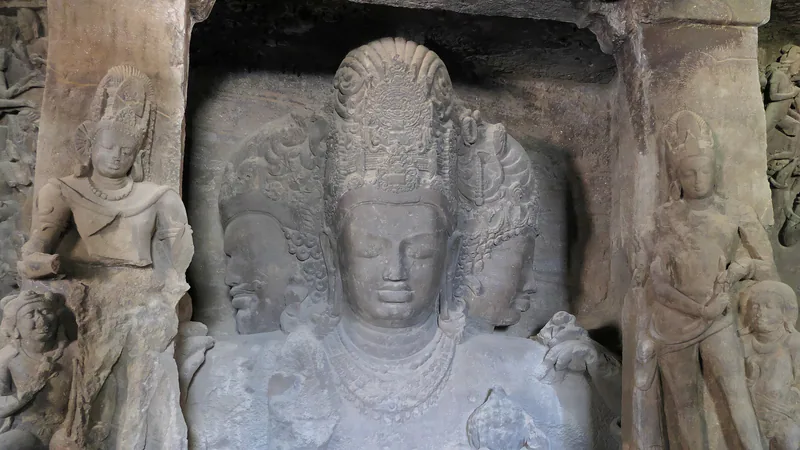
Four broad traditions are commonly distinguished. Vaishnavas worship Vishnu, especially as Krishna or Rama; Shaivas worship Shiva; Shaktas worship the Goddess, Devi, in forms such as Durga and Kali; and Smartas, traditionally associated with Shankara, honour five deities together (Vishnu, Shiva, the Goddess, Surya and Ganesha). The well-known "trinity" (trimurti) of Brahma the creator, Vishnu the preserver and Shiva the destroyer is a Puranic idea that matters less in daily worship than popular summaries suggest. For an overview of the pantheon, see Hindu Gods and Goddesses.
Key Beliefs: Dharma, Karma, Samsara and Moksha§
Despite their diversity, most Hindu traditions share a cluster of ideas. Dharma is the order that sustains the cosmos and society, and the duty that falls to each person according to stage of life and social position. Karma is action and its consequences, which ripen in this life or in future ones. Samsara is the cycle of birth, death and rebirth through which beings pass according to their karma. Moksha is liberation from that cycle, understood variously as union with or realisation of brahman, or as eternal loving service of God.
Classical texts list four legitimate aims of life (purusharthas): dharma, prosperity (artha), pleasure (kama) and liberation. They also describe paths to liberation, later summarised as the ways of action (karma yoga), knowledge (jnana yoga) and devotion (bhakti yoga). These ideas are treated in depth in Dharma, Karma, Samsara and Moksha, while the philosophical schools built on them are covered in Hinduism and Vedanta and Yoga Philosophy and Samadhi.
Caste and Social Order§
The ideal of varnashrama dharma divides society into four classes (varna): priests (Brahmins), warriors and rulers (Kshatriyas), merchants and farmers (Vaishyas) and labourers (Shudras), and life into four stages (ashrama): student, householder, forest-dweller and renouncer. The lived reality has been the far more complex system of thousands of hereditary communities (jati), with groups formerly treated as "untouchable," who today often call themselves Dalits, excluded altogether. Many saints and reformers rejected caste hierarchy, and India's 1950 constitution outlawed untouchability, but caste remains a contested and painful reality in Hindu societies.
Worship and Practice in Everyday Hinduism§
For most Hindus, religion is first of all practice rather than doctrine. Daily puja in the home or temple honours a deity's image with lamps, flowers, food, incense and song, and the central act of temple visiting is darshan, "seeing" the deity and being seen in return. Life is marked by rites of passage (samskaras), traditionally sixteen, from naming and the sacred-thread initiation to marriage and cremation. Pilgrimage to holy rivers and cities such as Varanasi, and festivals such as Diwali, Holi and Navaratri, structure the year; see Hindu Temples, Rituals and Festivals.
Alongside householder religion stands a long tradition of renunciation. Sannyasis and other ascetics leave family life to pursue liberation, often through yoga and meditation, and gurus play a central role as teachers and living embodiments of the divine. Astrology (jyotisha), discussed in Vedic Astrology, is widely consulted for choosing auspicious times.
Frequently asked questions§
Is Hinduism polytheistic or monotheistic?§
It can be described either way, and neither label fits neatly. Hindus worship many deities, but most traditions understand them as manifestations of a single supreme reality, whether a personal God such as Vishnu or Shiva or the impersonal brahman. Scholars sometimes use terms such as "henotheism" or "polymorphic monotheism" to capture this.
Who founded Hinduism?§
Hinduism has no single founder or founding date. It grew gradually from the religion of the Vedas, absorbing regional cults, renouncer traditions, devotional movements and tantric schools over several thousand years. Individual traditions within it, however, do look back to founding teachers such as Shankara, Ramanuja or Chaitanya.
What is the holy book of Hinduism?§
There is no single holy book. The Vedas are the most authoritative scriptures in principle, while the Bhagavad Gita, the epics and the Puranas are the most widely read in practice. Many communities also treat vernacular devotional works as scripture.
What does sanatana dharma mean?§
Sanatana dharma means "eternal dharma," the timeless order, law or duty. Since the nineteenth century many Hindus have used the phrase as a self-designation, preferring it to the foreign-derived word "Hinduism."
Sources and further reading§
- An Introduction to Hinduism — Gavin Flood, 1996
- Hinduism: A Very Short Introduction — Kim Knott, 1998
- The Hindus: An Alternative History — Wendy Doniger, 2009
- Hinduism: Past and Present — Axel Michaels, 2004
- The Camphor Flame: Popular Hinduism and Society in India — C. J. Fuller, 1992
- Hindus: Their Religious Beliefs and Practices — Julius Lipner, 1994
- The Rigveda: The Earliest Religious Poetry of India — Stephanie W. Jamison & Joel P. Brereton (trans.), 2014