Liber XIV · Hinduism · Chapter VII: Shaktism & the Goddess
Shaktism: Devi, Durga, Kali and the Hindu Goddess Tradition
Shaktism explained: the worship of the Hindu Goddess as supreme power, the Devi Mahatmya, Durga, Kali, the Mahavidyas, Shri Vidya and the Shakti Pithas.

Shaktism is the Hindu tradition that worships the Goddess, Devi or Mahadevi, as the supreme reality: the power (shakti) that creates, sustains and dissolves the universe and the mother of all beings. Its central scripture is the Devi Mahatmya, which tells how the Goddess Durga slew the buffalo demon, and its forms of the Goddess range from the gracious Lalita Tripurasundari of the Shri Vidya tradition to the fierce Kali of Bengal. Goddess worship is far older and broader than any single school, and in some form it is part of the religious life of almost every Hindu.
Origins of Goddess Worship in India§
Female deities appear in the earliest Indian sources, but their history is complex. Terracotta female figurines from the Indus civilisation have often been interpreted as mother goddesses, although their meaning cannot be confirmed. The Rigveda praises goddesses such as Ushas, the dawn, Aditi, the boundless mother of the gods, and Vak, sacred speech, who in a famous hymn (10.125) declares that she pervades heaven and earth and empowers the gods. Yet in Vedic religion goddesses were secondary to male deities.
Alongside the Brahmanical tradition, local goddesses of villages, mountains, rivers and diseases, worshipped by communities of every class, seem to have formed an ancient and enduring layer of Indian religion. Hymns to Durga were added to the Mahabharata, and the Puranas gradually identified many local goddesses as forms of one great Goddess. Over the following centuries, as described in Hindu Gods and Goddesses, the Goddess became both the consort of each great god and, for her devotees, the highest reality.
The Devi Mahatmya and the Victory of Durga§
The decisive text is the Devi Mahatmya, "the glorification of the Goddess," a 700-verse poem embedded in the Markandeya Purana and usually dated to about the fifth or sixth century CE. It is also called the Durga Saptashati ("seven hundred verses to Durga") or Chandi Path, and its recitation is a central act of Goddess worship to this day.
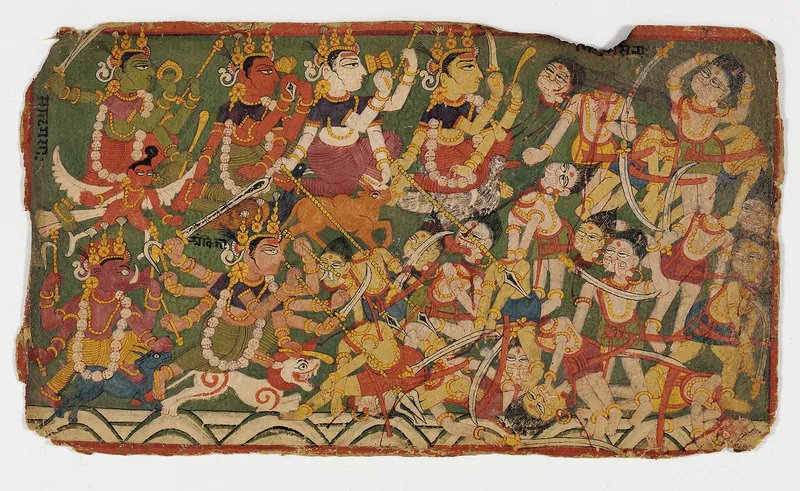
The poem tells three stories. In the first the Goddess, as the cosmic sleep of Vishnu, releases him to kill two demons born from his ear. In the second, the most famous, the buffalo demon Mahisha has defeated the gods, who pour out their fiery energies; these combine into a radiant Goddess, Durga, to whom each god gives a weapon. Riding a lion, she destroys Mahisha's armies and finally kills him as he emerges from his buffalo form. In the third, she defeats the demons Shumbha and Nishumbha; from her furious brow springs Kali, who beheads the generals Chanda and Munda and drinks the blood of Raktabija, a demon whose every drop of spilled blood produced a new demon. The text presents the Goddess as the supreme power who is at once the world's illusion, its creative nature and the knowledge that liberates.
Shakta Theology: Shakti, Shiva and the Divine Mother§
In much Hindu theology, every god has his shakti, his power or energy, personified as his consort: Lakshmi for Vishnu, Parvati for Shiva. Shaktas reverse the usual emphasis. A celebrated verse opening the Saundaryalahari, a hymn traditionally attributed to Shankara, says that Shiva can create only when united with Shakti; without her he cannot even stir. A popular play on words makes the same point: without the vowel "i," which stands for Shakti, Shiva becomes shava, a corpse.
The Goddess is identified with prakriti, the material and creative principle, with maya, the power that projects the world, and with consciousness itself. The Devi Bhagavata Purana, a large Shakta Purana usually dated to the late first or early second millennium, presents her as the source of Brahma, Vishnu and Shiva; its Devi Gita section, modelled on the Bhagavad Gita, has the Goddess teach her own supremacy. Above all, Shaktas approach her as Mother (Ma, Amma), loving and fierce at once, protecting her children while also embodying time and death.
Forms of the Goddess: Kali, the Mahavidyas and the Yoginis§
Kali§
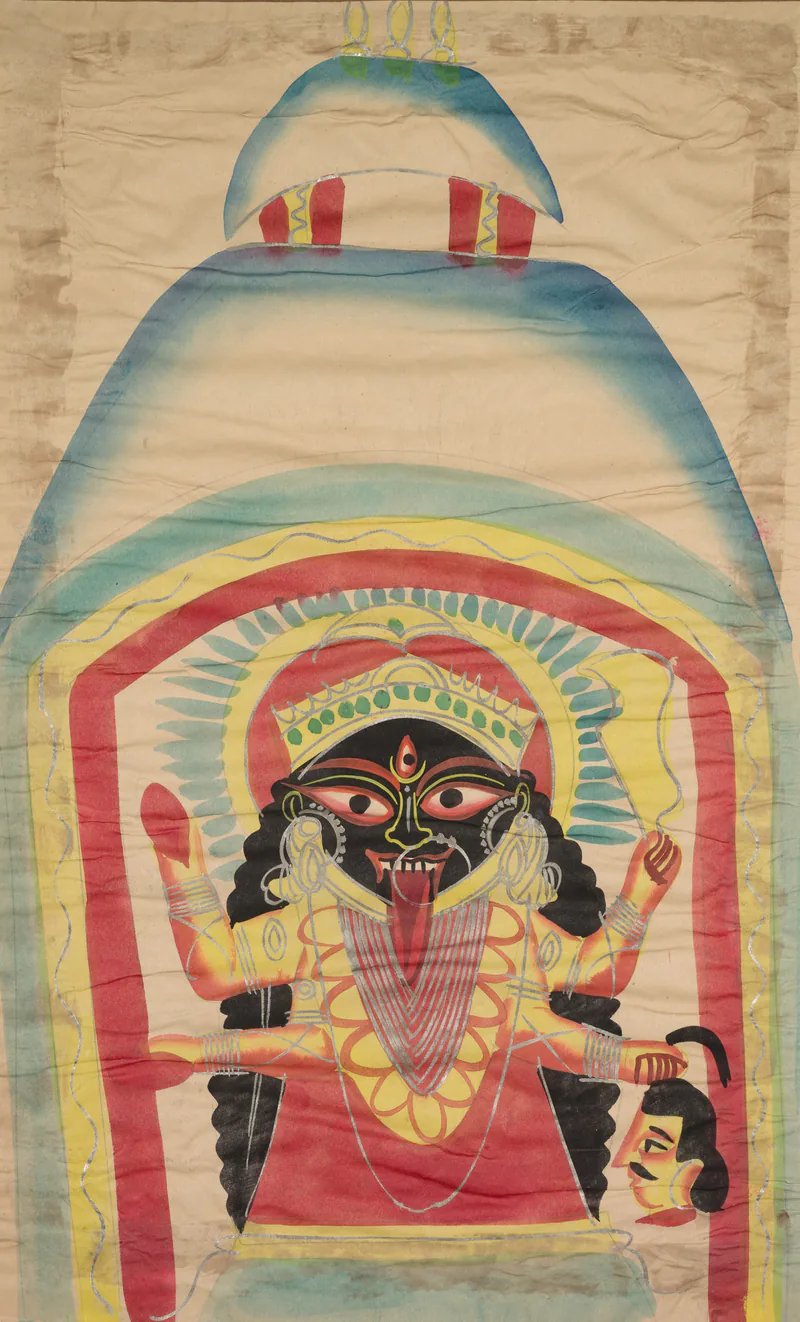
Kali, "the black one," is the most striking of the Goddess's forms. Classical images show her black or dark blue, naked or clad in a tiger skin, with a garland of heads and a skirt of severed arms, her tongue protruding, standing on the supine body of Shiva. To her devotees this terrifying appearance expresses her power over time and death and her destruction of the ego; she is the compassionate Mother who frees her children from fear. Her worship flourished in Bengal, where the eighteenth-century poet Ramprasad Sen addressed her in intimate songs, and where the mystic Ramakrishna (1836–1886) served as priest of the Kali temple at Dakshineswar.
The Ten Mahavidyas and the Yoginis§
Late medieval Shakta Tantras group ten "great wisdom" goddesses (Mahavidyas): Kali, Tara, Tripurasundari, Bhuvaneshvari, Bhairavi, Chinnamasta (who holds her own severed head), Dhumavati (the widow), Bagalamukhi, Matangi and Kamala. Many are unconventional, even transgressive figures, and they are worshipped mainly in tantric settings. Earlier, groups of seven or eight Mothers (Matrikas) and of sixty-four Yoginis, fierce female deities, received cults of their own; circular, open-air Yogini temples of about the ninth to eleventh centuries survive at sites such as Hirapur in Odisha and Bheraghat in Madhya Pradesh.
Shri Vidya, Kaula Tradition and Shakta Tantra§
Shaktism is closely linked with Tantra in Hinduism. The Kaula traditions of the late first millennium centred their worship on the Goddess and her retinues of Yoginis, and later Shakta lineages divided between the "family of Kali" (Kali-kula), strong in Bengal, Assam and Nepal, and the "family of Shri" (Shri-kula).
The best-known Shri-kula tradition is Shri Vidya, the worship of the Goddess as Lalita Tripurasundari, "the beautiful one of the three worlds." Its central object of worship is the Shri Chakra or Shri Yantra, a diagram of nine interlocking triangles (four pointing upward, five downward) surrounded by lotus petals and an enclosure, understood as the body of the Goddess and the map of the cosmos. Her secret fifteen-syllable mantra and her thousand names, the Lalita Sahasranama, are recited widely. In south India Shri Vidya was integrated into orthodox institutions, including monasteries associated with Shankara, and was interpreted in a respectable "right-hand" form; the eighteenth-century scholar Bhaskararaya wrote its most authoritative commentaries. For the more esoteric dimensions of Shakta Tantra, including the debated left-hand rites, see Tantra: History and Practice.
Shakti Pithas, Festivals and Living Goddess Worship§
According to a widespread myth, when Shiva's wife Sati killed herself at her father Daksha's sacrifice, Shiva wandered the universe carrying her body until Vishnu cut it to pieces with his discus. Where each part fell, a "seat of the Goddess" (Shakti Pitha) arose. Lists count fifty-one, fifty-two or more such sites. Among the most important are Kamakhya in Assam, where the Goddess is worshipped as a natural cleft in the rock and an annual festival (Ambubachi) marks her menstruation, Kalighat in Kolkata, Vaishno Devi in Jammu, Jvalamukhi in Himachal Pradesh, with its natural flames, and Hinglaj in Balochistan, Pakistan.
The great Goddess festival is Navaratri, the "nine nights" of autumn, celebrated in many forms: as Durga Puja in Bengal, with temporary images of Durga slaying Mahisha that are immersed in rivers at the end (Durga Puja in Kolkata was added to UNESCO's intangible heritage list in 2021), with circle dances (garba) in Gujarat, and with displays of dolls in Tamil Nadu. Kali Puja is celebrated in Bengal on the new-moon night of Diwali. Historically, and still at some Shakta temples, animals were offered to the fierce goddesses; many Shaktas reject the practice, substituting vegetable offerings such as pumpkins, and it is now restricted by law in several Indian states. Festivals and temple rites are described in Hindu Temples, Rituals and Festivals.
Scholars continue to debate how goddess worship relates to the lives of Hindu women: veneration of a powerful divine feminine has coexisted with patriarchal social structures, while women's own vows, songs and possession rites are an important and often overlooked part of Shakta religion.
Frequently asked questions§
What is the difference between Shakti and Shaktism?§
Shakti is the divine power or energy, personified as a goddess, that most Hindu traditions recognise. Shaktism is the specific tradition that regards the Goddess herself as the supreme reality and makes her the main object of worship.
Why does Kali stand on Shiva?§
Popular stories say that Kali, intoxicated by battle, could only be stopped when Shiva lay down in her path; on stepping on him she stopped in shame. Tantric interpretations see the image theologically: Shiva is pure, passive consciousness and Kali the active power without which he is inert.
What is the Shri Yantra?§
The Shri Yantra, or Shri Chakra, is a geometric diagram of nine interlocking triangles around a central point, used in the Shri Vidya tradition to worship the Goddess Lalita Tripurasundari. It is understood as both the Goddess's body and a map of the cosmos and of the path of meditation.
Sources and further reading§
- Hindu Goddesses: Visions of the Divine Feminine in the Hindu Religious Tradition — David Kinsley, 1986
- Tantric Visions of the Divine Feminine: The Ten Mahāvidyās — David Kinsley, 1997
- Encountering the Goddess: A Translation of the Devī-Māhātmya and a Study of Its Interpretation — Thomas B. Coburn, 1991
- The Triumph of the Goddess: The Canonical Models and Theological Visions of the Devī-Bhāgavata Purāṇa — C. Mackenzie Brown, 1990
- The Auspicious Wisdom: The Texts and Traditions of Śrīvidyā Śākta Tantrism in South India — Douglas Renfrew Brooks, 1992
- Encountering Kālī: In the Margins, at the Center, in the West — Rachel Fell McDermott & Jeffrey J. Kripal (eds.), 2003