Liber XIV · Hinduism · Chapter VII: Shaktism & the Goddess
Kali: The Hindu Goddess of Time, Death and Liberation
Kali, the Hindu goddess of time and death: her origins in the Devi Mahatmya, tantric worship, iconography, Bengali devotion, Ramakrishna and modern debates.

Kali is the fierce Hindu goddess of time, death and transformation, worshipped as the Divine Mother who destroys evil and the ego and grants liberation to her devotees. First prominent in the Devi Mahatmya as a terrifying warrior born from the Goddess Durga's brow, she became a supreme deity of tantric traditions and, especially in Bengal, the beloved "Ma" of an intimate devotional poetry; today she is among the most widely worshipped and most debated of Hindu deities.
The Name and Nature of Kali§
Kali means "the black one," the feminine form of kala, which in Sanskrit means both "black" and "time." Hindu theologians draw on both senses: she is the darkness beyond all form, and she is Time, which brings all beings to their end. As Mahakali she is the great cosmic power; as Shyama, "the dark one," she is the beloved mother of Bengali song; as Bhadrakali, "the auspicious Kali," she is a protective goddess of Kerala and Tamil Nadu.
Her devotees insist that her frightening appearance is not evil. Kali destroys demons, ignorance and the illusion of a separate ego, and for those who approach her as children she is a mother who removes fear. This combination of terror and tenderness, of death and grace, lies at the centre of her theology, which belongs to the wider Goddess tradition described in Shaktism.
Early History: From Vedic Hints to the Devi Mahatmya§
The name Kali appears in the Mundaka Upanishad (1.2.4), where it designates one of the seven flickering tongues of the sacrificial fire, not a goddess. The Mahabharata mentions a dark goddess of the night of death, Kalaratri, who appears to the warriors before their slaughter in the night raid of its tenth book. Many scholars think that dark, fierce goddesses associated with battlefields, mountains and cremation grounds were worshipped on the margins of Brahmanical society, including by tribal communities, before they entered Sanskrit literature, though the evidence is indirect.
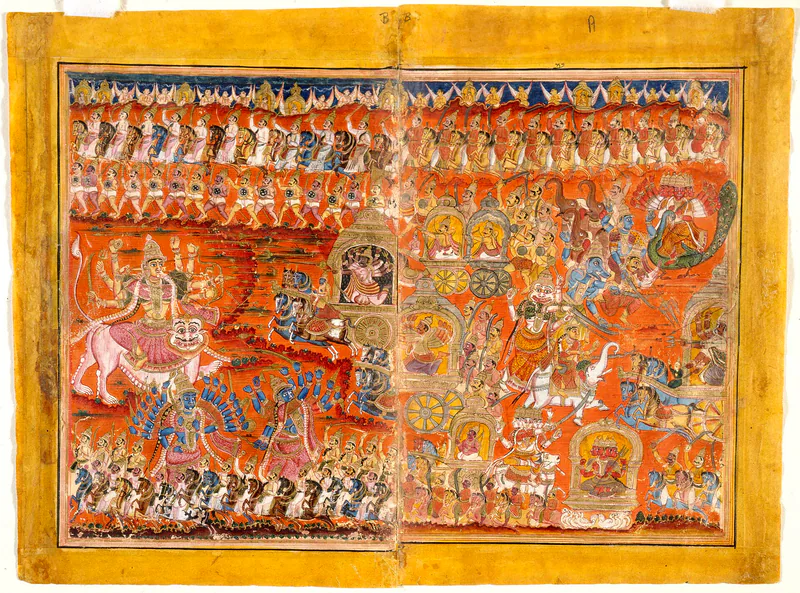
Kali's decisive literary appearance comes in the Devi Mahatmya, usually dated to about the fifth or sixth century CE. When the demon generals Chanda and Munda approach the Goddess, her face darkens with anger, and from her brow emerges Kali, gaunt, clad in a tiger skin and wearing a garland of skulls, who devours the demon armies and beheads both generals; she is thereafter called Chamunda. In the battle with Raktabija, a demon from each drop of whose spilled blood a new demon sprang, Kali spreads out her tongue and drinks his blood before it can touch the ground, so that the Goddess can destroy him. In this text Kali is a manifestation of the supreme Goddess, her fury given form.
Kali in Tantra: The Kali-kula and the Cremation Ground§
Kali rose to supremacy in tantric traditions of the late first and early second millennia. In Kashmir, the Krama school worshipped a sequence of twelve Kalis representing the phases of consciousness, a tradition discussed in Kashmir Shaivism. Later Shakta traditions distinguished a "family of Kali" (Kali-kula), strong in Bengal, Assam, Odisha and Nepal, from a "family of Shri" centred on the gentle goddess Lalita. Among the ten Mahavidyas, the "great wisdom" goddesses of late medieval Tantra, Kali stands first.
Tantric texts devoted to her, such as the Kali Tantra and the Mahanirvana Tantra (a text probably composed in Bengal in the eighteenth century, whose English translation by Arthur Avalon in 1913 introduced Kali to many Western readers), describe her worship with mantras, yantras and meditation on her form. In the cremation ground (smashana), where she is worshipped as Smashana Kali, ascetic practitioners historically confronted death and impurity directly, and some left-hand rites used substances otherwise forbidden. These practices are discussed historically in Tantra in Hinduism and The Left-Hand Path; most modern worship of Kali is devotional and domestic.
Kali Iconography and Its Meanings§
The most common image in eastern India is Dakshina Kali, a form whose standard iconography is often credited, in Bengali tradition, to the sixteenth-century tantric scholar Krishnananda Agamavagisha. She is black or dark blue, with dishevelled hair, three eyes and a lolling red tongue. She wears a garland of severed heads and a skirt of severed arms, and is otherwise naked. Of her four hands, the left ones hold a bloodied sword and a severed head, while the right ones make the gestures of fearlessness and of granting boons. She stands on the white, supine body of Shiva, usually with her right foot forward.
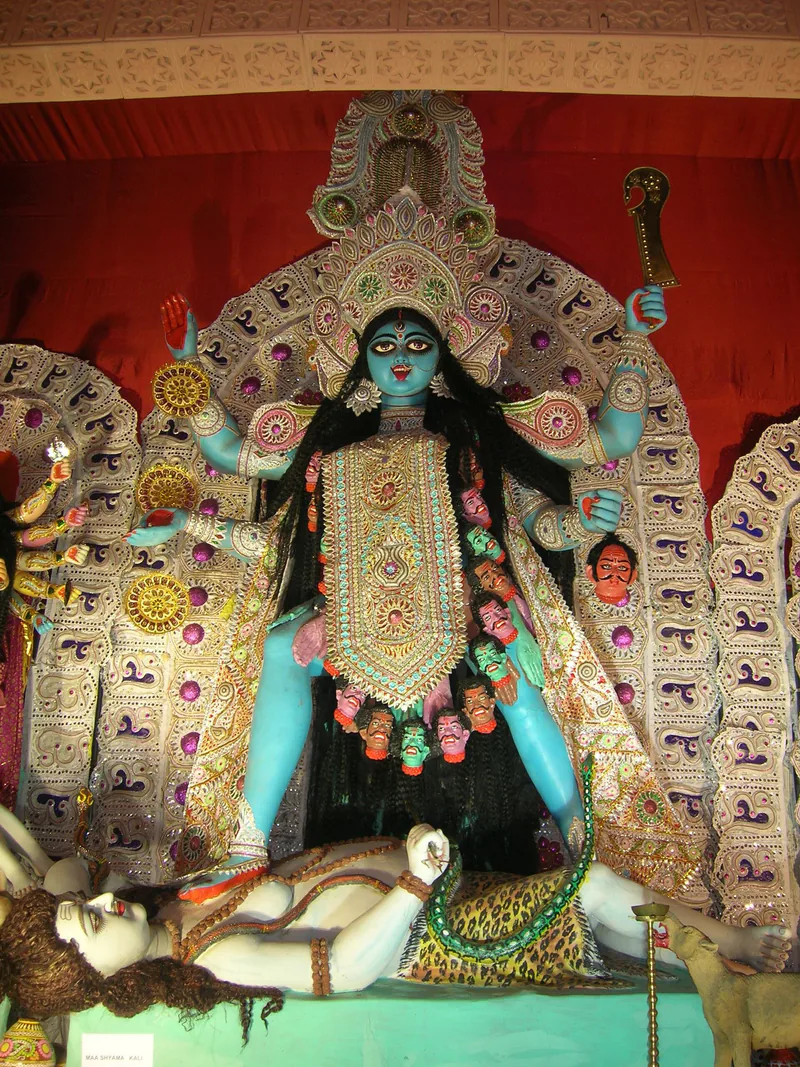
Devotees and theologians read each element symbolically:
- Her nakedness means that she is beyond all coverings of illusion; her darkness, that all forms dissolve into her as colours vanish into black.
- The garland of heads, often counted as fifty, is linked with the fifty letters of the Sanskrit alphabet, the sounds from which the world of names and forms is created.
- The sword cuts through ignorance, and the severed head is the ego that she removes.
- Her protruding tongue is explained in popular stories as a gesture of shame when, maddened by battle, she stepped on her husband Shiva, who had lain in her path to calm her. Tantric interpreters read the image differently: Shiva is pure, inert consciousness and Kali the active power that animates him.
The fear-dispelling and boon-granting hands show that this terrible figure is, for her devotees, the gracious Mother.
Devotion in Bengal: Ramprasad, Kalighat and Ramakrishna§
In Bengal, from the eighteenth century, Kali became the object of an intensely personal devotion. Ramprasad Sen (c. 1718–c. 1775), a poet from near Calcutta, composed songs (Shyama-sangit) in which he addresses Kali as a mother who is by turns loving, capricious and mischievous, complaining, pleading and teasing her as a child would. Kamalakanta Bhattacharya, of the late eighteenth and early nineteenth centuries, continued the tradition, and these songs are still sung throughout Bengal. Such poetry linked Shakta worship with the wider movement described in The Bhakti Movement.
The Kalighat temple in Kolkata, one of the Shakti Pithas, where the toe of the goddess Sati is believed to have fallen, has a temple building dating from 1809, though the site is much older. In 1855 the wealthy widow Rani Rashmoni founded the temple of Bhavatarini Kali at Dakshineswar, north of the city, where the young priest Ramakrishna (1836–1886) underwent ecstatic visions of the Goddess. Ramakrishna's disciple Swami Vivekananda, discussed in Vivekananda, wrote the English poem "Kali the Mother" and spoke of her as the Mother whose terrible form must be loved along with her gentle one.
Kali Puja is celebrated on the new-moon night of the month of Kartika, coinciding with Diwali, when temporary images are worshipped through the night in homes and public pavilions across Bengal, Assam and Odisha. Historically, animal sacrifice was offered to Kali at some temples; many devotees reject the practice, offering vegetables or sweets instead, and it is now restricted in several Indian states.
Kali in Politics, the West and Modern Debate§
In the nineteenth century, British writers associated Kali with the "Thugs," bands of highway robbers said to strangle travellers as an offering to her. Modern historians argue that colonial officials greatly exaggerated the religious character of these crimes, which were real, to justify new policing powers. At the same time, Bengali nationalists used the image of Kali and Durga to represent the motherland, most famously in the song "Vande Mataram" from Bankim Chandra Chatterjee's novel Anandamath (1882).
In the twentieth century Kali found new audiences in the West, where feminist spirituality, the Goddess movement and some forms of modern occultism adopted her as an image of female power and of the dark feminine, often with little reference to her Indian contexts. Academic study has also been contested: psychoanalytic readings of Kali worship and of Ramakrishna's mysticism, such as Jeffrey Kripal's Kali's Child (1995), provoked strong objections from Hindu critics, and the debate became an important episode in discussions of how outsiders should interpret living religions.
Frequently asked questions§
Is Kali an evil goddess?§
No. Although her appearance is terrifying, Hindus understand Kali as a divine mother who destroys demons, ignorance and the ego and who protects her devotees. Her fearsome form expresses her power over time and death, not malevolence.
What is the difference between Kali and Durga?§
Both are forms of the one Goddess. Durga is the radiant warrior who rides a lion and slays the buffalo demon, while Kali is the dark, terrifying form who in the Devi Mahatmya emerges from Durga's brow in anger to destroy particular demons.
Why is Kali standing on Shiva?§
A popular story says that Kali, intoxicated by battle, was stopped only when Shiva lay down in her path, and that she put out her tongue in embarrassment on stepping on him. Tantric theology reads the image as the union of Shiva, pure consciousness, with Kali, the dynamic power that animates it.
Sources and further reading§
- Encountering Kālī: In the Margins, at the Center, in the West — Rachel Fell McDermott & Jeffrey J. Kripal (eds.), 2003
- Mother of My Heart, Daughter of My Dreams: Kālī and Umā in the Devotional Poetry of Bengal — Rachel Fell McDermott, 2001
- The Sword and the Flute: Kālī and Kṛṣṇa, Dark Visions of the Terrible and the Sublime in Hindu Mythology — David R. Kinsley, 1975
- Hindu Goddesses: Visions of the Divine Feminine in the Hindu Religious Tradition — David Kinsley, 1986
- Kālī: The Feminine Force — Ajit Mookerjee, 1988
- Kali's Child: The Mystical and the Erotic in the Life and Teachings of Ramakrishna — Jeffrey J. Kripal, 1995