Liber XIV · Hinduism · Chapter I: Bhakti & Saints
The Bhakti Movement: Hindu Devotion and Its Poet-Saints
The bhakti movement explained: Hindu devotion, the Tamil Alvars and Nayanars, Basava, Jnaneshvar, Tukaram, Kabir, Mirabai, Tulsidas and Chaitanya.

Bhakti is loving devotion to a personal God, and the "bhakti movement" is the name given to the waves of devotional religion that spread across India from the Tamil south in about the sixth century to the north by the fifteenth and sixteenth centuries. Its poet-saints, among them Andal, Basava, Jnaneshvar, Tukaram, Kabir, Mirabai, Tulsidas and Chaitanya, sang in the languages of ordinary people rather than Sanskrit, often challenged caste and ritual, and created the hymns and stories through which most Hindus still experience their faith.
What Bhakti Means§
The Sanskrit word bhakti derives from the root bhaj, "to share, partake, belong to." It describes a relationship: the devotee belongs to God and shares in God's life, and God in turn is accessible, gracious and responsive. In contrast to the way of knowledge, which seeks to transcend personal forms, and the way of ritual action, which depends on correct performance, bhakti makes love the decisive path to liberation, and often regards love itself as the goal.
The Shvetashvatara Upanishad already speaks of devotion to God and to the teacher, and the Bhagavad Gita presents bhakti as the highest discipline: Krishna promises that whoever offers him even a leaf, a flower, a fruit or water with devotion will be accepted. The Bhagavata Purana, probably of the ninth or tenth century, made the love of the cowherd women for Krishna the supreme model of devotion and listed nine forms of bhakti, from hearing and singing God's names to service, friendship and complete self-offering. Later theologians, especially the Goswamis of Vrindavan, classified the emotional relationships one might have with God: as servant, friend, parent or lover. The philosophical background is set out in Dharma, Karma, Samsara and Moksha.
The Tamil Beginnings: Alvars and Nayanars§
The first great flowering of bhakti came in the Tamil country between about the sixth and ninth centuries. Twelve Vaishnava Alvars and sixty-three Shaiva Nayanars wandered from temple to temple singing in Tamil of their longing for Vishnu or Shiva, celebrating the sacred places where God dwelt and attacking Buddhists and Jains as rivals. Among them were the Shaiva woman saint Karaikkal Ammaiyar, perhaps of the sixth century, who asked Shiva to turn her into an emaciated ghost so that she could watch his dance in the cremation ground, and Andal, who imagined herself as Krishna's bride. Their hymns, gathered into the Vaishnava Divya Prabandham and the Shaiva Tirumurai, became scripture sung in temples to this day, as described in Vaishnavism and Shaivism.
Bhakti in Karnataka and Maharashtra§
In twelfth-century Karnataka, the Virashaiva saints Basava, Allama Prabhu and the woman mystic Akka Mahadevi composed vachanas, short free-verse sayings in Kannada that rejected temple ritual, caste and image worship in favour of inner devotion to Shiva. Akka Mahadevi, who renounced her husband and, according to her legend, wandered clothed only in her hair, called Shiva her only true husband. Centuries later, the Kannada Haridasas, such as Purandara Dasa (sixteenth century), sang of Vishnu and laid foundations of Carnatic music.
In Maharashtra the Varkari tradition centres on Vithoba, a form of Krishna, at Pandharpur. Its saints include Jnaneshvar (traditionally 1275–1296), whose Marathi commentary on the Gita is a classic of the language; the tailor Namdev; Chokhamela, an untouchable saint who was not allowed into the temple whose god he praised; the woman servant Janabai; Eknath in the sixteenth century; and Tukaram (seventeenth century), a grocer whose abhangas are still sung by millions. Each year hundreds of thousands of Varkaris walk to Pandharpur carrying the sandals of the saints in palanquins.
Saguna and Nirguna: The Saints of North India§
In the north, scholars often divide the saints into two broad streams.
Nirguna Sants: Kabir, Ravidas and Their Heirs§
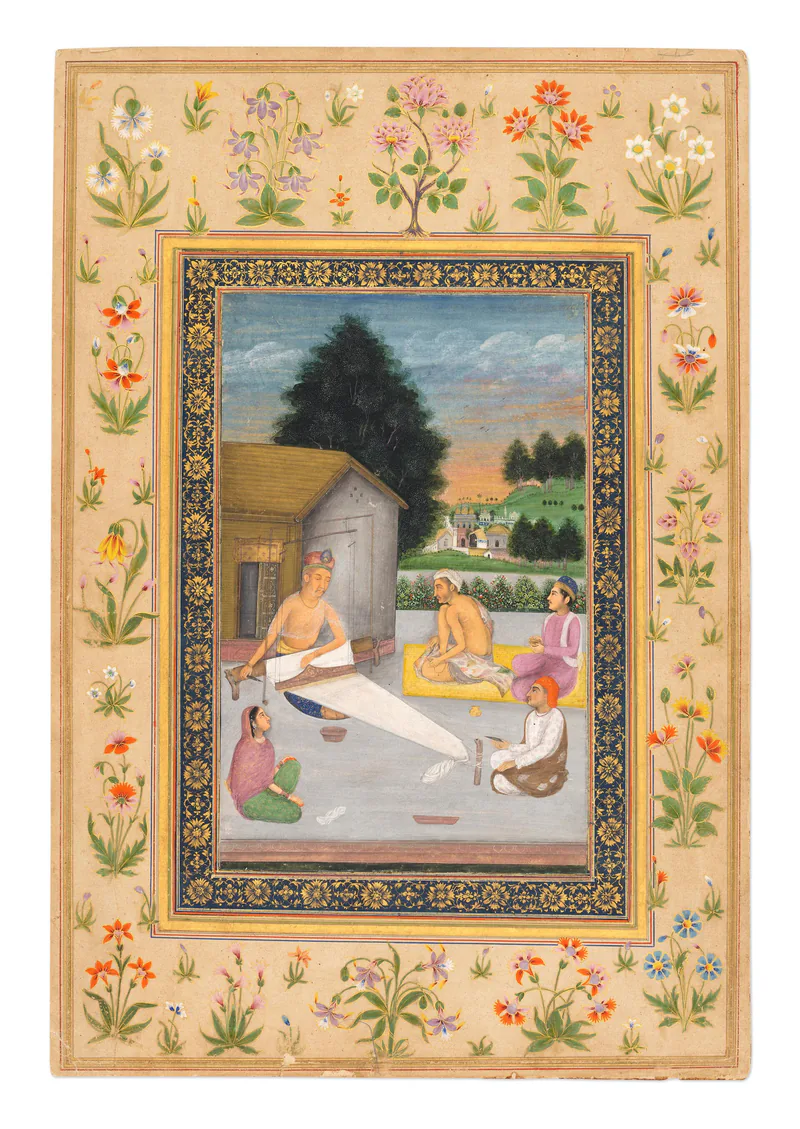
The nirguna saints, often called Sants, worshipped a God beyond all form and attributes, approached through the remembrance of the divine name and the teaching of the true guru. Kabir, a weaver of Muslim background who lived in Varanasi, probably in the fifteenth century, mocked the rituals of both Hindus and Muslims in pungent verses and pointed to the God within. Ravidas, a leatherworker of the same city, sang of a casteless realm without sorrow and is revered by the Ravidassia community. Their poems were included in the Sikh scripture, the Guru Granth Sahib, alongside those of Guru Nanak, whose relation to this Sant milieu is discussed in Guru Nanak and the Ten Sikh Gurus. Similarities between Sant poetry and the devotional mysticism described in Sufism have long been noted, though the extent of direct influence is debated.
Saguna Devotion: Surdas, Mirabai and Tulsidas§
Saguna saints worshipped God with form, above all Krishna and Rama. Surdas, traditionally said to have been blind, sang of the child Krishna and of the cowherd women's longing for him in the Braj dialect of Hindi. Mirabai, a Rajput princess of the sixteenth century, devoted herself to Krishna as her husband, defied her in-laws and became the most famous woman saint of north India; many of the songs attributed to her were composed later in her name, and the details of her life are debated. Tulsidas (traditionally 1532–1623) retold the Ramayana in the Awadhi Ramcharitmanas, which became the most beloved religious book of the Hindi-speaking world.
In Bengal, Chaitanya (1486–1534) led ecstatic processions singing the names of Krishna and inspired the Gaudiya Vaishnava tradition. In Gujarat, Narsinh Mehta (fifteenth century) wrote the hymn Vaishnava Jana To, describing the true devotee as one who feels the pain of others, which became a favourite of Mohandas Gandhi. Shakta devotion found voice in Bengal with Ramprasad Sen, as discussed in Shaktism, and Shaiva devotion in Kashmir with the fourteenth-century woman mystic Lalla.
Caste, Gender and the Social Meaning of Bhakti§
Bhakti is often described as a social revolution, and in important respects it was one. It used vernacular languages instead of Sanskrit, honoured saints who were women, labourers, untouchables and Muslims, and insisted that God values love above birth or learning. Its songs are full of criticism of empty ritual and Brahmin pride.
Historians also urge caution. Many devotional communities later reintroduced caste distinctions, Brahmin hagiographers reshaped low-caste saints' lives, and the songs of women saints were often transmitted and edited by men. The very idea of a single "bhakti movement," sweeping from south to north, has been examined by scholars such as John Stratton Hawley, who argues that it took shape largely in the twentieth century as part of the making of a national history. What is undisputed is the immense creativity of these traditions and their place at the heart of Hindu religious life.
Bhakti in Practice Today§
Devotional practice takes many forms: singing hymns (bhajan) and call-and-response chanting of divine names (kirtan), often for many hours; gatherings of the faithful (satsang); the repetition of God's name (nama-japa); pilgrimage, service to the deity and to devotees, and reverence for the guru and the saints, whose shrines are themselves places of pilgrimage. The emotional tone ranges from joyful celebration to viraha, the anguish of separation from the beloved God, which many poets regarded as the purest form of love.
In the modern period bhakti has shaped figures as different as Ramakrishna, Sai Baba of Shirdi (died 1918), who was revered by both Hindus and Muslims, and the global Hare Krishna movement. Through film songs, recordings, television epics and diaspora temples, the poems of the saints remain the most widely shared form of Hindu religious expression. For comparison with devotional mysticism in Christianity, see Christian Mystics.
Frequently asked questions§
What is the difference between saguna and nirguna bhakti?§
Saguna bhakti is devotion to God "with qualities," worshipped in a personal form such as Krishna, Rama or Shiva, often in images. Nirguna bhakti is devotion to God "without qualities," beyond all form, approached through the name of God and inner experience, as in the poetry of Kabir and Ravidas.
Who started the bhakti movement?§
No single person started it. Devotional ideas appear in the Bhagavad Gita, but the first great movement of bhakti poetry is associated with the Tamil Alvars and Nayanars between about the sixth and ninth centuries, from whom devotional religion spread across India over several centuries.
Was Kabir a Hindu or a Muslim?§
Kabir was born into a Muslim weaver family but rejected the external forms of both Hinduism and Islam, teaching devotion to a formless God within. Hindus, Muslims and Sikhs all claim him, and the Kabir Panth, a community of his followers, still exists today.
Sources and further reading§
- A Storm of Songs: India and the Idea of the Bhakti Movement — John Stratton Hawley, 2015
- Songs of the Saints of India — John Stratton Hawley & Mark Juergensmeyer, 1988
- The Bījak of Kabir — Linda Hess & Shukdeo Singh (trans.), 1983
- Hymns for the Drowning: Poems for Viṣṇu by Nammāḻvār — A. K. Ramanujan (trans.), 1981
- Says Tuka: Selected Poetry of Tukaram — Dilip Chitre (trans.), 1991
- Speaking of Śiva — A. K. Ramanujan (trans.), 1973