Liber XIV · Hinduism · Chapter V: The Puranas
The Bhagavata Purana: Krishna, Bhakti and the Twelve Books
The Bhagavata Purana explained: its date, frame story and twelve books, Krishna's childhood and the rasa lila, the nine forms of bhakti, commentaries and art.

The Bhagavata Purana, also called the Srimad Bhagavatam, is a Sanskrit scripture of twelve books devoted to Vishnu and above all to Krishna, whose childhood and youth among the cowherds of Vraja it narrates in its famous tenth book. Usually dated by scholars to around the ninth or tenth century CE, it became the central text of devotional Vaishnavism, the scripture from which teachers such as Vallabha and Chaitanya drew their theology, and the source of countless poems, paintings, dances and public recitations.
What the Bhagavata Purana Is: Date, Language and Setting§
The Bhagavata is counted among the eighteen great Puranas (mahapuranas), the encyclopaedic texts of myth, cosmology and sacred history surveyed in The Puranas. Tradition ascribes all the Puranas to the sage Vyasa, compiler of the Vedas and the Mahabharata. The Bhagavata tells its own origin: Vyasa, despite his great works, felt unfulfilled until the divine sage Narada told him that he had not yet sung fully of the Lord's glories, and Vyasa then composed the Bhagavata and taught it to his son Shuka.
The narrative is set within a double frame. The bard Suta recites the text to sages gathered in the Naimisha forest, recounting how Shuka once taught it to King Parikshit, grandson of the Pandava hero Arjuna. Cursed to die from a snakebite within seven days, Parikshit retires to the bank of the Ganga, and Shuka answers his question about what a person facing death should hear and remember.
Most scholars date the text to roughly the ninth or tenth century CE and locate its composition in the Tamil-speaking south, because its devotional mood closely resembles the songs of the Alvar poet-saints. Some argue for an earlier date, and the work clearly draws on older material, including the Vishnu Purana and the Harivamsha, an appendix to the Mahabharata that already tells Krishna's childhood. The Sanskrit is unusually dense and deliberately archaic, sometimes imitating Vedic forms, which may have been meant to give the new scripture the authority of antiquity.
Structure and Contents of the Twelve Books§
The text runs to about eighteen thousand verses in twelve books (skandhas). The opening books set out the frame and the principles of creation, and the third book includes the teaching of the sage Kapila to his mother Devahuti, a devotional version of the Samkhya philosophy described in The Six Schools of Hindu Philosophy. The fourth book tells of the child Dhruva, whose austerities win him a place as the pole star, and of the first righteous king, Prithu.
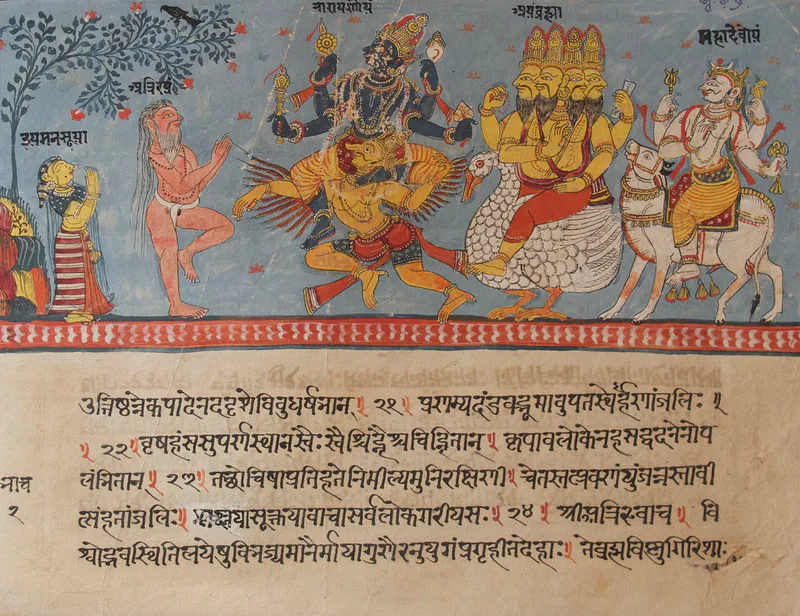
The fifth book describes the geography of the cosmos and the lives of Rishabha, a royal renouncer who is also revered by Jains as the first Tirthankara (see Rishabhanatha), and of the holy simpleton Jada Bharata. The sixth tells of Ajamila, a sinner saved by calling his son's name, Narayana, at death, a story often cited to show the power of the divine name. The seventh book contains the story of Prahlada and Narasimha, the eighth the rescue of the elephant Gajendra and the churning of the ocean, and the ninth the solar and lunar dynasties, including a brief retelling of the life of Rama. The avatar stories that run through these books are gathered in The Ten Avatars of Vishnu.
The tenth book is the heart of the work. The eleventh contains Krishna's final teaching to his friend Uddhava, sometimes called the Uddhava Gita, and the destruction of Krishna's clan, and the twelfth describes the decline of the Kali Yuga, the coming of Kalki and the death of Parikshit, bringing the frame to its close.
The Tenth Book: Krishna's Childhood and the Rasa Lila§
The tenth book narrates Krishna's life from his birth in a prison in Mathura, where the tyrant Kamsa has confined his parents, to his life as king of Dvaraka. His father Vasudeva carries the newborn across the Yamuna to the cowherd village of Gokula, where he is raised by Nanda and Yashoda. Episodes that every Hindu child knows follow: the infant Krishna sucking the life from the demoness Putana, stealing butter from the village houses, showing the whole universe inside his mouth to his astonished foster-mother, subduing the serpent Kaliya in the river, and lifting Mount Govardhana on one finger to shelter the cowherds from the storm sent by the offended god Indra.
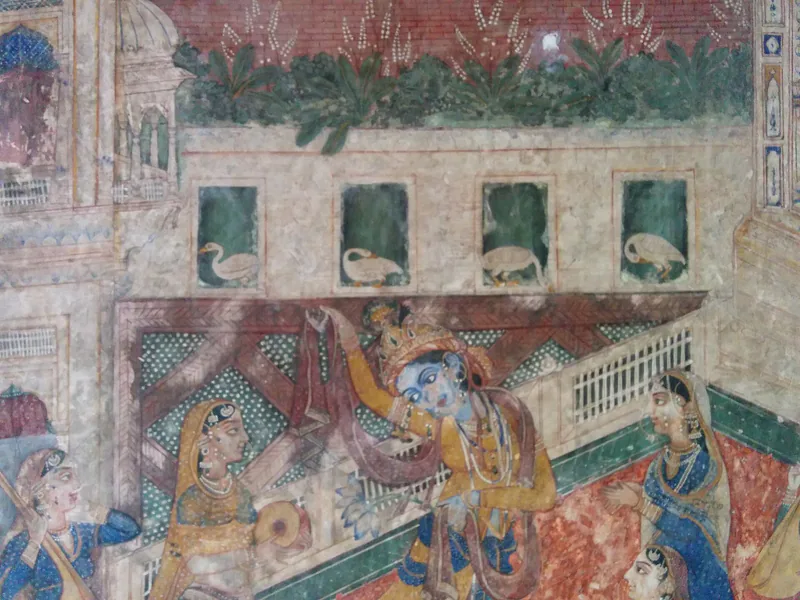
The most celebrated and most discussed section is the rasa panchadhyayi, five chapters describing the autumn night when Krishna's flute calls the cowherd women (gopis) from their homes into the forest. He dances the circular rasa dance with them, multiplying himself so that each woman believes he is with her alone, disappears when they grow proud, and returns when they search for him in anguish. Later chapters tell of the gopis' grief when Krishna leaves for Mathura, including the "song of the bee," in which a gopi addresses a bumblebee as if it were Krishna's messenger.
Within the tradition these chapters are read as the highest expression of the soul's love for God, not as an account of human romance; the text itself ends the episode by saying that one who hears it with faith is freed from lust. The gopis, who abandon family duties and social reputation for Krishna, became the supreme models of devotion for later Vaishnava schools.
The Theology of Bhakti in the Bhagavata§
The Bhagavata presents itself as a scripture of devotion. It speaks of God as Bhagavan, the personal Lord possessing all excellences, and it declares that Krishna is not merely one avatar among others but Bhagavan himself. Knowledge, ritual and yoga are honoured, but without devotion they are said to be barren. At the same time the text uses the language of nondual Vedanta, describing Brahman, the Self and the Lord as one reality seen in different ways, which allowed both Advaita and devotional theologians to claim it.
In the seventh book the boy Prahlada lists nine forms of devotion that became a classic scheme: hearing about God, singing his praise, remembering him, serving his feet, worshipping his image, bowing to him, acting as his servant, treating him as a friend, and offering oneself wholly to him. Devotion in the Bhagavata is also emotional; the true devotee weeps, laughs and sings, careless of social opinion. The text insists that bhakti is open to all, regardless of caste or gender, and many of its exemplary devotees are animals, demons, children, women and outcastes. Its place in the wider devotional history is traced in The Bhakti Movement.
Commentaries and the Schools of Vaishnava Theology§
No Purana attracted so many commentaries. The most influential general commentary, the Bhavartha-dipika of Shridhara Svami, probably of the fourteenth century, reads the text in a devotional framework that remains close to Advaita. The dualist philosopher Madhva wrote a short treatise on the Bhagavata's meaning, and Vallabha (1479–1531), founder of the Pushti Marga, wrote a large commentary called the Subodhini.
For the followers of Chaitanya in Bengal, the Bhagavata was the "spotless Purana" and the very form of Krishna. Jiva Gosvami's Sat-sandarbha in the sixteenth century built a full systematic theology on it, and later Gaudiya writers such as Vishvanatha Chakravarti continued the tradition, as described in Chaitanya and Gaudiya Vaishnavism. Doubts about the text's authority were also voiced: some critics, medieval and modern, attributed it to the thirteenth-century grammarian Bopadeva, who wrote works based on it. Defenders rejected the claim, and modern scholarship regards the text as considerably older than Bopadeva.
Recitation, Translation and the Arts§
The Bhagavata is a living ritual text. A Bhagavata saptaha, a public recitation and exposition of the whole text over seven days in memory of Parikshit's seven days, is a major religious event in many parts of India, often sponsored by families and attended by large audiences. Its stories are performed in the ras lila plays of the Braj region around Mathura and Vrindavan, in Manipuri dance and in the classical dance repertoires of the south and east.
Its influence on regional literature was immense. Medieval poets retold it in the languages of India: Maladhar Basu in Bengali in the fifteenth century, Pothana in Telugu, Jagannatha Dasa in Odia and Shankaradeva in Assamese, while Eknath wrote a celebrated Marathi commentary on the eleventh book. The painters of the Rajput and Pahari courts produced great illustrated series, among them the Kangra Bhagavata Purana paintings of the late eighteenth century, whose images of Krishna among the cowherds became icons of Indian art.
European scholarship took notice early: Eugène Burnouf published a French translation of the first books from 1840. In the twentieth century A. C. Bhaktivedanta Swami Prabhupada began a multi-volume English translation with commentary, completed by his disciples, which spread the text worldwide through the Hare Krishna movement, and scholarly translations by G. V. Tagare and Edwin Bryant have made it widely available to readers.
Frequently asked questions§
Is the Bhagavata Purana the same as the Bhagavad Gita?§
No. The Bhagavad Gita is an eighteen-chapter dialogue within the Mahabharata, while the Bhagavata Purana is a separate twelve-book work. Both centre on Krishna and both teach devotion, which is why their names are often confused.
When was the Bhagavata Purana written?§
Most scholars date it to around the ninth or tenth century CE, and many place it in South India because of its closeness to the Tamil Alvar poets. Tradition attributes it to the sage Vyasa at the beginning of the Kali Yuga, and some scholars argue for a somewhat earlier date.
Why is the rasa lila so important?§
For Vaishnava devotees, the rasa lila expresses the most intimate relationship between the soul and God. The gopis' total love for Krishna, at the cost of reputation and social duty, became the highest model of devotion, especially in the Gaudiya and Pushti Marga traditions.
What is a Bhagavata saptaha?§
It is a seven-day public recitation and explanation of the Bhagavata Purana, recalling the seven days in which Shuka taught it to the dying King Parikshit. It is usually led by a professional reciter and is regarded as a meritorious act for sponsors and listeners alike.
Sources and further reading§
- The Bhāgavata Purāṇa: Sacred Text and Living Tradition — Ravi M. Gupta and Kenneth R. Valpey (eds.), 2013
- The Divine Consort: Rādhā and the Goddesses of India — John Stratton Hawley and Donna Marie Wulff (eds.), 1982
- The Dance of Divine Love: The Rāsa Līlā of Krishna from the Bhāgavata Purāṇa — Graham M. Schweig, 2005
- Krishna: A Sourcebook — Edwin F. Bryant (ed.), 2007
- The Bhāgavata Purāṇa — G. V. Tagare (tr.), 1976