Liber XIV · Hinduism · Chapter XI: Vaishnavism
Chaitanya and Gaudiya Vaishnavism: From Bengal to ISKCON
Chaitanya Mahaprabhu and Gaudiya Vaishnavism: his life, the six Gosvamis of Vrindavan, Radha-Krishna theology, kirtan and the Hare Krishna movement (ISKCON).

Gaudiya Vaishnavism is the devotional tradition of Krishna worship founded in Bengal by the saint Chaitanya (1486–1534), whose followers regard him as Krishna himself, appearing together with his beloved Radha in a single form. Built on the Bhagavata Purana and the theology of his disciples the Gosvamis of Vrindavan, it centres on ecstatic love for Radha and Krishna and on the congregational chanting of God's names, and through the International Society for Krishna Consciousness (ISKCON), founded in New York in 1966, it became one of the best-known forms of Hinduism worldwide.
Chaitanya's Life: From Nimai Pandit to Krishna Chaitanya§
Chaitanya was born in 1486 in Navadvipa, a centre of Sanskrit learning in Bengal, and was known in his youth as Nimai. He became a brilliant young teacher of grammar, but a journey to Gaya around 1508, to perform rites for his dead father, changed his life. There he met the ascetic Ishvara Puri, received initiation, and returned home overwhelmed by love for Krishna, weeping, singing and falling into trances.
In Navadvipa he gathered companions for nightly sessions of kirtan, devotional singing with drums and cymbals, which soon spilled into the streets as processions. His biographers tell of a confrontation with the town's Muslim magistrate, who had tried to stop the singing, and who was won over. Among his closest associates were the elder devotee Advaita Acharya and the wandering ascetic Nityananda, who became the leading preacher of the movement in Bengal.
In 1510 Chaitanya took the vows of renunciation (sannyasa) and the name Krishna Chaitanya. At his mother's request he settled in Puri, in Odisha, near the great temple of Jagannatha. From there he travelled through South India and later to Vrindavan, the land of Krishna's youth, before returning to Puri, where he spent his last years in states of intense devotional absorption. He died in 1534; the circumstances of his death are not clearly recorded and became the subject of differing legends.
Chaitanya wrote almost nothing himself; tradition credits him with eight Sanskrit verses of instruction, the Shikshashtaka. His life is known through devotional biographies, above all Vrindavana Dasa's Bengali Chaitanya Bhagavata of the mid-sixteenth century and Krishnadasa Kaviraja's Chaitanya Charitamrita, completed perhaps in the early seventeenth century, a work that is both biography and theological summa.
The Six Gosvamis of Vrindavan and the Recovery of Braj§
Chaitanya sent several followers to Vrindavan, on the Yamuna near Mathura, a region that had lost most of its ancient sacred geography. Two brothers, Rupa and Sanatana, former officials at the court of the sultan of Bengal, became the leaders of this community, joined by their nephew Jiva, by Gopala Bhatta, Raghunatha Dasa and Raghunatha Bhatta. Together they are remembered as the six Gosvamis.
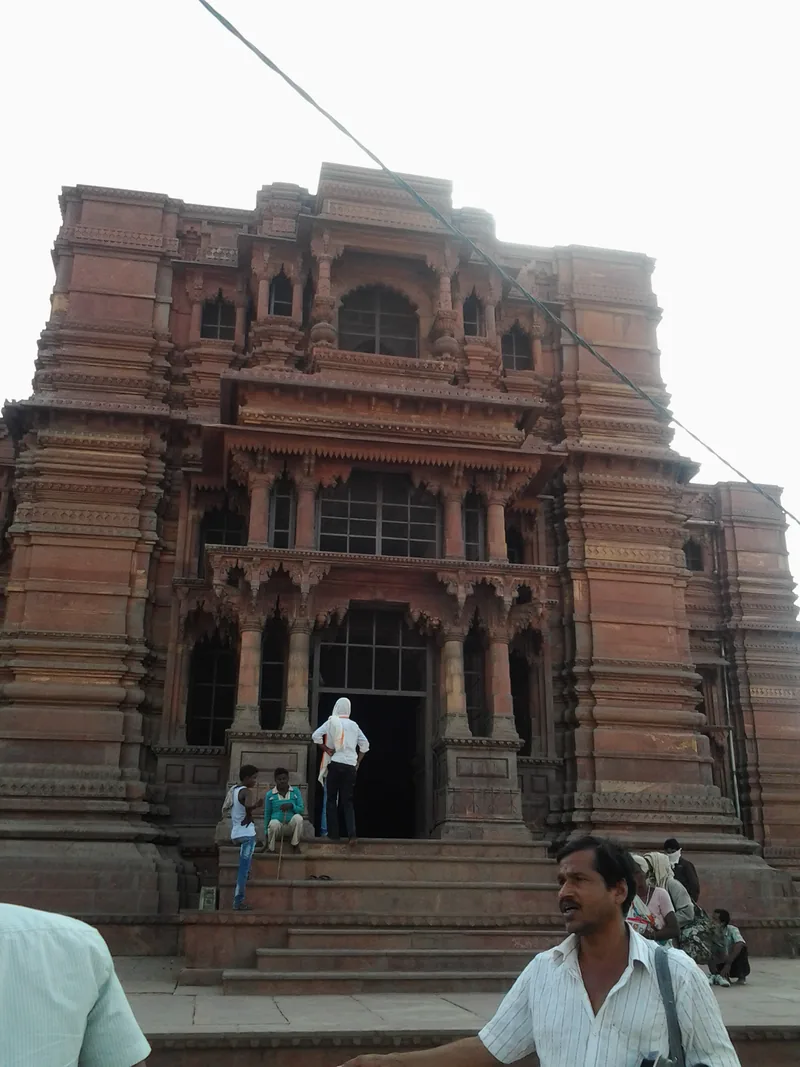
They identified the groves, ponds and hills associated with Krishna's pastimes and established temples, some with the patronage of Rajput nobles of the Mughal court; the red sandstone temple of Govindadeva, built in 1590, is among the finest of the period. They also wrote a large body of Sanskrit poetry, drama and theology. In this way Vrindavan became, from the sixteenth century, the pilgrimage centre it remains today, and the Gaudiya school shaped the landscape of Braj as much as its theology.
Gaudiya Theology: Radha, Krishna and Inconceivable Difference§
Gaudiya theology takes the Bhagavata Purana as its highest scripture and Krishna, the cowherd of Vraja, as the supreme form of God rather than an avatar of Vishnu. Other Vaishnava schools, surveyed in Vaishnavism, usually place Vishnu or Narayana above his descents; the Gaudiyas reverse the order. Radha, the chief of the cowherd women, is understood as Krishna's own power of bliss (hladini shakti), and their love is the ultimate reality. Krishnadasa Kaviraja explains Chaitanya's coming as Krishna's wish to taste Radha's love from her side, so that he appears as Krishna with Radha's emotions and golden complexion.
Jiva Gosvami systematised the relation between God, souls and the world as achintya-bhedabheda, "inconceivable difference and non-difference." Souls and the world are both one with God, as his energies, and distinct from him; how this can be so is beyond reason but known through scripture. The doctrine positions the school between the nondualism of Adi Shankara and the strict dualism of Madhva.
Rupa Gosvami's Bhaktirasamritasindhu and Ujjvalanilamani adapted classical Sanskrit aesthetics, the theory of rasa, or aesthetic emotion, to devotion. The devotee relates to Krishna in one of five principal moods: peaceful reverence, servitude, friendship, parental affection and erotic love (madhurya), the last regarded as the fullest. In the advanced practice called raganuga bhakti, devotees follow in imagination the feelings of particular residents of Vraja, such as Krishna's friends, his foster-parents or the companions of Radha.
Kirtan, the Holy Name and Devotional Practice§
Gaudiya practice gives first place to the name of God, held to be non-different from Krishna himself. The best-known prayer is the "great mantra" (maha-mantra) of thirty-two syllables combining the names Hare, Krishna and Rama, found in a late text called the Kali-santarana Upanishad, which presents it as the remedy for the present Kali Yuga. Devotees chant it in congregational kirtan and in private recitation (japa) on a string of 108 beads of tulasi wood.
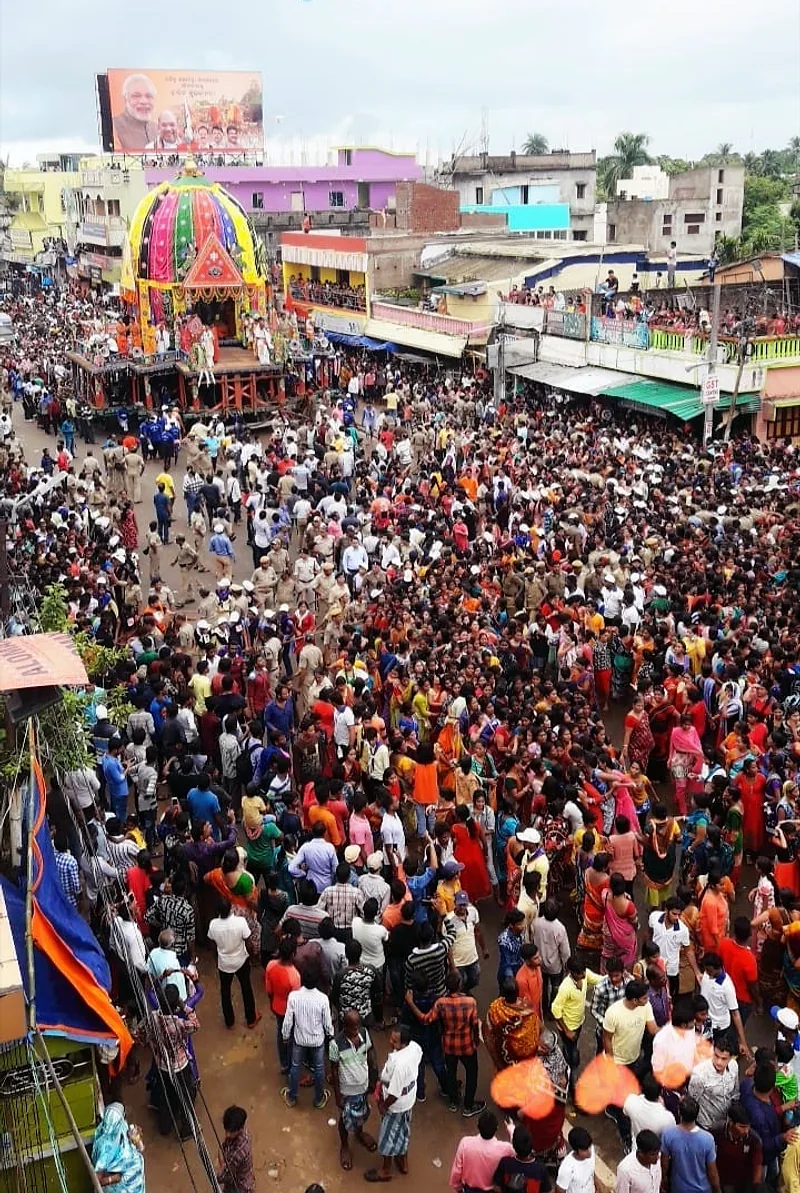
Other practices include worship of the temple images of Radha and Krishna with offerings of food, which is then distributed as sanctified prasada; study and recitation of the Bhagavata; pilgrimage to Navadvipa, Puri and Vrindavan; and observance of festivals such as Janmashtami, Radhashtami and the chariot festival (Ratha Yatra) of Jagannatha at Puri. Traditional Gaudiya communities are lineages of initiating gurus, often households descended from Nityananda and Advaita, alongside celibate renunciants. The school also spread to Manipur, where royal patronage in the eighteenth century made it the dominant religion and shaped the region's classical dance. Its place among the devotional saints of India is traced in The Bhakti Movement.
From Bengal to the World: Bhaktivinoda, the Gaudiya Math and ISKCON§
By the nineteenth century educated Bengalis often looked down on popular Vaishnavism, associating it with esoteric offshoots such as the Sahajiyas, who interpreted Radha and Krishna's love through ritual practice between human partners. A revival was led by Kedarnath Datta (1838–1914), a government magistrate known as Bhaktivinoda Thakur, who wrote prolifically, presented Chaitanya's teaching in modern terms, and identified a site at Mayapur near Navadvipa as Chaitanya's birthplace. His son, Bhaktisiddhanta Sarasvati (1874–1937), founded the Gaudiya Math, a missionary institution of celibate preachers that established centres throughout India and sent the first preachers to Europe in the 1930s.
One of Bhaktisiddhanta's disciples, Abhay Charan De, later A. C. Bhaktivedanta Swami Prabhupada (1896–1977), travelled to New York in 1965 at the age of sixty-nine and founded the International Society for Krishna Consciousness in 1966. ISKCON grew quickly among young Americans and Europeans of the counterculture; its saffron-robed chanters became a familiar sight in city streets, and a 1969 recording of the maha-mantra produced by George Harrison reached the British charts. Prabhupada published translations of the Bhagavad Gita and the Bhagavata Purana with his commentaries, and before his death established a Governing Body Commission to lead the society.
ISKCON members follow four regulative principles, abstaining from meat, fish and eggs, intoxicants, gambling and sex outside marriage, and chant sixteen rounds of the mantra daily. Today its largest constituencies are Indian, both in India and in the diaspora, and its world headquarters stands at Mayapur.
Scholarship, Controversy and Diversity§
Academic study of the tradition was pioneered by scholars such as Sushil Kumar De and Edward C. Dimock, and has grown into a large field. ISKCON became a classic case study for scholars of new religious movements: in the 1970s it faced accusations of "brainwashing" and attempts at deprogramming, while sociologists who studied it, such as E. Burke Rochford, emphasised the voluntary commitment of its members. After Prabhupada's death the society went through disputes over succession, the fall of several initiating gurus and, in the 1990s, public acknowledgement of the abuse of children in some of its boarding schools, which led to a compensation settlement and new protection policies.
It is important to remember that ISKCON is only one branch of a large and varied tradition. Gaudiya Vaishnavism also includes hereditary lineages in Bengal and Vrindavan, numerous Gaudiya Math institutions, and many independent teachers, who sometimes differ sharply over theology, initiation and practice. For millions of Bengali, Odia and Manipuri Hindus, it is simply the ancestral form of their religion.
Frequently asked questions§
Do Gaudiya Vaishnavas believe Chaitanya was God?§
Yes. Gaudiya Vaishnavas regard Chaitanya as Krishna himself, appearing in the mood of Radha in order to experience her love and to teach devotion through the chanting of the holy names. Other Vaishnava schools generally honour him as a great saint without accepting this identification.
Is ISKCON part of Hinduism?§
ISKCON belongs to the Gaudiya Vaishnava tradition, which is a branch of Hinduism, and it is widely accepted as such by Hindus in India and abroad. Some members prefer to describe their faith as "Krishna consciousness" or Vaishnavism rather than using the broader term Hinduism.
What does "Hare" mean in the Hare Krishna mantra?§
In Gaudiya interpretation "Hare" is the vocative form of Hara, a name of Radha as the power of devotion, so that the mantra calls upon both Radha and Krishna. Other interpretations take it as a form of Hari, a name of Vishnu.
Sources and further reading§
- Caitanya Caritāmṛta of Kṛṣṇadāsa Kavirāja — Edward C. Dimock Jr. and Tony K. Stewart, 1999
- Early History of the Vaiṣṇava Faith and Movement in Bengal — Sushil Kumar De, 1942
- The Place of the Hidden Moon: Erotic Mysticism in the Vaiṣṇava-Sahajiyā Cult of Bengal — Edward C. Dimock Jr., 1966
- The Final Word: The Caitanya Caritamrta and the Grammar of Religious Tradition — Tony K. Stewart, 2010
- The Hare Krishna Movement: The Postcharismatic Fate of a Religious Transplant — Edwin F. Bryant and Maria L. Ekstrand (eds.), 2004
- Hare Krishna Transformed — E. Burke Rochford Jr., 2007
- Chaitanya's Pilgrimages and Teachings — Jadunath Sarkar, 1913