Liber XIV · Hinduism · Chapter XI: Vaishnavism
Vaishnavism: Worship of Vishnu, Krishna and Rama in Hinduism
Vaishnavism explained: worship of Vishnu, Krishna and Rama, its origins, the Alvars, Ramanuja, Madhva, Chaitanya, the four sampradayas and practice.

Vaishnavism is the Hindu tradition that worships Vishnu, or one of his incarnations, above all Krishna and Rama, as the supreme God. Generally reckoned the largest of the Hindu traditions, it combines a theology of a personal, loving and gracious Lord with intense devotional practice, and it includes major schools such as Sri Vaishnavism, founded on the teaching of Ramanuja, the Dvaita school of Madhva and the Krishna devotion of Chaitanya, from which the modern Hare Krishna movement descends.
Origins of Vaishnavism: Vishnu, Narayana and Vasudeva-Krishna§
In the Rigveda Vishnu is a minor but beneficent god, celebrated for taking three strides that measured out the earth, atmosphere and sky. Vaishnavism as a religion arose from the fusion of this Vedic figure with other deities. One was Narayana, a cosmic god associated with the primordial waters. Another was Vasudeva-Krishna, a hero-god of the Vrishni clan of north-western India, worshipped by devotees called bhagavatas. A stone pillar at Besnagar near Vidisha, erected around the late second century BCE by Heliodorus, a Greek ambassador from the Indo-Greek king Antialcidas, records that Heliodorus was a bhagavata and dedicated the pillar to Vasudeva, "god of gods." It is among the earliest datable evidence of Krishna worship.
The Bhagavad Gita, in which Krishna reveals himself as the supreme Lord, and the Narayaniya section of the Mahabharata set out an early Vaishnava theology. In the following centuries the Pancharatra tradition, with its scriptures (samhitas) on temple worship and its doctrine that God manifests in emanations (vyuhas), and the Vaikhanasa tradition of temple priests gave the religion its ritual form. Gupta emperors of the fourth and fifth centuries styled themselves "supreme devotees of the Lord" (paramabhagavata), and Vishnu's avatars became the subject of great temple sculpture. The texts that shaped this growth are described in The Puranas and The Epics and the Bhagavad Gita.
Vaishnava Theology: The Lord, His Consort and His Descents§
Vaishnavas hold that Vishnu is the supreme, personal God, possessed of infinite auspicious qualities, the creator, sustainer and dissolver of the world, and the inner controller of every soul. He is inseparable from his consort Lakshmi, also called Shri, who in Sri Vaishnavism mediates his grace to devotees. According to the Pancharatra, God exists in five modes: in his transcendent form in his heaven Vaikuntha, in his emanations, in his descents as avatars, as the inner controller in the heart, and in the consecrated temple image (archa), which is a real and gracious embodiment of God for the sake of worshippers.
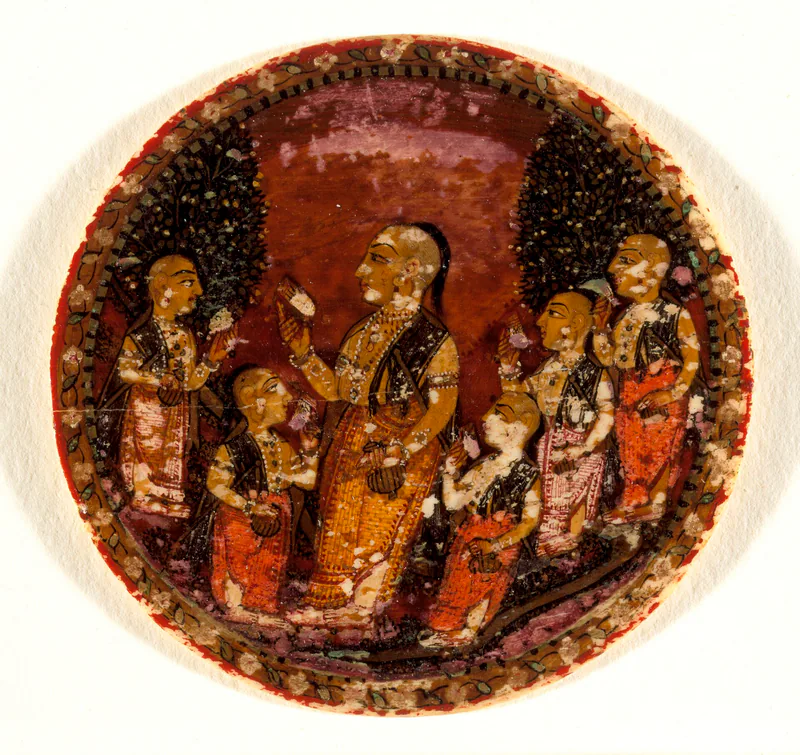
The theology of the avatar is central. The Bhagavad Gita says that whenever dharma declines, the Lord takes birth age after age to protect the good and destroy evil. Of the ten classical avatars, Rama and Krishna are the most important. Rama, hero of the Ramayana, is the model of the righteous king and dutiful son. Krishna is worshipped in many aspects: the mischievous child who steals butter, the young cowherd whose flute draws the cowherd women (gopis) to dance with him in the forest of Vrindavan, the statesman of the Mahabharata and the teacher of the Gita. Some Vaishnava traditions regard Krishna not as an avatar of Vishnu but as the supreme God himself, of whom Vishnu is an expansion.
Vaishnava schools also debate the role of grace. Salvation is generally understood as eternal life in the presence of God, in loving service, rather than the dissolution of the self in an impersonal absolute, and it is attained through devotion and complete surrender (prapatti) to the Lord.
The Alvars and the Rise of Devotional Vaishnavism§
Between roughly the sixth and ninth centuries, twelve Tamil poet-saints known as the Alvars, "those immersed" in God, wandered between the temples of south India singing hymns of passionate devotion to Vishnu. Among them were Nammalvar, whose Tiruvaymoli became known as the "Tamil Veda," and Andal, the only woman among them, who imagined herself as Krishna's bride. Their four thousand verses were collected in the tenth century by Nathamuni as the Nalayira Divya Prabandham and are recited in Vaishnava temples alongside Sanskrit texts. The Alvars made devotion, rather than ritual or caste status, the way to God, and they inspired the wider movement described in The Bhakti Movement.
The Four Sampradayas and Other Vaishnava Schools§
Later tradition speaks of four main Vaishnava lineages (sampradayas), each linked to a philosophical interpretation of Vedanta.
Sri Vaishnavism and Ramanuja§
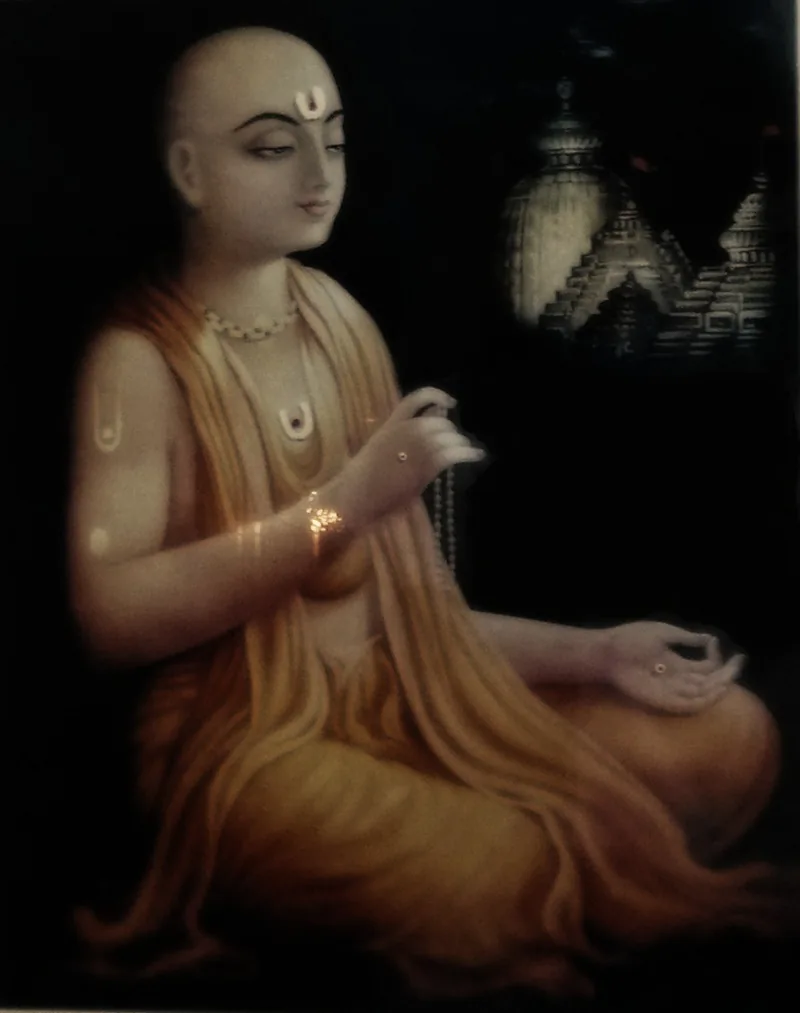
The Sri Vaishnava tradition, based at the temple of Srirangam in Tamil Nadu, unites the Tamil hymns of the Alvars with Sanskrit Vedanta. Its great teacher Ramanuja (traditionally 1017–1137) taught Vishishtadvaita, "qualified non-dualism": souls and the world are real and distinct, yet form the body of God, who is their inner self. Later the community divided into a northern school (Vadakalai), which held that the soul must make some effort towards God, like a baby monkey clinging to its mother, and a southern school (Tenkalai), which held that God's grace does everything, as a mother cat carries her kitten.
Madhva, Nimbarka and Vallabha§
Madhva (traditionally 1238–1317), based at Udupi in Karnataka, taught Dvaita, "dualism": an eternal difference between God, souls and matter. Nimbarka, whose dates are uncertain, taught a "difference and non-difference" (dvaitadvaita) and centred worship on Radha and Krishna. Vallabha (1479–1531) founded the Pushtimarga, the "path of grace," in which devotees serve Krishna as the child Shrinathji, whose principal image is at Nathdwara in Rajasthan, with elaborate daily offerings of food, music and adornment. These philosophical positions are compared in Hinduism and Vedanta.
Chaitanya and Gaudiya Vaishnavism§
In Bengal, Chaitanya (1486–1534) led ecstatic congregational singing of the names of Krishna (sankirtana) and was regarded by his followers as Krishna and Radha united in one body. His disciples, the Goswamis of Vrindavan, systematised a theology of devotional emotion and of "inconceivable difference and non-difference" between God and his energies. Radha, Krishna's beloved, already celebrated in Jayadeva's twelfth-century Sanskrit poem Gitagovinda, became the model of the devotee's love. In 1966 A. C. Bhaktivedanta Swami Prabhupada founded the International Society for Krishna Consciousness (ISKCON) in New York, carrying Gaudiya Vaishnavism, and the chanting of the Hare Krishna mantra, around the world.
Rama Devotion and Regional Traditions§
Devotion to Rama was promoted by the Ramanandi order, traced to the teacher Ramananda (probably fourteenth or fifteenth century), today one of the largest ascetic orders in India, and by Tulsidas's Ramcharitmanas. In Maharashtra the Varkari tradition worships Vithoba of Pandharpur, a form of Krishna, through the songs of Jnaneshvar, Namdev and Tukaram and an annual pilgrimage on foot. In Assam, Shankaradeva (traditionally 1449–1568) founded a devotional movement centred on congregational prayer halls, and in Gujarat the Swaminarayan movement, founded by Sahajanand Swami (1781–1830), has become a major global community.
Vaishnava Practice: Temples, Names and Holy Places§
Vaishnava practice is devotional and often richly sensory. Devotees mark the forehead with a vertical tilak, commonly a U-shaped sign representing Vishnu's foot, whose form differs by lineage. The holy basil plant, tulsi, regarded as a form of Lakshmi or as Krishna's beloved, is grown and worshipped in courtyards, and its wood is made into prayer beads for repeating divine names (japa). Many Vaishnavas are strictly vegetarian, offer all food to God before eating it as sanctified prasada, and fast on the eleventh lunar day, Ekadashi.
Great temples include Srirangam, Tirupati (Venkateshvara), Guruvayur, Udupi and Jagannath at Puri, whose chariot festival (Rath Yatra) draws enormous crowds. Pilgrims visit Krishna's land of Vraja around Mathura and Vrindavan, Rama's city of Ayodhya and Dwarka on the western coast. Major festivals include Krishna's birthday (Janmashtami), Rama's birthday (Rama Navami) and Holi, associated with Krishna's play with the cowherd women. Daily worship follows the patterns described in Hindu Temples, Rituals and Festivals.
Frequently asked questions§
What is the difference between Vaishnavism and Shaivism?§
Vaishnavism worships Vishnu and his avatars as the supreme God, while Shaivism gives that place to Shiva. The two traditions share scriptures, temples and many ideas, but differ in their mythology, sacred marks, rituals, holy places and theological schools.
Is Krishna an avatar of Vishnu?§
In most Vaishnava traditions Krishna is the eighth avatar of Vishnu. Gaudiya Vaishnavas and some other Krishna-centred schools reverse this, regarding Krishna as the original supreme God and Vishnu as one of his forms.
Are Hare Krishnas Vaishnavas?§
Yes. The International Society for Krishna Consciousness, founded in 1966, belongs to the Gaudiya Vaishnava tradition that goes back to Chaitanya in sixteenth-century Bengal, and its devotees worship Krishna as the supreme God.
Sources and further reading§
- Vaishnavism, Śaivism and Minor Religious Systems — R. G. Bhandarkar, 1913
- The Theology of Rāmānuja — John Braisted Carman, 1974
- Krishna: A Sourcebook — Edwin F. Bryant (ed.), 2007
- Gitagovinda: Love Song of the Dark Lord — Barbara Stoler Miller (trans.), 1977
- Vaiṣṇavism: Its Philosophy, Theology and Religious Discipline — S. M. Srinivasa Chari, 1994
- Hare Krishna Transformed — E. Burke Rochford Jr., 2007