Liber XIV · Hinduism · Chapter XII: The Vedas & Upanishads
Om (Aum): Meaning and History of Hinduism's Sacred Syllable
Om (Aum), the sacred syllable of Hinduism: its Vedic origins, its meaning in the Upanishads, its use in yoga and ritual, and Om in Jainism and Buddhism.

Om, also written Aum, is the most sacred syllable of Hinduism: a sound chanted at the beginning and end of Vedic recitation, prayers and rituals, and identified in the Upanishads with Brahman, the ultimate reality, and with the whole of existence. Called the pranava, it began as a ritual word of assent and chant in the Vedic liturgy, became the supreme object of meditation in the Upanishads and yoga, and is shared, in different forms and meanings, by Jains, Buddhists and Sikhs.
Om in the Vedas: Assent, Chant and the Udgitha§
Om does not appear as a word in the oldest hymns of the Rigveda, but it is prominent in the ritual literature that grew up around them, discussed in The Vedas and Upanishads. In the Brahmanas and related texts it is the solemn "yes" with which priests respond to recitations, and it opens and closes the chanting of Vedic verses. In the Samaveda liturgy the singers' main chant, the udgitha, begins with Om, and the syllable came to be identified with the chant itself.
The name pranava, used for Om from early times, is usually explained as "the reverberating" or "the resounding praise." Om was also called the akshara, a word that means both "syllable" and "imperishable," a double meaning that later thinkers exploited. In Sanskrit phonetics the vowel o is a merger of a and u, which made it possible to analyse Om as three elements, A, U and M, an analysis that became central to its later symbolism.
The Vedic law books made Om a rule of study. The Manusmriti instructs a student to pronounce Om at the beginning and end of each lesson in the Veda, warning that otherwise learning slips away, and it places Om, together with the three "great utterances" bhur, bhuvah and svah, before the Gayatri Mantra, the formula still recited in that form today.
Om in the Upanishads: The Syllable as Brahman§
The early Upanishads transformed Om from a ritual sound into a symbol of ultimate reality. The Chandogya Upanishad opens by instructing its reader to venerate the udgitha as Om, calling it the essence of all essences. The Taittiriya Upanishad declares that Om is Brahman and that Om is this whole world. In the Katha Upanishad, Yama, the lord of death, tells the boy Nachiketas that the word which all the Vedas proclaim and for which seekers practise austerity is Om, and that knowing this syllable one obtains whatever one desires.
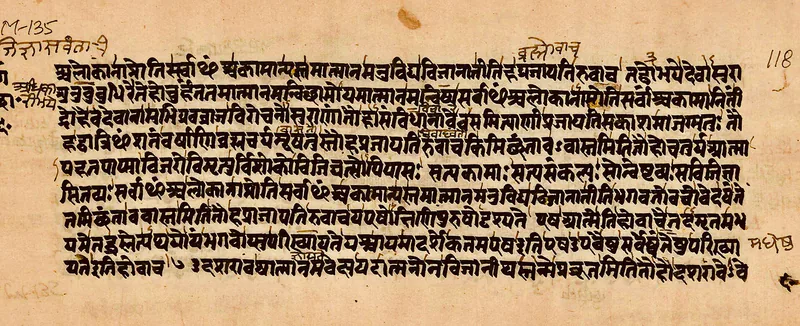
The Mundaka Upanishad offers a memorable image of meditation: Om is the bow, the self is the arrow, and Brahman is the target, to be struck by an undistracted mind. The Prashna Upanishad describes the fruits of meditating on Om with one, two or three of its measures, leading to different destinies after death. The later Maitri Upanishad distinguishes two Brahmans, one sound and one soundless, and teaches that through the sound one reaches the soundless.
In all these texts Om functions as a bridge between the audible world and what lies beyond speech. It is a sound that can be uttered, yet it is identified with the source of all sounds and things. The ideas of these Upanishads are surveyed more broadly in Hinduism and Vedanta.
The Mandukya Upanishad: A, U, M and the Fourth§
The shortest of the principal Upanishads, the Mandukya, consisting of only twelve verses, is entirely devoted to Om, and it became the classic statement of the syllable's meaning. It begins by declaring that Om is all this: past, present and future, and whatever lies beyond the three times. It then correlates the self (atman) with Om in four "quarters."
The first quarter, corresponding to the sound A, is the waking state, in which consciousness is directed outward to the physical world. The second, U, is the dream state, in which consciousness knows inner, subtle objects. The third, M, is deep, dreamless sleep, a state of undivided awareness and bliss in which all distinctions are merged. The fourth, called simply turiya, "the fourth," corresponds to no letter at all: it is the silence after the syllable, pure consciousness without object, peaceful and non-dual, which the text identifies with the self.
Around the sixth century CE the teacher Gaudapada composed a verse commentary on the Mandukya, the Mandukya Karika, the earliest surviving systematic text of nondual Vedanta. Adi Shankara, discussed in Adi Shankara: Life, Works and the Advaita Vedanta Tradition, commented on both, and the analysis of Om into waking, dream, sleep and the fourth became a foundation of Advaita contemplative practice.
Om in Yoga, the Bhagavad Gita and Daily Ritual§
The Yoga Sutras of Patanjali give Om a precise role. After defining Ishvara, the Lord, as a special self untouched by affliction and karma, the text says that his expression is the pranava, and that the practitioner should repeat it while reflecting on its meaning, which leads to inward-turned consciousness and removes obstacles. Commentators linked this to japa, repeated recitation, as a method of concentration.

The Bhagavad Gita speaks of Om in several places. Krishna says that among the Vedas he is the syllable Om, and that one who leaves the body uttering Om and remembering him reaches the highest goal. The seventeenth chapter explains the formula Om tat sat, "Om, that, the real," used to sanctify sacrifices, gifts and austerities.
In everyday Hindu practice Om is ubiquitous. Most mantras begin with it, as in the familiar invocation of Shiva, Om namah shivaya; prayers end with it, often with the words Om shanti shanti shanti, "Om, peace, peace, peace." It is whispered to or traced on the tongue of newborn children in some birth rites, written at the head of letters and account books, painted on house walls and temple doorways, and chanted at the start of yoga classes. Its written form, ॐ, a Devanagari ligature with a crescent and dot above, is one of the most widely recognised religious symbols in the world.
The Sacred Sound in Tantra, Grammar and Philosophy of Language§
Later Indian thought elaborated the theology of Om in several directions. Puranic and devotional texts identified its three letters with the three great gods, Brahma, Vishnu and Shiva, and with the three Vedas and the three worlds. The crescent and dot of the written sign were explained as the resonance (nada) and the point (bindu) into which the sound dissolves, symbols that became important in tantric theories of sound.
Indian philosophy of language reflected deeply on the sacred word. The grammarian Bhartrihari, probably of the fifth century CE, taught that ultimate reality is the "word-Brahman" (shabda-brahman), of which the world is a manifestation. The Tantras developed this into detailed cosmologies in which reality unfolds through levels of speech, from the supreme, silent word to audible sound, and in which Om and other seed syllables (bija) are condensed forms of divine power. Practitioners of nada yoga meditated on inner sounds culminating in silence. These ideas are related to the subtle-body teachings described in Nadis, Prana and the Subtle Body, where Om is often associated with the brow centre.
Om Beyond Hinduism: Jain, Buddhist and Sikh Forms§
Om is not exclusively Hindu. Jains use it as a compressed form of homage to the five supreme beings honoured in the Navkar Mantra; a traditional explanation derives it from the initial letters of their names, which combine into A-U-M. In Buddhism Om opens many mantras and dharanis, of which the most famous is Om mani padme hum, associated with the bodhisattva Avalokiteshvara and central to Vajrayana Buddhism. In Japan the pairing of the first and last letters of the Sanskrit alphabet, a and hum, appears in the open- and closed-mouthed guardian figures at temple gates, a symbolism developed in Shingon esoteric Buddhism.
In Sikhism the opening words of the Guru Granth Sahib, Ik Onkar, "One Onkar," use a word related to Om but give it a distinctive meaning, affirming the oneness of God; see Sikh Beliefs: Ik Onkar, Naam and Seva.
In the modern world Om has become a global symbol of spirituality, chanted in yoga studios, printed on clothing and adopted by new religious movements. Some popular claims, such as reports that scientists have recorded the sun or the universe "sounding Om," have no scientific basis. For Hindus, the syllable remains above all a sacred sound to be used with reverence, and its commercial use on everyday objects is sometimes a cause of offence.
Frequently asked questions§
What does Om mean?§
Om has no simple dictionary meaning. In the Vedas it is a sacred word of assent and chant; in the Upanishads it is the sound-symbol of Brahman, the ultimate reality, and of everything that exists; and in the Mandukya Upanishad its parts stand for the states of consciousness and the silent fourth beyond them.
Is it Om or Aum?§
Both are correct. In Sanskrit the vowel o is understood as a combination of a and u, so the syllable can be written Om or analysed as A-U-M, as the Mandukya Upanishad does.
Why is Om chanted at the beginning of mantras?§
Hindu tradition regards Om as the primordial sound and the source of all mantras, so it is placed at the beginning to sanctify and empower what follows. The law books also prescribe it at the beginning and end of Vedic study.
Is Om used in Buddhism?§
Yes. Many Buddhist mantras begin with Om, including Om mani padme hum, though Buddhists do not interpret it as a symbol of Brahman in the Hindu sense.
Sources and further reading§
- The Principal Upaniṣads — S. Radhakrishnan, 1953
- Upaniṣads — Patrick Olivelle, 1996
- Understanding Mantras — Harvey P. Alper (ed.), 1989
- Vāc: The Concept of the Word in Selected Hindu Tantras — André Padoux, 1990
- The Āgamaśāstra of Gauḍapāda — Vidhushekhara Bhattacharya, 1943
- Sound and Communication: An Aesthetic Cultural History of Sanskrit Hinduism — Annette Wilke and Oliver Moebus, 2011