History of Jainism: From Mahavira to the Global Diaspora
A history of Jainism from Mahavira and the Mauryas through Karnataka, Gujarat and the Mughal court to colonial scholarship, modern India and the diaspora.

The history of Jainism spans some two and a half thousand years, from the teaching of Mahavira in the Ganges valley in the fifth or sixth century BCE to communities of practising Jains on every continent today. Supported by kings in its early and medieval phases and by merchant communities throughout, Jainism spread from Bihar to Odisha, Mathura, Karnataka, the Tamil country, Gujarat and Rajasthan, divided into its two great traditions, and survived periods of decline to become one of India's most influential religious minorities. Jains themselves regard their religion as eternal, rediscovered in every age; this article follows what historians can trace.
Shramana Origins in the Ganges Valley§
Jainism arose among the shramana ("striving") movements of the eastern Ganges valley — the region of Magadha, roughly modern Bihar — in the centuries when cities and states were forming there. These movements, which also produced Buddhism and the now-extinct Ajivikas, emphasised renunciation, karma and rebirth, and liberation through ascetic discipline rather than Vedic sacrifice. The scholar Johannes Bronkhorst has argued that this "Greater Magadha" had a religious culture distinct from the Brahmanical heartland further west.
Jain tradition holds that Mahavira was preceded by twenty-three Tirthankaras. Historians generally accept that the twenty-third, Parshvanatha, was a real ascetic teacher of an earlier generation, whose followers Mahavira encountered. Mahavira himself, whose life is told in Mahavira and the 24 Tirthankaras, appears in early Buddhist texts as Nigantha Nataputta, "the unfettered one of the Nata clan", a rival teacher. Jain tradition dates his liberation to 527 BCE, but many historians prefer a date several decades later, in the fifth century BCE, in line with revised dates for the Buddha.
After Mahavira, leadership passed to his disciples Gautama and Sudharman. The teachings were transmitted orally, and Jain tradition records successive gatherings of monks to recover them: at Pataliputra after a famine in the time of the Mauryas, later at Mathura and Valabhi, and finally at Valabhi in Gujarat in the fifth century CE, where the Shvetambara canon was written down. The story of these councils is told in The Jain Agamas.
Mauryas, Kharavela and the Spread of Jainism§
Jain sources claim that Chandragupta Maurya, founder of the Mauryan empire (late fourth century BCE), abdicated, became a disciple of the teacher Bhadrabahu and travelled with him to Shravanabelagola in Karnataka, where he ended his life by ritual fasting. The story is attested in inscriptions and texts from several centuries later, and historians are divided on how much of it to accept. Shvetambara tradition also honours Samprati, a grandson of Ashoka, as a great patron who sent Jain teachers to new regions.
Firmer evidence comes from the Hathigumpha inscription at Udayagiri near Bhubaneswar in Odisha, usually dated to the first century BCE. In it King Kharavela of Kalinga opens with a salutation to the Arhats and Siddhas — an early form of the formula preserved in the Navkar Mantra — and records his patronage of Jain ascetics, for whom caves were cut in the nearby Udayagiri and Khandagiri hills.
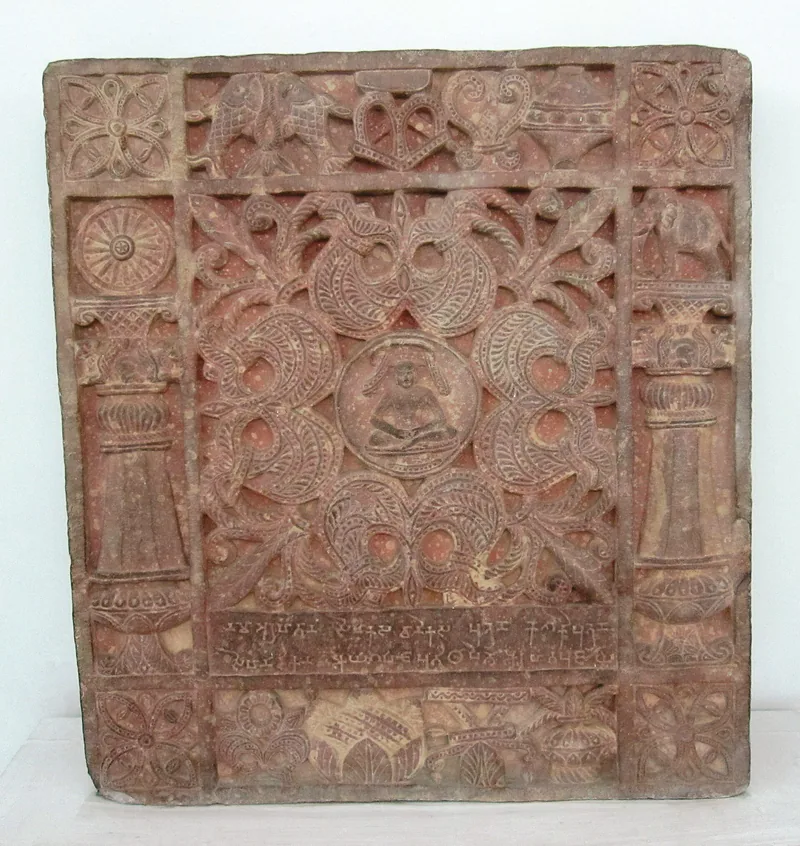
In the north-west, excavations at the Kankali Tila mound in Mathura revealed a Jain stupa and a wealth of sculpture and inscriptions from the Kushan period, roughly the first to third centuries CE. The inscriptions record gifts by merchants, artisans and many women, and name monastic lineages that match lists in the Shvetambara Kalpa Sutra. The Mathura images include some of the earliest surviving representations of the Tirthankaras.
Jainism in the South: Karnataka and the Tamil Country§
From the early centuries CE Jainism became a major force in the south. In the Tamil country, inscriptions in Tamil-Brahmi script in rock shelters near Madurai, some of which have carved stone beds, are associated with Jain ascetics. Jain authors contributed significantly to classical Tamil literature, including the ethical verses of the Naladiyar and the epic Jivaka Chintamani. From the seventh century the Shaiva and Vaishnava devotional movements, led by poet-saints such as Appar and Sambandar, challenged Jain influence at the Pallava and Pandya courts; Shaiva hagiography tells of Jains defeated in debate and executed at Madurai, a story most historians treat as polemical legend rather than reliable record. Jain communities survived in Tamil Nadu in smaller numbers.
In Karnataka, Jainism enjoyed royal patronage for centuries. The Western Ganga dynasty is said in tradition to have been founded with the help of a Jain teacher, and it was a Ganga minister, Chavundaraya, who commissioned the colossus of Bahubali described in Bahubali and the Gommateshvara Statue. The Rashtrakuta king Amoghavarsha I (ninth century) was a patron of the Digambara teachers Jinasena and Gunabhadra, authors of the Adipurana and Uttarapurana. The three great poets of early Kannada literature — Pampa, Ponna and Ranna, of the tenth century — were all Jains. Under the Hoysalas (eleventh to fourteenth centuries) Jains remained prominent: King Vishnuvardhana is said to have become a Vaishnava, but his queen Shantala and his general Gangaraja were notable Jain patrons. The rise of the Virashaiva (Lingayat) movement from the twelfth century reduced Jain influence, though important Jain communities endure in Karnataka, for example at Moodabidri on the coast.
Gujarat and Rajasthan: Kings, Ministers and Monks§
From about the tenth century the centre of Shvetambara Jainism lay in Gujarat and Rajasthan. Under the Chaulukya (Solanki) kings of Gujarat, the scholar-monk Hemachandra (1089–1172) wrote grammars, poetry, a manual of yoga and the monumental Trishashtishalakapurushacharitra, a history of the sixty-three great figures of Jain tradition. Jain sources say that his influence led King Kumarapala (r. c. 1143–1172) to adopt Jain practices and to forbid animal slaughter in his realm; how far these measures went is debated, but Kumarapala certainly built Jain temples, including the great temple at Taranga.
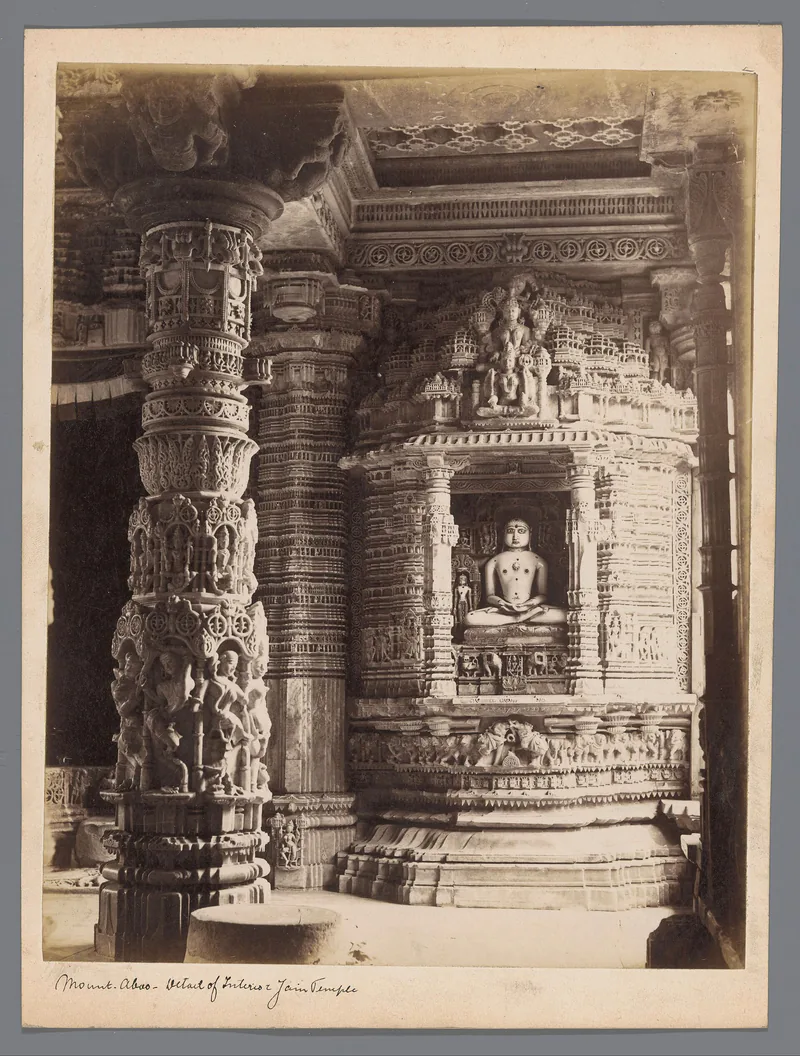
Jain ministers and merchants financed the marble temples of Mount Abu — Vimala Vasahi (1031) and the Luna Vasahi of the brothers Vastupala and Tejapala (thirteenth century) — and later the temple complex of Ranakpur (fifteenth century) and the temple-city of Shatrunjaya, described in Jain Temples and Pilgrimage. Monks founded manuscript libraries (bhandaras) at Patan, Jaisalmer and Cambay that preserved not only Jain texts but much of India's wider literary heritage. The Shvetambara monastic order divided into lineages called gacchas, among which the Kharatara and Tapa Gacchas became the most important.
Jains Under Mughal and British Rule§
Jain monks attended the Mughal court of Akbar, who invited the Tapa Gaccha leader Hiravijaya Suri to Fatehpur Sikri in the early 1580s. According to Jain sources and surviving imperial orders, Akbar responded by restricting animal slaughter on certain days, including the days of Paryushana, and protecting Jain pilgrimage sites. Monks of the Kharatara Gaccha also visited the court. In the seventeenth century Jain merchants such as Shantidas Jhaveri of Ahmedabad dealt with the Mughal emperors, and in Agra the poet Banarsidas led a lay circle devoted to the teachings of Kundakunda. Reform movements that rejected image worship, described in Sthanakvasi and Terapanth, arose in this period.
Under British rule the first European studies of Jainism often treated it as an offshoot of Buddhism. The German Indologist Hermann Jacobi, whose translations appeared in the Sacred Books of the East from 1884, showed from the canonical sources that Jainism was an independent and ancient tradition. Jains founded associations, schools and printing presses, published their scriptures and took part in debates about Indian identity. In 1893 the lay scholar Virchand Gandhi represented Jainism at the World's Parliament of Religions in Chicago.
Jainism in Modern India and the Global Diaspora§
Jains played a visible role in modern India. Mohandas Gandhi grew up among Jains in Gujarat and counted the Jain lay teacher Shrimad Rajchandra among his formative influences, and the language of ahimsa entered national politics through him. In 1974–75 the 2,500th anniversary of Mahavira's liberation was celebrated across India, and a common Jain flag and emblem were adopted. In 2014 the Government of India notified Jains as a national minority community. The 2011 census counted about 4.45 million Jains, concentrated in Maharashtra, Rajasthan, Gujarat, Madhya Pradesh and Karnataka.
Jain migration began on a significant scale in the late nineteenth and early twentieth centuries, when Gujarati Jains settled in East Africa, especially Kenya. Many later moved to Britain, where the Jain Centre in Leicester opened in a converted chapel in 1988. In North America the Federation of Jain Associations (JAINA), founded in 1981, links dozens of local centres, and Jain diamond merchants form a prominent community in Antwerp. Diaspora Jains have adapted practice to new settings — through lay-led temples that serve both traditions, youth education and the travelling samans and samanis of the Terapanth — while maintaining close ties with India. These developments are surveyed in What Is Jainism?.
Frequently asked questions§
When did Jainism begin?§
Jains believe their religion is eternal and is taught anew by Tirthankaras in each cycle of time. Historians trace the present tradition to Mahavira in the fifth or sixth century BCE and to his predecessor Parshva, who probably lived a few centuries earlier.
Which kings supported Jainism?§
Jain tradition names Chandragupta Maurya and Samprati; inscriptions confirm the patronage of Kharavela of Kalinga. Later patrons included the Ganga and Rashtrakuta kings of Karnataka and the Chaulukya king Kumarapala of Gujarat.
Why did Jainism decline in South India?§
From the seventh century, Shaiva and Vaishnava devotional movements won royal favour in the Tamil country, and in Karnataka the Virashaiva movement grew from the twelfth century. Jain communities nevertheless survived in both regions.
Where do Jains live today?§
Most of the roughly 4.5 million Jains live in India, especially in Maharashtra, Rajasthan, Gujarat, Madhya Pradesh and Karnataka. There are also established communities in East Africa, Britain, North America and Belgium.
Sources and further reading§
- The Jains — Paul Dundas, 1992
- The Jaina Path of Purification — Padmanabh S. Jaini, 1979
- Greater Magadha: Studies in the Culture of Early India — Johannes Bronkhorst, 2007
- Jainism in South India and Some Jaina Epigraphs — P. B. Desai, 1957
- Mediaeval Jainism: With Special Reference to the Vijayanagara Empire — B. A. Saletore, 1938
- Organizing Jainism in India and England — Marcus Banks, 1992