Liber XVIII · Jainism · Chapter IV: Jain Teachings
The Navkar Mantra: Meaning of Jainism's Namokar Prayer
The Navkar or Namokar Mantra, Jainism's central prayer: its Prakrit text and meaning, the five supreme beings, its ancient sources and its uses.

The Navkar Mantra, also called the Namokar or Namaskara Mantra, is the most important prayer of Jainism: a short Prakrit formula that pays homage to the five kinds of supreme beings — the Arihants, the Siddhas, the Acharyas, the Upadhyayas and all monks and nuns. It names no individual and asks for nothing; Jains recite it daily, at the start of rituals and at the moment of death, and regard it as the essence of their scriptures.
The Text of the Navkar Mantra and Its Meaning§
The mantra is in Prakrit, the vernacular language of ancient Jain scripture. In its common Shvetambara form its five lines are:
- Namo arihantanam — homage to the Arihants;
- Namo siddhanam — homage to the Siddhas;
- Namo ayariyanam — homage to the Acharyas;
- Namo uvajjhayanam — homage to the Upadhyayas;
- Namo loe savva sahunam — homage to all the Sadhus in the world.
These five lines are often followed by a four-line coda (chulika): "This fivefold salutation destroys all sins, and of all auspicious things it is the foremost." Shvetambaras treat the coda as part of the "Navkar" ("ninefold") formula of nine lines, while many Digambaras recite only the five lines and pronounce some words differently (for example arahantanam and airiyanam). The five lines contain thirty-five syllables and the whole nine-line text sixty-eight, numbers which Jain devotional literature often cites.
The word namo (Sanskrit namah) expresses reverent bowing. Jains emphasise that the mantra honours qualities rather than persons: anyone, of any time or place, who attains those qualities is included.
The Pancha Parameshthi: Five Supreme Beings§
Arihants and Siddhas§
The Arihants ("destroyers of the enemies," the inner enemies being the passions) are souls who have attained omniscience while still embodied and who teach the path; the Tirthankaras, described in Mahavira and the 24 Tirthankaras, are the supreme examples. The Siddhas ("perfected ones") are souls who have shed all karma and dwell bodiless at the summit of the universe.
Although Siddhas are spiritually higher, the Arihants are named first, because without their teaching no one would know the way to liberation. This order reflects the Jain view, set out in Jain Teachings, that liberation comes from knowledge and conduct rather than divine grace.
Acharyas, Upadhyayas and Sadhus§
The remaining three are living ascetics. The Acharyas are heads of ascetic orders who guide the community and uphold discipline; the Upadhyayas are preceptors who teach scripture to monks and nuns; and the Sadhus are all renouncers who follow the five great vows. Since savva sahunam ("all sadhus") covers every true ascetic, the mantra extends homage beyond sectarian boundaries. The ranks and lives of these renouncers are described in Jain Monks and Nuns.
Ancient Sources of the Navkar Mantra§
The earliest datable form of the opening words occurs in the Hathigumpha ("elephant cave") inscription at Udayagiri near Bhubaneswar in Odisha, carved for King Kharavela of Kalinga. The inscription opens with homage to the Arhats and to all the Siddhas. Its date is debated, but most scholars place it in the first or second century BCE, which makes it one of the oldest Jain inscriptions.
In the scriptures, the mantra stands at the head of the Digambara Shatkhandagama, the oldest surviving text of that tradition, and in the Shvetambara manuscript tradition it opens the Vyakhyaprajnapti or Bhagavati Sutra, followed by a homage to the Brahmi script. Jain commentators came to describe the mantra as the essence of all fourteen Purvas, the lost "former" scriptures discussed in The Jain Agamas. Medieval authors wrote whole treatises on its meaning, explaining each syllable and the merit of its recitation.
How Jains Use the Navkar Mantra§
Daily recitation and the rosary§
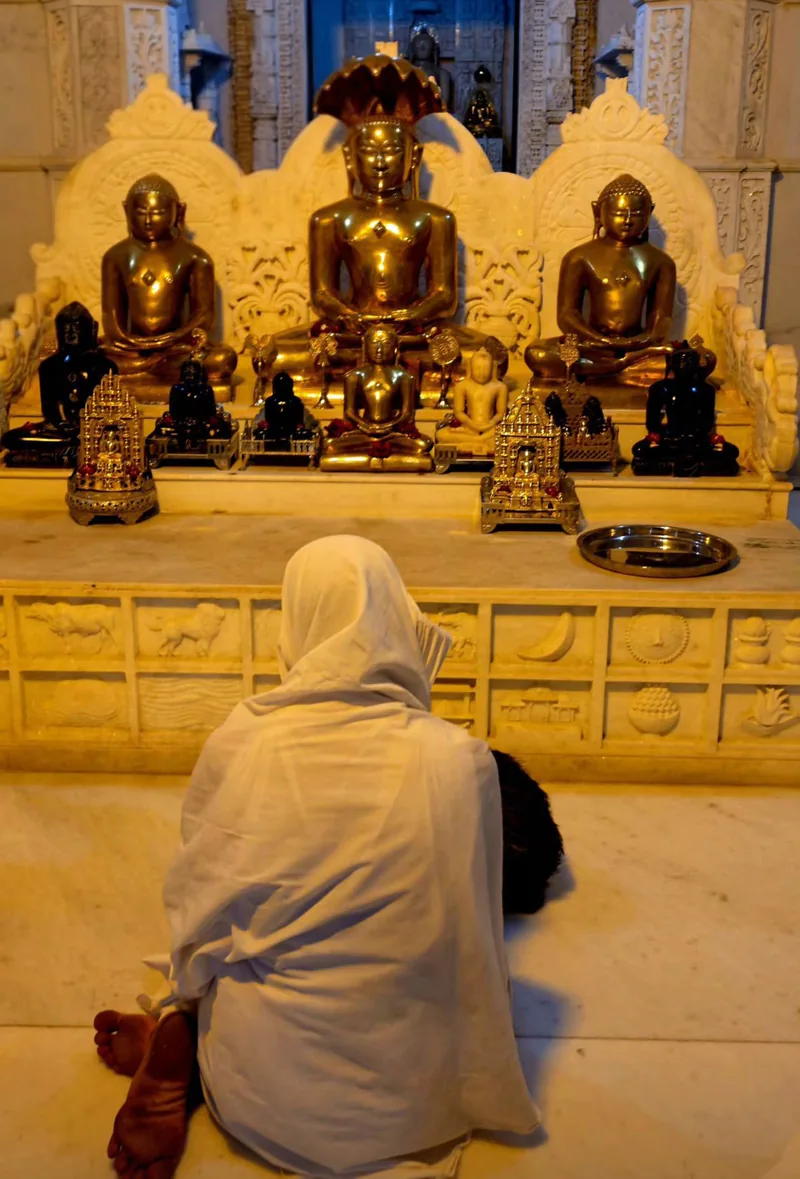
Many Jains recite the mantra on waking, before eating, before travel, before sleep and at the start of every ritual and religious meeting. It is often counted on a rosary (navkarvali) of 108 beads. Jain tradition explains this number as the sum of the qualities of the five beings: twelve for the Arihants, eight for the Siddhas, thirty-six for the Acharyas, twenty-five for the Upadhyayas and twenty-seven for the Sadhus.
At death and in protection§
Reciting the mantra, or hearing it, at the moment of death is considered especially valuable, since the soul's last state of mind is believed to influence its next birth; relatives recite it beside the dying, including those who have taken the vow described in Sallekhana and Santhara. Story literature tells how creatures that heard the mantra as they died were reborn in heaven. The best known concerns two snakes rescued from a burning log by the future Tirthankara Parshva, who heard the salutation as they died and were reborn as the deities Dharanendra and Padmavati, as told in Parshvanatha.
Popular devotion also treats the mantra as protective and auspicious, able to remove obstacles and dangers. Learned Jains insist that its power lies in purifying the reciter's mind rather than in compelling any outside force, but in practice both understandings coexist, as they do with sacred formulas in many religions.
In meditation§
In meditative practice the mantra serves as a focus for concentration. Later manuals associate each of the five beings with a colour — commonly white for the Arihants, red for the Siddhas, yellow for the Acharyas, green or blue for the Upadhyayas and dark blue or black for the Sadhus — and teach visualisation of the syllables in different parts of the body or on the petals of an imagined lotus. These techniques, which developed in the medieval period alongside wider Indian tantric methods, are discussed in Jain Meditation and compared with Hindu practices in Tantra in Hinduism.
The Siddhachakra and the Nine Positions§
The five beings of the Navkar Mantra are the centre of the Siddhachakra ("wheel of the Siddhas"), one of the principal objects of Shvetambara worship. It is a lotus-shaped diagram, usually cast in metal or painted, with the Arihant at the centre, the Siddha, Acharya, Upadhyaya and Sadhu on four petals, and on the four diagonal petals the four virtues of right faith, right knowledge, right conduct and austerity. Together these are the navapada, the "nine positions."
The Siddhachakra is worshipped above all during the two nine-day periods of Ayambil Oli each year, in the months of Chaitra and Ashvin, when many Shvetambaras eat a single plain, unspiced meal a day and devote each day to one of the nine positions. Its devotional literature includes the popular tale of King Shripal, cured of leprosy through the worship of the Siddhachakra performed by his wife Mayanasundari. The diagram belongs to a broader Jain use of sacred figures and yantras, which can be compared with the symbols discussed in Religious Symbols.
The Navkar Mantra in Modern Jainism§
The mantra has become the most recognisable expression of shared Jain identity across sects and across the diaspora. It is printed on calendars, framed in homes and shops, sung in many musical settings and chanted collectively at large public gatherings. Because it praises qualities and not a named figure, Jains often present it as universal, a prayer that a member of any religion could recite. Its place in Jain worship is comparable, in function though not in theology, to the Mool Mantar in Sikhism, discussed in Sikh Beliefs, or to the Gayatri in Hindu practice.
Frequently asked questions§
What does "Namo Arihantanam" mean?§
It means "homage to the Arihants," the souls who have conquered their inner enemies — the passions — and attained omniscience while still embodied. It is the first line of the Navkar Mantra.
Why is the Navkar Mantra called universal?§
It honours five classes of spiritual beings by their qualities rather than by name, and asks for nothing in return. Jains therefore present it as a prayer that does not depend on any particular person, sect or worldly request.
Why do Jains chant the Navkar Mantra 108 times?§
The 108 beads of the Jain rosary correspond to the traditional qualities of the five supreme beings: 12 of the Arihants, 8 of the Siddhas, 36 of the Acharyas, 25 of the Upadhyayas and 27 of the Sadhus.
Is the Navkar Mantra the same for Digambaras and Shvetambaras?§
The five lines are shared, with minor differences of pronunciation. Shvetambaras usually add a four-line coda praising the formula, and some Digambaras recite only the five main lines.
Sources and further reading§
- The Jaina Path of Purification — Padmanabh S. Jaini, 1979
- Absent Lord: Ascetics and Kings in a Jain Ritual Culture — Lawrence A. Babb, 1996
- Singing to the Jinas: Jain Laywomen, Mandal Singing, and the Negotiations of Jain Devotion — M. Whitney Kelting, 2001
- Jains in the World: Religious Values and Ideology in India — John E. Cort, 2001
- The Jains — Paul Dundas, 1992
- Jainism: An Introduction — Jeffery D. Long, 2009