Liber XVIII · Jainism · Chapter IV: Jain Teachings
The Jain Agamas: Scriptures and Canon of Jainism Explained
The Jain Agamas explained: the lost Purvas, the Angas, the Valabhi council, the 45-text Shvetambara canon, Digambara scriptures and manuscript libraries.

The Jain Agamas are the scriptures believed to preserve the teaching of Mahavira, as remembered and arranged by his disciples. The Shvetambara tradition recognises a canon of 45 texts (32 among the non-image-worshipping sects), written in Ardhamagadhi Prakrit and finally edited at a council at Valabhi in the fifth century CE; the Digambara tradition holds that the original canon was lost and gives scriptural status instead to later works such as the Shatkhandagama and the treatises of Kundakunda.
Mahavira's Teaching and Its Transmission§
According to Jain tradition, after attaining omniscience Mahavira preached in a divine sound understood by all beings, and his eleven chief disciples, the ganadharas, arranged his words into scripture. This body of teaching is called shruta, "what is heard," and its Shvetambara form agama, "what has come down." It was transmitted orally from teacher to pupil for centuries.
The arrangement attributed to the ganadharas consisted of twelve Angas. The twelfth, the Drishtivada ("disputation about views"), is said to have contained the fourteen Purvas ("former texts"), which some scholars and tradition connect with teachings older than Mahavira, perhaps going back to the community of Parshvanatha. Both traditions agree that knowledge of the Purvas declined generation by generation and was finally lost, and that the Drishtivada no longer exists.
Modern scholarship treats the canon as the product of a long history. Linguistic and stylistic study shows layers of different date: the first book of the Acaranga Sutra and parts of the Sutrakritanga and Uttaradhyayana are generally regarded as the oldest, perhaps going back to the third or fourth century BCE, while other texts are considerably later.
Councils and the Writing Down of the Canon§
Jain tradition remembers three councils (vachanas, "recitations") at which the scriptures were gathered after periods of crisis:

- Pataliputra, perhaps in the third century BCE, under the elder Sthulabhadra, after a long famine had scattered the community and disrupted memorisation. Digambara tradition connects the same famine with the migration of Bhadrabahu's followers to the south and the beginnings of the sectarian division described in Digambara and Shvetambara Jainism.
- Mathura and Valabhi, at about the same time in the early fourth century CE, under Skandila and Nagarjuna respectively, which produced two slightly different recensions.
- Valabhi, the final council, under Devarddhi Gani Kshamashramana, traditionally 980 or 993 years after Mahavira's liberation — around 453 or 466 CE — at which the texts were committed to writing in the form in which Shvetambaras have them today.
Because Digambaras do not accept these councils, the Valabhi canon is specifically a Shvetambara scripture.
The Shvetambara Canon of 45 Agamas§
Image-worshipping Shvetambaras (Murtipujakas) recognise 45 texts in six groups. The Sthanakvasi and Terapanthi sects accept a smaller canon of 32, omitting texts they regard as later or as supporting image worship.
The eleven Angas§
The surviving Angas are the core of the canon:
- Acaranga — the conduct of monks, with the oldest account of Mahavira's austerities;
- Sutrakritanga — doctrine and refutation of rival schools;
- Sthananga and 4. Samavayanga — numerical lists of doctrinal topics;
- Vyakhyaprajnapti or Bhagavati — a large compendium of questions and answers between Mahavira and his disciple Gautama;
- Jnatadharmakatha — parables and stories;
- Upasakadasha — the lives of ten exemplary lay followers;
- Antakriddasha and 9. Anuttaraupapatikadasha — stories of those who attained liberation or the highest heavens;
- Prashnavyakarana — on the influx and stopping of karma;
- Vipakashruta — on the fruits of good and bad deeds.
Upangas, Chedasutras, Mulasutras and others§
The other groups are the twelve Upangas ("subsidiary limbs"), including cosmological works; ten Prakirnakas ("miscellanies"), including texts on dying well; six Chedasutras, which deal with monastic discipline and expiation; four Mulasutras ("root texts"), basic works studied by young ascetics, including the Uttaradhyayana and the Dashavaikalika; and two "appendices," the Nandi and Anuyogadvara, concerned with knowledge and methods of exposition.
The best-known Jain scripture outside the community is the Kalpa Sutra, attributed to Bhadrabahu and transmitted as part of a Chedasutra. It contains the lives of the Tirthankaras, the list of elders and rules for the rainy season, and it is read aloud each year during Paryushana. Illustrated Kalpa Sutra manuscripts of the fourteenth to sixteenth centuries are among the masterpieces of Western Indian painting.
Commentaries§
Around the canon grew layers of commentary: Prakrit verse summaries called niryuktis, expanded bhashyas, prose churnis, and Sanskrit tikas. The eighth-century polymath Haribhadra and the eleventh-century monk Abhayadeva, who commented on nine of the Angas, were among the most important commentators, and for Shvetambaras the canon has always been read through this commentarial tradition.
Digambara Scriptures and the Four Anuyogas§
Digambaras hold that the original Angas and Purvas were lost within a few centuries of Mahavira, and that the texts preserved at Valabhi are not authentic. Their oldest scripture is the Shatkhandagama ("scripture in six parts"), composed in Shauraseni Prakrit by Pushpadanta and Bhutabali, who are said to have learned fragments of a Purva from the teacher Dharasena; its date is uncertain, with estimates ranging over the first centuries CE. With it stands the Kashayaprabhrita of Gunadhara. Both are known chiefly through the vast commentaries of Virasena and his pupil Jinasena in the ninth century, the Dhavala and Jayadhavala, preserved in palm-leaf manuscripts at Moodbidri in Karnataka and published only in the twentieth century.
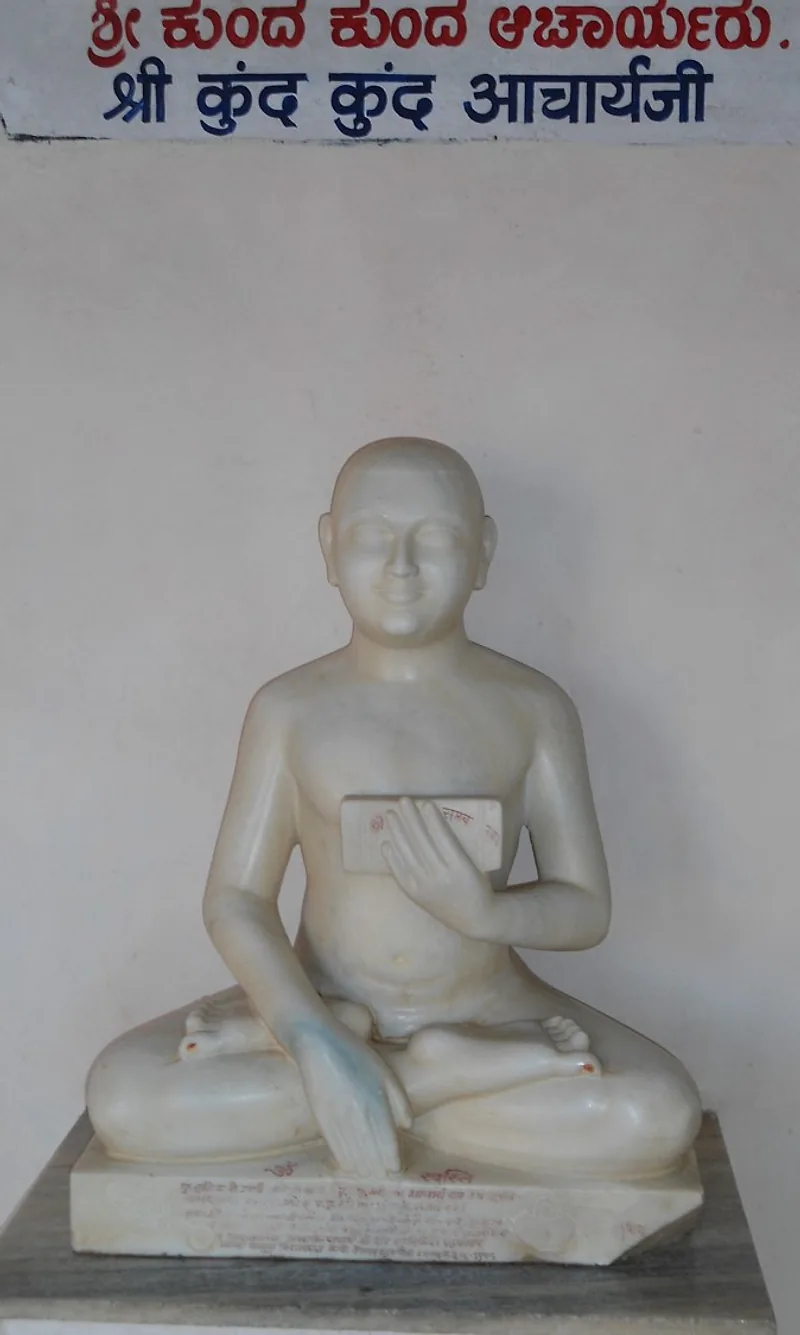
The works of Kundakunda — above all the Samayasara, Pravachanasara, Niyamasara and Panchastikayasara — have even greater influence on Digambara religious life, especially through their teaching on the pure soul. Kundakunda's date is much debated, with proposals ranging from the early centuries CE to the eighth century.
Digambaras arrange their authoritative literature into four anuyogas ("expositions"):
- Prathamanuyoga — narrative works on the Tirthankaras and other great figures, such as Jinasena's Adipurana;
- Karananuyoga — cosmology and the calculation of karma, such as the Tiloyapannatti, described further in Jain Cosmology;
- Charananuyoga — conduct for ascetics and laypeople, such as the Mulachara;
- Dravyanuyoga — metaphysics, including Kundakunda and Umasvati's Tattvartha Sutra, the one text accepted by both traditions and discussed in Jain Teachings.
Manuscripts, Libraries and the Worship of Knowledge§
Jains have long regarded the copying and preservation of scripture as an act of merit. Wealthy laypeople sponsored the copying of manuscripts on palm leaf and later on paper, and Jain communities built manuscript libraries called bhandaras, often in temple basements. The collections at Jaisalmer in Rajasthan and at Patan and Khambhat in Gujarat contain palm-leaf manuscripts from around the eleventh and twelfth centuries onwards and preserve not only Jain works but also Buddhist, Hindu and secular texts that survive nowhere else.
Knowledge itself is worshipped. Shvetambaras celebrate Jnana Panchami, when manuscripts are displayed and honoured, and Digambaras observe Shruta Panchami, commemorating the completion of the Shatkhandagama.
Western Scholarship on the Jain Canon§
European study of the Agamas began in the nineteenth century. The German Indologist Hermann Jacobi translated the Acaranga and Kalpa Sutra in 1884 and the Uttaradhyayana and Sutrakritanga in 1895 for the Sacred Books of the East series, and used them to demonstrate that Jainism was an independent religion, not an offshoot of Buddhism. Walther Schubring's systematic account of Jain doctrine was built on close study of the canon, and later scholars such as Kendall Folkert examined how the scriptures function within Jain communities. Comparison with other Indian scriptural collections can be made through Buddhist Scriptures and The Vedas and Upanishads.
Frequently asked questions§
What are the Jain Agamas?§
They are the canonical scriptures of Jainism, believed to preserve Mahavira's teaching as arranged by his disciples. The Shvetambara canon consists of 45 texts (32 for some sects), written in Ardhamagadhi Prakrit.
How many Agamas are there in Jainism?§
Image-worshipping Shvetambaras accept 45, while Sthanakvasis and Terapanthis accept 32. Digambaras hold that the original Agamas were lost and follow other texts instead.
What language are the Jain scriptures written in?§
The Shvetambara canon is in Ardhamagadhi, a Prakrit language, while the oldest Digambara texts are in Shauraseni Prakrit. Later Jain literature also uses Sanskrit, Apabhramsha, Kannada, Tamil, Gujarati and Hindi.
Do Digambaras accept the Shvetambara scriptures?§
No. They regard the original canon as lost and treat the Shatkhandagama, the Kashayaprabhrita, the works of Kundakunda and other texts as authoritative. Both traditions accept the Tattvartha Sutra.
Sources and further reading§
- Jaina Sutras — Hermann Jacobi (trans.), 1884
- The Doctrine of the Jainas — Walther Schubring, 1935
- A History of the Canonical Literature of the Jainas — Hiralal Rasikdas Kapadia, 1941
- Scripture and Community: Collected Essays on the Jains — Kendall W. Folkert, 1993
- The Jains — Paul Dundas, 1992
- The Jaina Path of Purification — Padmanabh S. Jaini, 1979