Liber XVIII · Jainism · Chapter II: Digambara & Shvetambara
Kundakunda and the Samayasara: Digambara Philosophy of the Soul
Kundakunda, the great Digambara Jain teacher: the Samayasara and his other works, the two standpoints, the pure soul and his influence up to Kanji Svami.

Kundakunda is the most revered teacher of the Digambara Jain tradition and the author of the Samayasara ("The Essence of the Self"), a Prakrit work that describes the soul as pure, conscious and untouched by karma when seen from the ultimate standpoint. Digambara Jains recite his name immediately after those of Mahavira and his chief disciple Gautama in a traditional benediction. His date is uncertain — proposals range from the first to the eighth century CE — but his writings have shaped Digambara spirituality for well over a thousand years and inspired several modern lay movements.
Who Was Kundakunda? Name, Date and Legend§
Kundakunda's name is usually explained as coming from Kondakunde, a place now identified with Konakondla in Andhra Pradesh, near the old border of the Kannada and Telugu regions. Digambara sources also know him as Padmanandi and by several epithets, and later lineage lists place him at the head of the most prestigious line of Digambara monks, the Mula Sangha, whose members often called themselves the "Kundakunda lineage" (Kundakundanvaya).
His date is one of the most debated questions in Jain studies. Digambara tradition places him around the turn of the Common Era. The Indian scholar A. N. Upadhye, in his edition of the Pravachanasara (1935), argued for the early centuries CE. Others have pointed to the developed philosophical vocabulary of the works, and to the absence of early references to them, to argue for a much later date, as late as the seventh or eighth century. Some scholars also suspect that not every work in his name comes from a single author. The safest statement is that the corpus attributed to him was in existence and highly authoritative by the time of the commentator Amritachandra in the tenth century.
Legends add to his stature. One tells that he travelled through the air to the continent of Mahavideha to hear the living Tirthankara Simandhara, who according to Jain cosmology is preaching there now. Another describes a debate with Shvetambara monks at Mount Girnar, in which he caused the goddess of speech to declare that the Digambara path was the original one. Both legends express the Digambara conviction that Kundakunda's teaching carries direct authority despite the loss, in their view, of the ancient canon described in Digambara and Shvetambara Jainism.
The Works of Kundakunda§
Kundakunda wrote in verse in Shauraseni Prakrit, the scriptural language of the Digambaras. Tradition credits him with eighty-four "gifts" (pahudas), but a much smaller number survive:

- Samayasara — "The Essence of the Self", some four hundred verses on the nature of the soul from the ultimate standpoint. It is his best-known and most influential work.
- Pravachanasara — "The Essence of the Teaching", in three parts on knowledge, the objects of knowledge and conduct.
- Panchastikayasara — "The Essence of the Five Extended Substances", an account of the substances that make up the universe, discussed in The Six Dravyas.
- Niyamasara — "The Essence of Restraint", on the path of right faith, knowledge and conduct.
- Ashtapahuda — "Eight Gifts", short works on faith, conduct, the ascetic's life and related subjects.
- Barasa Anuvekkha — "Twelve Reflections", verses on the contemplations of impermanence, helplessness and the other themes that Jain meditators repeatedly consider.
These works share much with the systematic doctrine of the Tattvartha Sutra — the substances, the categories of truth (tattvas) and the stages of karma — but they are written in a more personal and contemplative register, repeatedly turning the reader's attention back to the self.
The Two Standpoints: Nishchaya and Vyavahara§
Jain philosophy has long used nayas, partial viewpoints, to show that reality can be described in different and complementary ways, as explained in Jain Teachings: Soul, Karma and Many-Sidedness. Kundakunda reduced the many viewpoints to a fundamental pair.
From the conventional standpoint (vyavahara naya), the soul is described as embodied, bound by karmic matter, subject to passions, born and dying in many forms, and as the doer of good and bad actions. This is the language of ordinary religious life, of vows, rituals and merit.
From the ultimate or real standpoint (nishchaya naya), the soul is pure consciousness, characterised by knowledge and perception. It is not truly bound by matter, because two substances can never become one; it does not really "do" karma, which is the activity of matter; it is the doer only of its own states of consciousness. The passions — anger, pride, deceit and greed — are not the self but foreign states arising in connection with karma.
The Samayasara insists that the conventional standpoint is useful, as a foreign language is useful for teaching someone who does not understand their own, but that it cannot by itself lead to liberation. What liberates is the direct realisation of the pure self.
Bheda-Vijnana: Knowing the Self as Distinct§
The practical heart of Kundakunda's teaching is bheda-vijnana, "the knowledge of difference". The seeker learns to discriminate, again and again, between the knowing self and everything that is not the self: the body, the senses, karmic matter, thoughts, emotions and even the wish for liberation. Kundakunda compares the soul to a crystal that appears red when placed next to a red flower, though its own nature is clear; the passions colour the soul only while it fails to recognise its own nature.
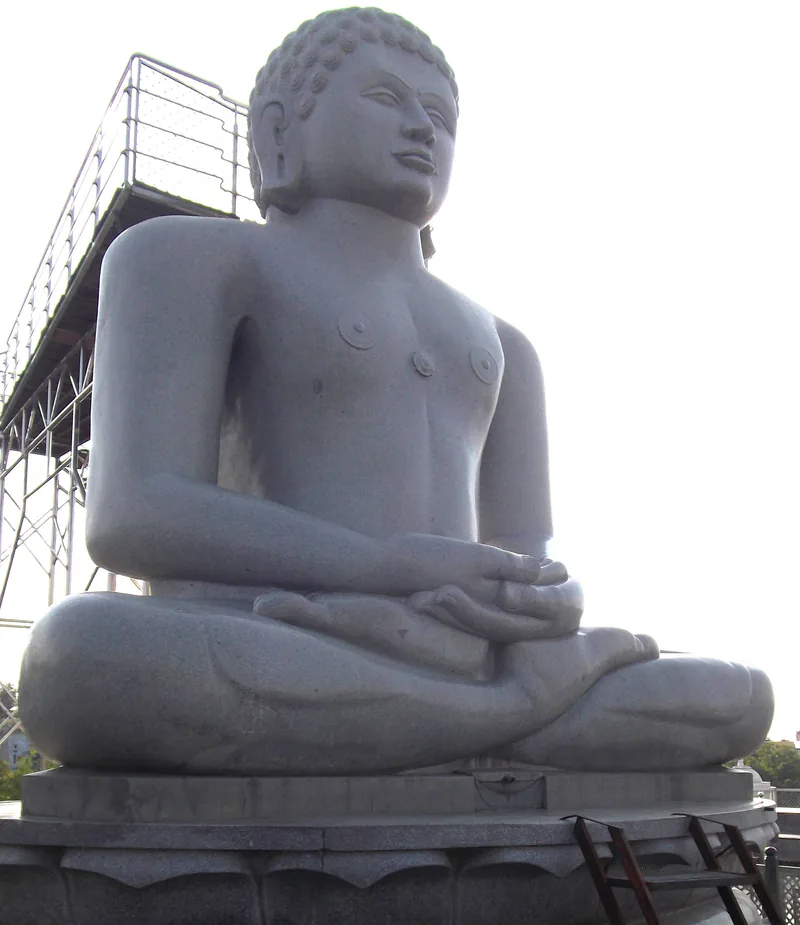
For Kundakunda this inner discrimination is the true meaning of the Three Jewels: right faith is conviction in the pure self, right knowledge is knowing it, and right conduct is abiding in it. Outward vows, fasting and worship are valuable as supports, but if performed with a sense of "I am the doer" they only produce merit (punya), which binds as surely as demerit — a golden chain, as he puts it, binds as tightly as an iron one.
This teaching has always carried a risk that his commentators recognised: a reader might conclude that conduct does not matter. Kundakunda himself was a naked monk who took ascetic discipline for granted, and mainstream Digambara teachers have consistently read him as describing the inner goal of a disciplined life rather than a replacement for it. Scholars have often compared his thought with Advaita Vedanta, described in Vedanta, but there are basic differences: for Kundakunda there are infinitely many individual souls, and the material world is real rather than an illusion.
Commentators and the Adhyatma Tradition§
The Samayasara became a classic through its commentators. Amritachandra (tenth century) wrote the Sanskrit commentary Atmakhyati ("Proclamation of the Self") and a cycle of verses, the Samayasara Kalasha, that became devotional texts in their own right. Jayasena (twelfth century) wrote a commentary that placed more emphasis on the conventional standpoint and on ascetic discipline.
In seventeenth-century Agra a circle of lay Jains devoted to "the study of the self" (adhyatma) read Kundakunda and Amritachandra closely. Its most famous member, the merchant-poet Banarsidas (1586–c. 1643), turned the Samayasara into Hindi verse as the Natak Samaysar and wrote the Ardhakathanak ("Half a Tale"), one of the earliest autobiographies in an Indian language. The adhyatma circle criticised the wealth and ritual authority of the bhattarakas, the clothed Digambara clerics who then managed temples, and it fed into the reformist Digambara Terapanth described in Sthanakvasi and Terapanth.
Kundakunda in Modern Jainism§
In the twentieth century the Samayasara acquired a new mass audience through Kanji Svami (1890–1980), a Sthanakvasi monk from Saurashtra who, after reading the work, left his order and in 1934 declared himself a Digambara layman. From his centre at Songadh in Gujarat he gave daily discourses on Kundakunda, and his followers built temples, published scriptures in large numbers and established communities in India and abroad. Many Digambara monks criticised the movement for seeming to belittle ascetic practice and ritual merit, and the resulting debate between "nishchaya" and "vyavahara" emphases remains a live issue in Digambara life.
Kundakunda is also honoured by the ascetic orders. Modern Digambara acharyas such as Vidyasagar (1946–2024) taught and commented on his works, and his name is invoked at the beginning of sermons and rituals across the Digambara world. For many Jains his verses provide the most direct statement of what the whole tradition is aiming at: the recognition of the soul as it truly is.
Frequently asked questions§
Who was Kundakunda?§
Kundakunda was a Digambara Jain monk and philosopher, the most revered teacher of that tradition after Mahavira and his disciple Gautama. His dates are uncertain, with scholarly proposals ranging from the first to the eighth century CE.
What is the Samayasara about?§
The Samayasara describes the soul from the ultimate standpoint as pure consciousness, distinct from the body, karmic matter and the passions. It teaches that liberation comes through realising this distinction directly.
What are nishchaya naya and vyavahara naya?§
They are the ultimate and conventional standpoints. From the conventional standpoint the soul is bound and acts; from the ultimate standpoint it is pure and is the doer only of its own conscious states.
Do Shvetambara Jains read Kundakunda?§
His works belong to the Digambara tradition and are not part of the Shvetambara canon. Some Shvetambara thinkers have engaged with his ideas, and his influence reached Shvetambara-born figures such as Kanji Svami.
Sources and further reading§
- Harmless Souls: Karmic Bondage and Religious Change in Early Jainism with Special Reference to Umasvati and Kundakunda — W. J. Johnson, 1995
- Pravacanasara of Kundakunda — A. N. Upadhye, 1935
- Samayasara — Kundakunda, 1930
- Half a Tale: A Study in the Interrelationship between Autobiography and History — Mukund Lath, 1981
- The Jaina Path of Purification — Padmanabh S. Jaini, 1979
- The Jains — Paul Dundas, 1992