Liber XVIII · Jainism · Chapter IV: Jain Teachings
The Tattvartha Sutra of Umasvati: Jainism's Core Text
The Tattvartha Sutra of Umasvati, the one text accepted by all Jains: its author and date, its ten chapters on the path to liberation and its commentaries.

The Tattvartha Sutra ("Treatise on the Meaning of the Categories of Truth"), attributed to the teacher Umasvati, is a concise Sanskrit summary of the whole of Jain doctrine and the only scripture accepted as authoritative by both Digambara and Shvetambara Jains. In about 350 short aphorisms arranged in ten chapters, it moves from knowledge and the nature of the soul, through cosmology, matter and karma, to the vows, austerity and final liberation. It was probably composed between the second and fifth centuries CE, and it has been the basis of Jain teaching and commentary ever since.
Umasvati and the Date of the Tattvartha Sutra§
Little is known of the author. The Shvetambara tradition accepts a commentary (Bhashya) on the sutra as Umasvati's own, and its closing verses say that he was the son of Svati and Uma, born at Nyagrodhika, a member of a monastic branch called Uccairnagara, and that he composed the work at Kusumapura, the old name of Pataliputra (modern Patna). Shvetambaras also attribute to him the verse treatise Prashamarati ("Delight in Tranquillity").
Digambaras call him Umasvami, sometimes give him the epithet Gridhrapiccha ("vulture-feathered", after his whisk), and regard him as a pupil of Kundakunda. They do not accept the Bhashya as his. Each tradition therefore claims the author as its own, and the question of which he belonged to — or whether he wrote before the division between them had hardened — has been debated by scholars for more than a century.
His date is likewise uncertain. Most estimates fall between the second and fifth centuries CE, with many modern scholars favouring the later part of that range on the basis of the text's developed philosophical vocabulary and its relation to Buddhist and Brahmanical literature.
The First Jain Scripture in Sanskrit§
Earlier Jain scriptures, the Agamas described in The Jain Agamas, are in Prakrit and are often discursive, repetitive and organised by subject only loosely. Umasvati did for Jainism what the authors of the Yoga Sutras, Nyaya Sutras and Brahma Sutras did for their schools: he distilled a large body of teaching into compressed aphorisms in Sanskrit, the shared language of Indian learned debate. This brought Jain doctrine into dialogue with other philosophical systems and gave Jain teachers a framework for systematic exposition.
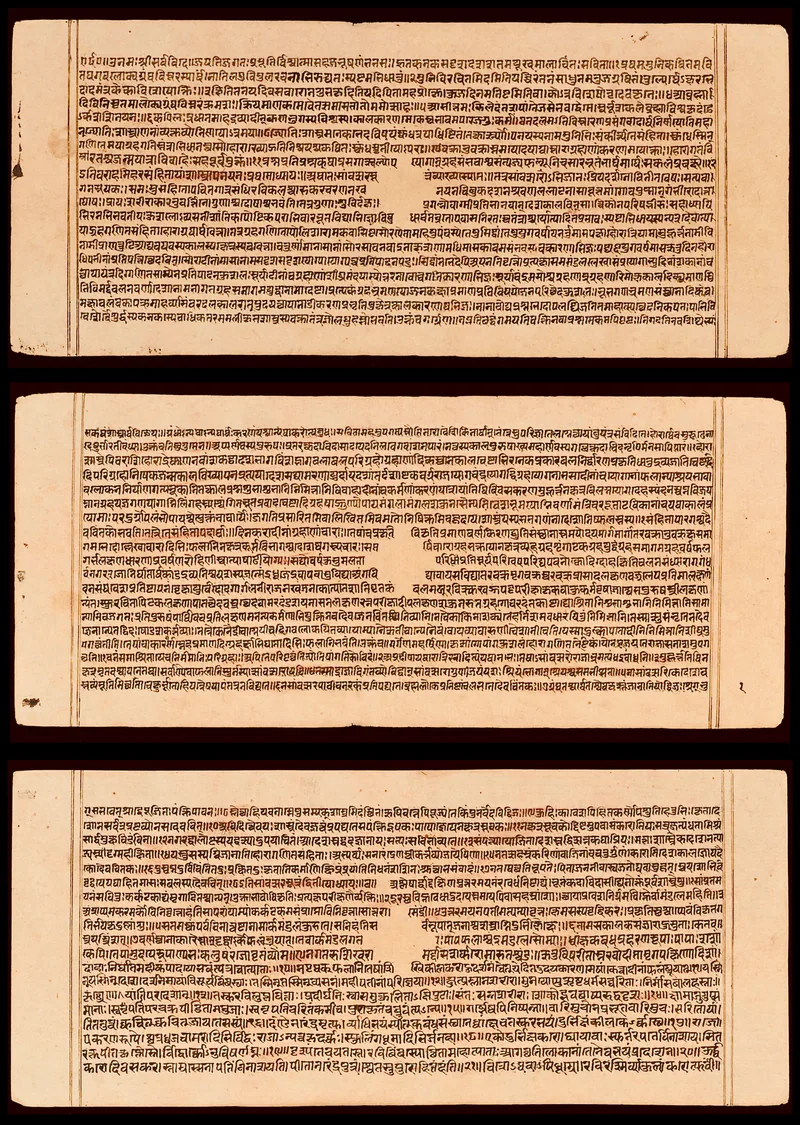
The opening aphorism sets out the theme of the whole work: right faith, right knowledge and right conduct together constitute the path to liberation. The second explains that right faith is belief in the tattvas — the categories of truth — as they really are, which gives the work its title. The work is short enough to be memorised, and many Jains do memorise it.
The Ten Chapters: A Map of the Jain Path§
Each chapter takes up one part of the system:
- Knowledge — the three jewels, the seven tattvas, the means of knowledge (pramana) and standpoints (naya), and the five kinds of knowledge, from ordinary sense-cognition to omniscience.
- The soul — the states of the soul in relation to karma, the classes of living beings, the senses and the five kinds of body.
- The lower and middle worlds — the seven hells and the continents and oceans of the middle world centred on Jambudvipa.
- The gods — the classes of celestial beings and their heavens.
- Non-soul — the substances of the universe, matter and atoms, discussed in The Six Dravyas.
- Influx (asrava) — how activity of body, speech and mind draws karmic matter to the soul.
- The vows — the five vows of non-violence, truth, non-stealing, chastity and non-possession, and the lay vows, ending with the voluntary death of sallekhana.
- Bondage (bandha) — the causes of bondage and the eight types of karma with their subtypes.
- Stoppage and wearing away (samvara and nirjara) — restraint, the ten virtues, the twelve reflections, the twenty-two hardships, and the external and internal austerities, including meditation.
- Liberation — the destruction of all karma and the ascent of the liberated soul.
The sequence is itself a teaching. It follows the soul from its embodied condition, through an analysis of the universe in which it is bound and the mechanism of bondage, to the practices that halt and reverse that mechanism.
Key Teachings of the Tattvartha Sutra§
Several definitions in the work became classic. Violence (himsa) is defined as the destruction of life through careless or passion-driven activity, a formula that places the moral weight of an act on the state of mind of the agent as well as on its result; the wider ethics of ahimsa rests on this definition. Possessiveness is defined not as owning things but as attachment (murccha), a point developed in Aparigraha. Meditation (dhyana) is defined as the restriction of thought to a single object, and four kinds — two harmful and two beneficial — are distinguished, as explained in Jain Meditation.
The eighth chapter gives the standard Jain account of karma: five causes of bondage (wrong faith, non-restraint, carelessness, passions and activity) and eight types of karma, four of which obscure the soul's knowledge, perception, energy and right faith and conduct, and four of which determine its body, lifespan, status and experiences of pleasure and pain. The tenth chapter describes the liberated soul rising to the top of the universe like a gourd freed from its coating of mud, which floats to the surface of water.
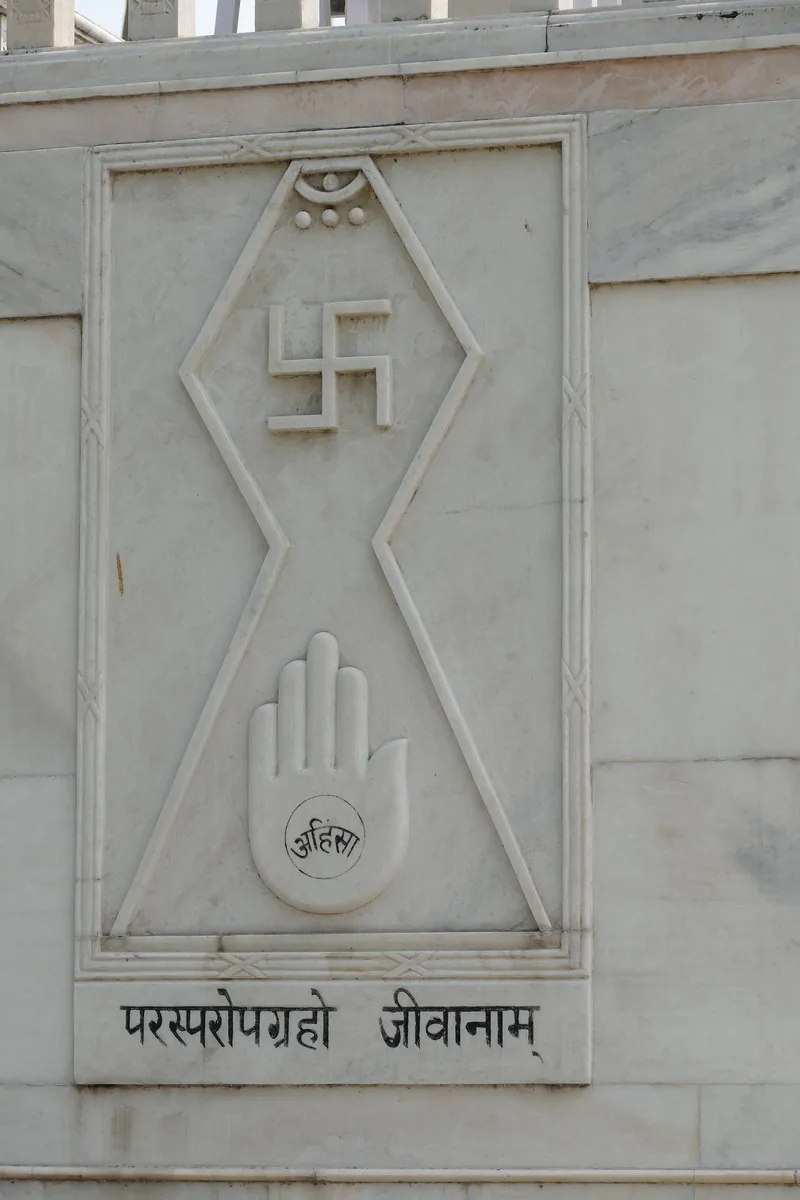
One short aphorism from the fifth chapter, parasparopagraho jivanam, "souls render service to one another", has acquired a life of its own. It was adopted as the motto of the common Jain emblem in 1974–75, during the commemoration of the 2,500th anniversary of Mahavira's liberation, and is widely quoted as a summary of Jain ecological and social ethics.
Commentaries in the Two Traditions§
The sutra's brevity made commentary essential, and the commentaries became central works of Jain philosophy:
- Bhashya — the commentary that Shvetambaras regard as Umasvati's own, the basis of later Shvetambara exegesis, including the large commentary of Siddhasenagani (eighth century).
- Sarvarthasiddhi — by the Digambara Pujyapada Devanandi (usually dated to the fifth or sixth century), the foundational Digambara commentary.
- Tattvarthavarttika (or Rajavarttika) — by Akalanka (eighth century), a major work of Jain logic and epistemology.
- Tattvarthashlokavarttika — by Vidyananda (ninth century), an extensive verse-commentary engaging with rival schools.
Because Digambara and Shvetambara versions of the text differ in some readings and in the number of aphorisms (roughly 344 against 357), and because each tradition reads it through its own commentaries, the Tattvartha Sutra both unites the traditions and records their differences. In the twentieth century the scholar Pandit Sukhlal Sanghvi wrote an influential modern commentary, and English translations were made by J. L. Jaini (1920) and, with the Bhashya and later commentaries, by Nathmal Tatia in That Which Is (1994).
The Tattvartha Sutra in Jain Life Today§
The Tattvartha Sutra is not only a philosophical classic but a devotional text. During Das Lakshana, the Digambara festival of ten virtues described in Paryushana and Jain Festivals, many communities read or expound one chapter on each of the ten days. A popular saying holds that reciting the ten chapters brings the merit of a fast. It is a standard text in Jain religious schools (pathshalas), in the training of monks and nuns of both traditions, and in university courses on Indian philosophy, and its framework underlies most modern introductions to Jain teaching, including Jain Teachings: Soul, Karma and Anekantavada.
Frequently asked questions§
Who wrote the Tattvartha Sutra?§
It is attributed to Umasvati (Umasvami in Digambara usage), a Jain teacher who probably lived between the second and fifth centuries CE. Both the Digambara and Shvetambara traditions claim him as one of their own.
Why is the Tattvartha Sutra important?§
It is the only Jain scripture accepted as authoritative by all sects. It summarises the entire Jain path in about 350 aphorisms and was the first Jain work in Sanskrit, the language of classical Indian philosophy.
What are the seven tattvas?§
They are soul (jiva), non-soul (ajiva), influx of karma (asrava), bondage (bandha), stoppage of karma (samvara), wearing away of karma (nirjara) and liberation (moksha). Together they explain how the soul is bound and how it is freed.
What does "parasparopagraho jivanam" mean?§
It means "souls render service to one another". This aphorism from the fifth chapter of the Tattvartha Sutra is the motto of the Jain emblem.
Sources and further reading§
- That Which Is: Tattvartha Sutra — Umasvati, 1994
- Tattvarthadhigama Sutra — Umasvati, 1920
- Reality: English Translation of Shri Pujyapada's Sarvarthasiddhi — S. A. Jain, 1960
- Harmless Souls: Karmic Bondage and Religious Change in Early Jainism with Special Reference to Umasvati and Kundakunda — W. J. Johnson, 1995
- The Jaina Path of Purification — Padmanabh S. Jaini, 1979
- The Doctrine of the Jainas — Walther Schubring, 1935