Liber XVIII · Jainism · Chapter III: Jain Cosmology
The Six Dravyas: Soul, Matter, Space and Time in Jainism
The six dravyas of Jainism explained: soul, matter, the media of motion and rest, space and time, with Jain atomism and the extended substances.

In Jain philosophy the universe is made of six eternal substances (dravyas): souls (jiva), matter (pudgala), the medium of motion (dharma), the medium of rest (adharma), space (akasha) and time (kala). None was created and none will ever be destroyed; their combinations and changes account for everything that exists, from the movement of atoms to the bondage and liberation of souls. The doctrine is set out systematically in Umasvati's Tattvartha Sutra and in the Digambara works of Kundakunda and Nemichandra.
What Is a Dravya? Substance, Quality and Mode§
The Tattvartha Sutra, discussed in The Tattvartha Sutra of Umasvati, defines a substance by existence itself: "existence is the mark of substance". It then defines existence in a characteristically Jain way: whatever exists is endowed with origination, destruction and permanence at the same time. A gold bracelet melted down and made into a necklace illustrates the point: one form is destroyed, another arises, and the gold persists throughout.
A substance therefore has two aspects. Its qualities (gunas) belong to it permanently — consciousness for the soul, touch, taste, smell and colour for matter. Its modes (paryayas) are the changing states those qualities take from moment to moment. This analysis lies at the heart of the Jain doctrine of many-sidedness, explained in Jain Teachings: Soul, Karma and Anekantavada. From the point of view of substance, the world is permanent; from the point of view of modes, it is constantly changing. Jain philosophers presented this as a middle position between the Buddhist teaching that everything is momentary and the view of some Brahmanical schools that true reality is unchanging.
The Six Substances at a Glance§
- Jiva (soul) — conscious, formless, infinite in number; the only substance capable of bondage and liberation.
- Pudgala (matter) — the only substance with form (murta): touch, taste, smell and colour; made of atoms.
- Dharma (medium of motion) — a single, formless substance pervading the inhabited universe that makes motion possible.
- Adharma (medium of rest) — a single, formless substance that makes rest possible.
- Akasha (space) — infinite space that gives room to all the other substances.
- Kala (time) — the condition of change and succession.
In this technical sense dharma and adharma have nothing to do with their ordinary meanings of religion or righteousness and their opposite. The list is summarised in the tenth-century Digambara primer Dravyasamgraha ("Compendium of Substances") of Nemichandra, a short verse work still used to teach Jain metaphysics.
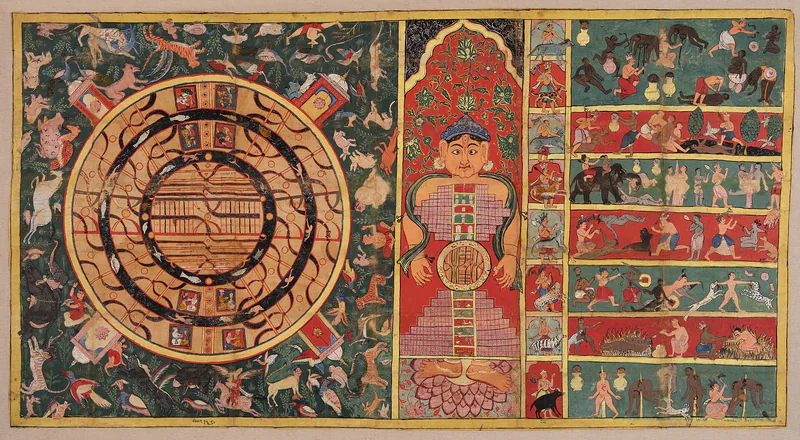
Jiva: The Infinite Souls§
The defining mark of the soul is upayoga, conscious attentiveness, which shows itself as knowing and perceiving. Souls are infinite in number, each fully individual. A soul has no fixed size: like the light of a lamp that fills a small or large room, it expands or contracts to fill the body it occupies, whether that of an elephant or an insect.
Embodied souls are classified by the number of their senses. The lowest are one-sensed beings, which have only touch: earth-bodies, water-bodies, fire-bodies, air-bodies and plants. Below even ordinary plants lie the nigoda, minute beings that share a common body and are born and die in vast numbers. Above them come mobile beings with two senses (such as worms), three senses (such as ants), four senses (such as bees) and five senses (animals, humans, gods and hell-beings), the last divided into those with and without a mind. This classification is the basis of Jain ethics: the duty of non-violence extends to every class of life, and the more senses a being has, the graver the harm of injuring it.
Liberated souls, the siddhas, have shed all matter. Freed from karmic weight they rise to the summit of the universe, where they remain eternally in omniscience and bliss.
Pudgala: Jain Atomism and Karmic Matter§
Matter is the substance with form. Its smallest unit is the atom (paramanu), indivisible, eternal and too fine to perceive, which has one taste, one smell, one colour and two kinds of touch. Atoms combine into aggregates (skandhas) through the qualities of smoothness and roughness: according to the Tattvartha Sutra, bonding occurs when these qualities differ by two degrees. Aggregates range from the subtlest to the grossest; sound, light, heat, shade and darkness are all regarded as modes of matter. Jains, unlike the Nyaya and Vaisheshika schools, therefore treated sound as material rather than as a quality of space.
The most distinctive feature of Jain atomism is that karma is matter. The universe is filled with fine particles of karmic matter, which are drawn to the soul by its activity of body, speech and mind, and fixed there by the passions of anger, pride, deceit and greed. This material karma obscures the soul's innate knowledge, perception, energy and bliss. Liberation is the complete separation of soul from matter, achieved by stopping the influx of new karma and wearing away the old through austerity. Classical sources distinguish groups (vargana) of matter suited to forming bodies, speech, mind and karma.
Dharma, Adharma and Space: The Frame of the Universe§
Jain thinkers asked why things move and why they come to rest, and why the inhabited universe has limits. Their answer was two substances found in no other Indian school. Dharma is the condition of motion: it does not cause anything to move but makes motion possible, as water allows a fish to swim. Adharma is the condition of rest, as the shade of a tree allows a tired traveller to stop. Both are single, continuous and formless.
Space (akasha) is infinite. The part of space in which dharma and adharma are present, and in which souls and matter can therefore move and remain, is the lokakasha, the space of the universe, whose shape is described in Jain Cosmology. Beyond it lies alokakasha, empty space without end, into which nothing can pass. This is why the liberated soul, rising upward by its own nature, stops at the top of the universe: the medium of motion ends there. The theory thus joins physics, cosmology and soteriology in a single system.
Time and the Extended Substances§
Five of the six substances are called astikaya, "having extension" or literally "existent bodies", because they occupy many spatial units (pradeshas): souls, matter, dharma, adharma and space. Dharma, adharma and each individual soul have an innumerable but finite number of spatial units, equal to those of the universe — which is why, in Jain teaching, the soul of an omniscient being can momentarily expand to fill the entire cosmos before liberation. Space has an infinite number. Kundakunda's Panchastikayasara is devoted to these five.
Time is the exception. In the Digambara view it is a true substance made of countless separate time-atoms (kalanu), one at every point of the universe, which never combine and so do not form an extended body; their function is to make change and succession possible. Conventional time — moments, hours, days and the great cycles of ages — is measured on this basis. In the Tattvartha Sutra as read by Shvetambaras, however, time is introduced with the phrase "according to some", and several Shvetambara thinkers treated it as a mode of the other substances rather than an independent one. The difference is a good example of debate within a shared framework.
The Dravyas in Comparison and in Modern Jain Thought§
The Jain list of substances invites comparison with the categories of the Vaisheshika school, which also counts atoms, space, time and souls among its substances, and with the twenty-five principles of Samkhya, both described in The Six Schools of Hindu Philosophy. Distinctive to Jainism are the material nature of karma, the variable size of the soul, the media of motion and rest, and the insistence that every substance is both permanent and changing.
In the twentieth century many Jain authors compared dharma to the ether of nineteenth-century physics or to physical fields, and Jain atomism to modern atomic theory. Historians of philosophy generally treat these as modern apologetic comparisons rather than as evidence that ancient Jains anticipated modern science; the Jain system was built to answer different questions, above all how a conscious soul becomes bound to matter and how it can be freed.
Frequently asked questions§
What are the six dravyas in Jainism?§
They are soul (jiva), matter (pudgala), the medium of motion (dharma), the medium of rest (adharma), space (akasha) and time (kala). Jains hold that these six eternal substances make up the whole universe.
What is pudgala in Jainism?§
Pudgala is matter, the only substance with sensible qualities such as colour and touch. It consists of indivisible atoms, and Jains regard karma itself as a subtle form of pudgala that binds the soul.
What do dharma and adharma mean in Jain metaphysics?§
In this technical sense they are formless substances that make motion and rest possible. They fill only the inhabited universe, which is why nothing — not even a liberated soul — can move beyond its upper limit.
Is time a substance in Jainism?§
Digambaras regard time as a true substance composed of time-atoms. Some Shvetambara thinkers held that time is not an independent substance but an aspect of the others.
Sources and further reading§
- That Which Is: Tattvartha Sutra — Umasvati, 1994
- Dravya-samgraha — Nemichandra, 1917
- Jaina Theories of Reality and Knowledge — Y. J. Padmarajiah, 1963
- Studies in Jaina Philosophy — Nathmal Tatia, 1951
- The Doctrine of the Jainas — Walther Schubring, 1935
- The Jaina Path of Purification — Padmanabh S. Jaini, 1979