Liber XVIII · Jainism · Chapter IV: Jain Teachings
Jain Teachings: Soul, Karma and Many-Sidedness (Anekantavada)
Jain teachings explained: the soul (jiva) and matter, karma as subtle particles, the seven tattvas, the three jewels and the doctrine of anekantavada.

Jain teachings centre on the eternal soul (jiva), its bondage by karma — understood as a fine form of matter that adheres to the soul — and its liberation through the "three jewels" of right faith, right knowledge and right conduct. Jain philosophy also developed a distinctive theory of knowledge, anekantavada or "many-sidedness," which holds that reality is complex and that every statement about it is true only from a particular standpoint.
Jain Scriptures and the Tattvartha Sutra§
The teachings of Mahavira, as remembered by his disciples, were transmitted orally for centuries. The Shvetambara tradition preserves a canon of texts called the Agamas, edited at a council at Valabhi in Gujarat in the fifth century CE; the Acaranga Sutra and Sutrakritanga are among the oldest. Digambaras hold that the original canon was lost and give scriptural authority to other works, such as the Shatkhandagama and the treatises of Kundakunda, discussed in Digambara and Shvetambara Jainism.
The one text accepted by both traditions is the Tattvartha Sutra ("Treatise on the Nature of Reality") by Umasvati, also called Umasvami, a concise summary of Jain doctrine in Sanskrit aphorisms. Its date is uncertain, with scholars proposing anywhere from the second to the fifth century CE. Its first aphorism states that right faith, right knowledge and right conduct together constitute the path to liberation, and its ten chapters provide the framework followed in this article.
Jiva and Ajiva: Soul and Non-Soul§
Jain metaphysics is realist and dualist. The universe consists of six eternal substances (dravyas): souls (jiva) and five non-living substances (ajiva) — matter (pudgala), the medium of motion (dharma), the medium of rest (adharma), space (akasha) and time (kala). The terms dharma and adharma here have a technical meaning quite different from their ethical sense in Hinduism and Buddhism.

There are infinitely many souls, each an individual that is eternal and uncreated. A soul's nature is consciousness, expressed as infinite knowledge, perception, bliss and energy. Souls take the size of the body they inhabit, expanding and contracting like the light of a lamp in a large or small room. They are found everywhere: not only in humans and animals but in plants, in water, fire, air and earth, and in the minute beings called nigoda that fill the universe. Living beings are ranked by the number of their senses, from one to five, a classification that underlies Jain ethics, as explained in Ahimsa and the Jain Vows.
The Jain Theory of Karma§
Karma as matter§
In most Indian traditions karma means action and its consequences. In Jainism it is also a substance: an extremely fine kind of matter that pervades the universe. When the soul acts, through body, speech or mind, and especially when it is moved by the passions (kashayas) of anger, pride, deceit and greed, karmic particles flow into it and bind to it, as dust sticks to an oiled surface. The intensity of the passion determines how long the karma stays and how strongly it will take effect. Jain texts also describe leshyas, "colourings" of the soul ranging from black to white, which reflect its moral state.
The eight types of karma§
Karma is divided into eight main types. Four are called "destructive" (ghatiya) because they obscure the soul's essential qualities: karma that obscures knowledge, karma that obscures perception, deluding karma, which produces false belief and the passions, and obstructive karma, which hinders energy and generosity. Four are "non-destructive" (aghatiya): they determine the feelings of pleasure and pain, the length of life, the kind of body and the family or status into which one is born. When the four destructive karmas are eliminated, the soul becomes omniscient; when the remaining four exhaust themselves at death, it is fully liberated.
The Tattvas: The Path from Bondage to Liberation§
The Tattvartha Sutra lists seven tattvas, "realities" or principles, that explain the soul's predicament and its escape. Shvetambara tradition often adds two more, merit (punya) and demerit (papa), to make nine.
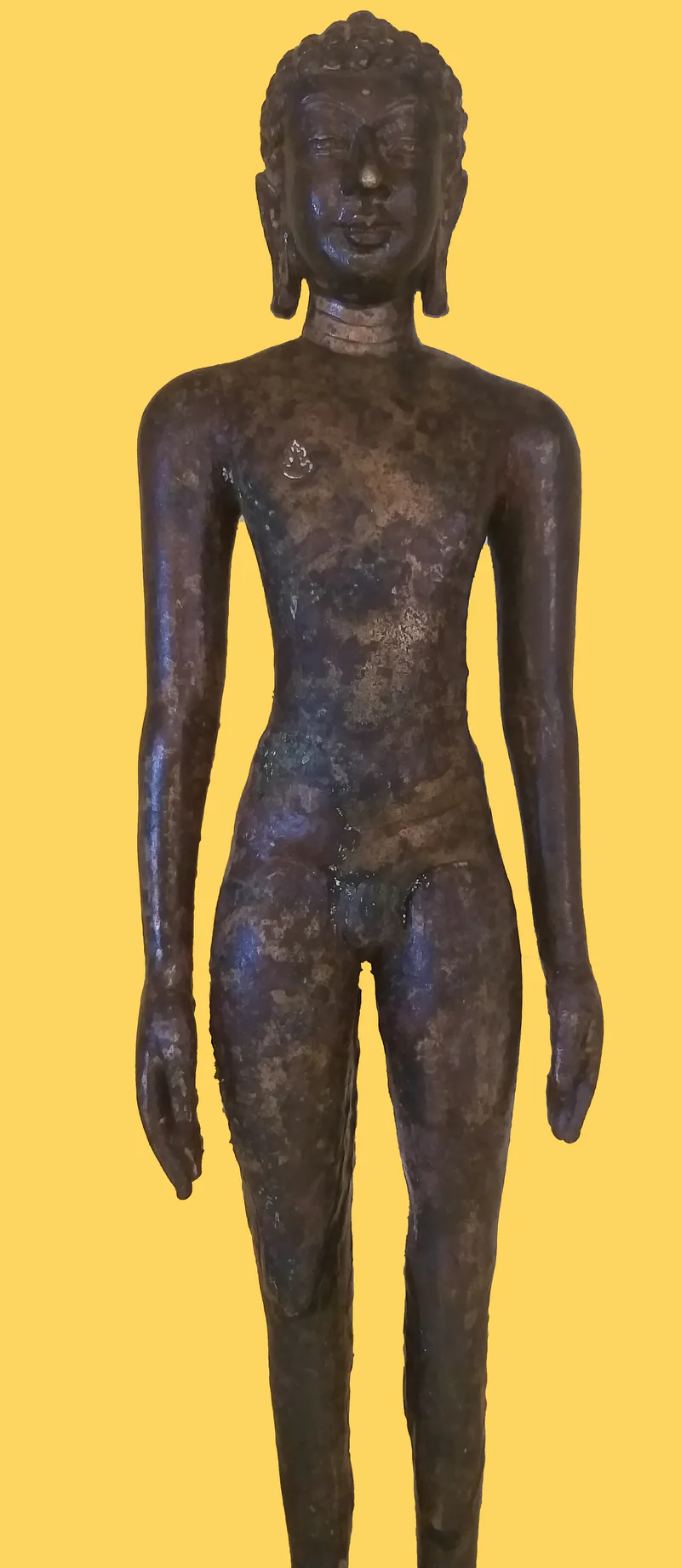
- Jiva — the soul.
- Ajiva — the non-living.
- Asrava — the influx of karma into the soul.
- Bandha — the binding of karma to the soul.
- Samvara — the stopping of influx, through vows, vigilance and self-control.
- Nirjara — the shedding of karma already bound, above all through austerity (tapas).
- Moksha — liberation, when all karma is gone.
This scheme gives Jain practice its logic. Restraint (samvara) closes the door to new karma; fasting, meditation, study, service and other internal and external austerities wear away old karma (nirjara). Jain thinkers mapped the soul's progress in fourteen gunasthanas, "stages of quality," from the deepest delusion to omniscience and the final instant before liberation. At death a fully liberated soul rises by its natural upward motion to the top of the universe, as described in Jain Cosmology.
The Three Jewels: Right Faith, Knowledge and Conduct§
The path to liberation consists of three inseparable elements, the ratnatraya or "three jewels":
- Right faith or insight (samyak darshana) — conviction in the truth of the tattvas as taught by the Jinas, and the turning point at which the soul begins its real progress.
- Right knowledge (samyak jnana) — accurate understanding of reality. Jains distinguish five kinds of knowledge: sensory, scriptural, clairvoyant, telepathic and omniscient (kevala), the last being the knowledge of all things, past, present and future, possessed by the Jinas.
- Right conduct (samyak charitra) — living according to the vows, culminating in the complete renunciation of the ascetic.
Jain teachers insist that conduct without insight is blind, and insight without conduct ineffective. The figure of the omniscient Tirthankara who embodies all three is described in Mahavira and the 24 Tirthankaras.
Anekantavada: The Doctrine of Many-Sidedness§
Standpoints and sevenfold predication§
Because only an omniscient being sees reality in all its aspects, Jain philosophers argued that ordinary statements are partial. Anekantavada, "the doctrine of non-one-sidedness," holds that things have innumerable attributes, some apparently contradictory: a pot is permanent as clay and impermanent as a particular shape. Nayavada, the theory of standpoints, classifies the viewpoints from which statements are made. Syadvada, the doctrine of "maybe" or "in some respect," qualifies each assertion with the word syat, and its sevenfold predication (saptabhangi) lists the possible combinations: in some respect a thing is; is not; is and is not; is inexpressible; is and is inexpressible; is not and is inexpressible; is, is not and is inexpressible.
The blind men and the elephant§
Jain authors often illustrated the idea with the parable of blind men who touch different parts of an elephant and each describe the whole animal wrongly — a story found also in Buddhist and Hindu sources. In debate, anekantavada allowed Jain philosophers such as Siddhasena Divakara, Samantabhadra, Haribhadra and Hemachandra to argue that rival schools each grasped one aspect of the truth while mistaking it for the whole. In modern times it has often been presented as an intellectual form of ahimsa and a basis for religious tolerance, though some scholars caution that classical Jain thinkers used it primarily to defend their own position rather than to relativise all views.
Frequently asked questions§
What is the Jain view of karma?§
Jains see karma as subtle matter that binds to the soul when it acts with passion. This karmic matter obscures the soul's knowledge, perception, bliss and energy and causes rebirth until it is stopped by restraint and removed by austerity.
What are the three jewels of Jainism?§
They are right faith (or insight), right knowledge and right conduct. Together they form the path to liberation set out in the opening aphorism of the Tattvartha Sutra.
What does anekantavada mean?§
It means "non-one-sidedness" or "many-sidedness." The doctrine holds that reality has many aspects and that any statement about it is true only from a certain standpoint, so that rival views may each contain part of the truth.
Sources and further reading§
- That Which Is: Tattvartha Sutra — Umasvati, 1994
- The Jaina Path of Purification — Padmanabh S. Jaini, 1979
- The Doctrine of the Jainas — Walther Schubring, 1935
- The Jains — Paul Dundas, 1992
- Jainism: An Introduction — Jeffery D. Long, 2009