Liber XVIII · Jainism · Chapter V: Mahavira & the Tirthankaras
Mahavira and the 24 Tirthankaras: The Ford-Makers of Jainism
Mahavira and the 24 Tirthankaras: the meaning of ford-maker, the lives of Rishabha, Neminatha, Parshva and Mahavira, and the five auspicious events.

The Tirthankaras are the twenty-four great teachers of Jainism who, in each half-cycle of cosmic time, conquer their passions, attain omniscience and establish the fourfold community of monks, nuns, laymen and laywomen. The name means "ford-maker": a Tirthankara builds a crossing over the river of rebirth. In the present age the first was Rishabha and the last was Mahavira, the historical teacher who lived in north-eastern India around the sixth or fifth century BCE and gave Jainism its present form.
What Is a Tirthankara?§
In Jain belief a Tirthankara is not a god, an avatar or a messenger from heaven. He is a human soul that, through many lifetimes of discipline, has bound a special karma that makes it a teacher, and that in its final life destroys the karmas obscuring knowledge and perception, becoming omniscient. Such a being is called a jina, "conqueror," from which the word Jain derives: a Jain is a follower of the Jinas. Not every omniscient being is a Tirthankara; many attain liberation without founding a community. The Tirthankara is distinguished by teaching in a divine assembly hall, the samavasarana, built by the gods, where humans, gods and animals all hear the sermon, and by re-establishing the fourfold Jain community.
After death the Tirthankara becomes a siddha, a liberated soul at the summit of the universe, no longer involved in worldly affairs. This is why, as explained in What Is Jainism?, Jain worship of Tirthankara images is understood not as a request for favours but as veneration of an ideal. Jain cosmology also holds that Tirthankaras are teaching now in other regions of the universe; one of them, Simandhar Svami, is the focus of a popular modern devotion.
The Five Auspicious Events§
The life of every Tirthankara follows the same pattern of five kalyanakas, "auspicious events," at which the gods descend to celebrate:
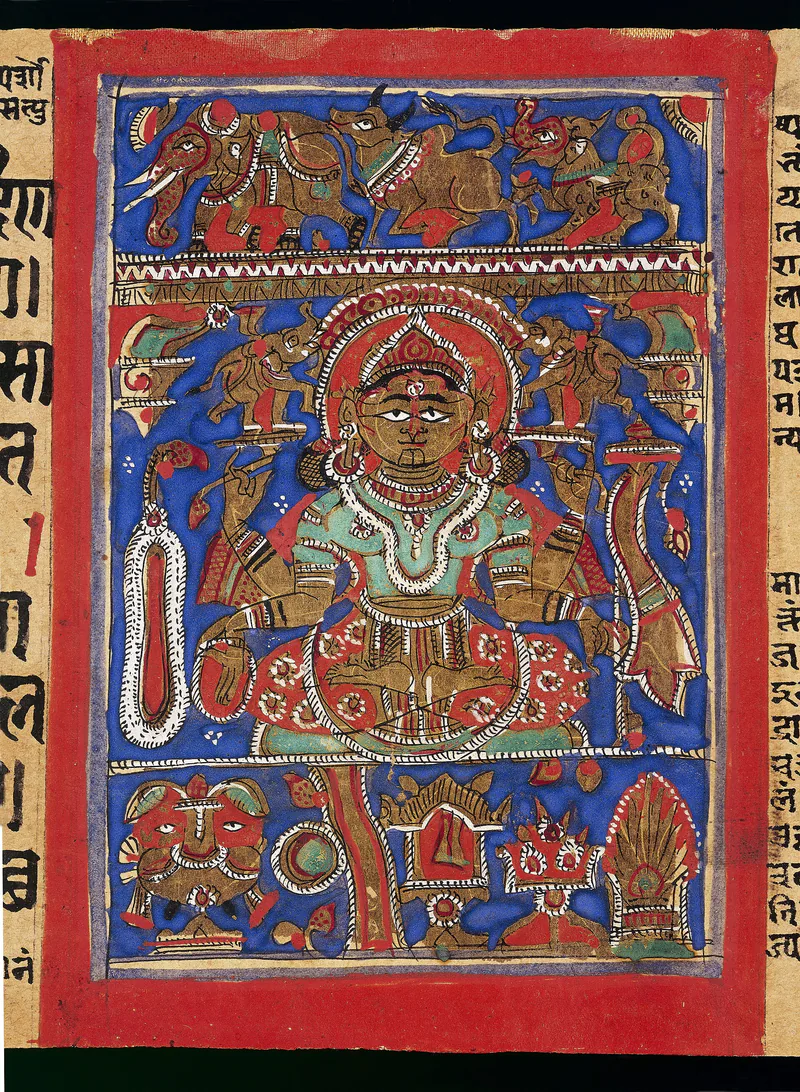
- Conception (chyavana or garbha), announced to the mother by a series of auspicious dreams — fourteen in Shvetambara tradition, sixteen in Digambara — such as an elephant, a bull, a lion, the goddess Lakshmi, the full moon and the sun.
- Birth (janma), after which the god Indra carries the infant to Mount Meru to be bathed, an event re-enacted in temple ritual.
- Renunciation (diksha), when the future Tirthankara abandons home and possessions and pulls out his hair.
- Omniscience (kevala jnana), attained after a period of austerity and meditation.
- Liberation (nirvana or moksha), at death.
The places of these events are among the most important Jain pilgrimage sites, as described in Jain Temples and Pilgrimage.
The Twenty-Four Tirthankaras of the Present Age§
The twenty-four Tirthankaras of our half-cycle, in order, are: Rishabha (Adinatha), Ajita, Sambhava, Abhinandana, Sumati, Padmaprabha, Suparshva, Chandraprabha, Pushpadanta (Suvidhi), Shitala, Shreyamsa, Vasupujya, Vimala, Ananta, Dharma, Shanti, Kunthu, Ara, Malli, Munisuvrata, Nami, Nemi (Arishtanemi), Parshva and Mahavira (Vardhamana). The suffix -natha, "lord," is often added, as in Shantinatha or Parshvanatha.
In sculpture the Tirthankaras look almost identical — seated in meditation or standing upright in the posture of "abandoning the body" (kayotsarga) — because they represent the same perfected state. They are identified by emblems on the pedestal: a bull for Rishabha, a deer for Shanti, a conch for Nemi, a snake for Parshva and a lion for Mahavira, among others. Parshva is usually shown sheltered by a many-hooded serpent, and Rishabha often with locks of hair falling on his shoulders. The two sects differ on some details: Shvetambaras hold that the nineteenth Tirthankara, Malli, was a woman, while Digambaras, who teach that a woman cannot attain liberation without rebirth as a man, regard Malli as male (see Digambara and Shvetambara Jainism).
Rishabha, the first Tirthankara§
Rishabha lived, according to tradition, in an age of immense antiquity when humans first needed laws and skills. Jain texts credit him with teaching agriculture, crafts, writing and the arts of civilisation before renouncing the world. His sons include Bharata, the first universal emperor, after whom tradition names India (Bharata), and Bahubali, whose colossal image stands at Shravanabelagola in Karnataka. Rishabha attained liberation on Mount Ashtapada. He also appears in Hindu tradition: the Bhagavata Purana counts a Rishabha among the incarnations of Vishnu.
Neminatha and Parshva§
Neminatha, the twenty-second Tirthankara, is in Jain tradition a cousin of Krishna. On his way to his wedding with the princess Rajimati he saw animals penned up to be slaughtered for the feast; moved by compassion, he renounced the world, and Rajimati later became a nun. He attained liberation on Mount Girnar in Gujarat.
Parshva, the twenty-third, was a prince of Varanasi whose traditional dates are 877–777 BCE, placing him about 250 years before Mahavira. Many historians accept that he was a real teacher, as early texts mention followers of Parshva who met Mahavira's disciples. His teaching is remembered as a fourfold restraint — not to harm, lie, steal or possess — to which Mahavira is said to have added chastity as a separate vow. Stories tell how the serpent king Dharanendra and his consort Padmavati sheltered Parshva during a storm sent by an enemy, which explains the serpent canopy in his images.
The Life of Mahavira§
Birth and renunciation§
Vardhamana, later called Mahavira, was born at Kundagrama near Vaishali in present-day Bihar, son of Siddhartha, a chief of the Jnatrika clan, and Trishala. Jain tradition gives 599 BCE for his birth and 527 BCE for his liberation; many scholars place his life several decades later, and the question remains open. Buddhist texts refer to him as Nigantha Nataputta, the "unbound one of the Jnatrika clan," one of the rival teachers of the Buddha's time.
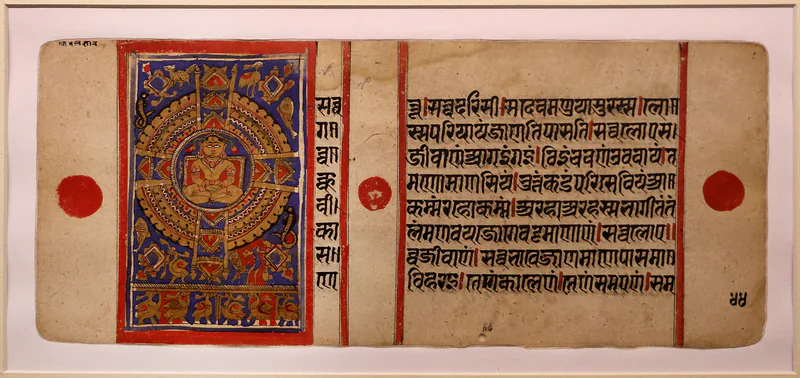
The two Jain traditions tell his early life differently. Shvetambara sources, notably the Kalpa Sutra, relate that he was first conceived in the womb of a Brahmin woman, Devananda, and transferred by a divine general to the womb of the Kshatriya queen Trishala; that he married Yashoda and had a daughter; and that he renounced the world at thirty after his parents' death. Digambaras reject the embryo transfer and hold that he never married.
Austerity and omniscience§
For twelve and a half years Mahavira wandered as a naked ascetic through eastern India, fasting, meditating and enduring hardship and abuse; the Acaranga Sutra, one of the oldest Jain texts, describes these austerities in vivid terms. For some years he was accompanied by Gosala, who later led the rival Ajivika movement. At the age of forty-two, meditating under a sal tree by the river Rijupalika, he attained omniscience.
Teaching and liberation§
Mahavira's first great converts were eleven learned Brahmins, led by Indrabhuti Gautama, who became his chief disciples (ganadharas). For about thirty years he taught across Magadha and neighbouring kingdoms, organising monks, nuns and lay followers. He attained liberation at Pava (Pavapuri) in Bihar at the age of seventy-two. Jains celebrate this event at Diwali, lighting lamps to replace the light of knowledge that departed with him, and his birth at Mahavir Jayanti. His teachings, transmitted through his disciple Sudharman, form the basis of the doctrines described in Jain Teachings.
The Tirthankaras in Jain Worship and Art§
The Tirthankaras are the focus of Jain temple worship, hymns and pilgrimage. Manuscripts of the Kalpa Sutra, richly illustrated in western India from the fourteenth century onwards, depict the mother's dreams, the bathing on Mount Meru and the samavasarana. Shvetambara communities recite the Kalpa Sutra during the festival of Paryushana. Stone images from Mathura in the early centuries CE are among the earliest surviving Jain sculpture, and the cosmological setting of the Tirthankaras' appearance in each age is described in Jain Cosmology.
Frequently asked questions§
What does Tirthankara mean?§
It means "ford-maker," one who creates a tirtha, a crossing place, over the ocean of rebirth. The term also refers to the fourfold community of monks, nuns, laymen and laywomen that each Tirthankara establishes.
Was Mahavira the founder of Jainism?§
Jains see Mahavira as the last of twenty-four Tirthankaras in this age, not as the founder of a new religion. Historians agree that he reorganised an existing ascetic tradition associated with Parshva and gave Jainism its classical shape.
When did Mahavira live?§
Jain tradition dates his life to 599–527 BCE. Many modern scholars prefer a later date, placing his death in the fifth century BCE, and the precise chronology remains debated.
Are the Tirthankaras gods?§
No. They were human beings who achieved omniscience and liberation by their own efforts. Jains worship them as perfect models, but they are believed to be beyond any involvement in the world.
Sources and further reading§
- Jaina Sutras — Hermann Jacobi (trans.), 1884
- The Jains — Paul Dundas, 1992
- The Jaina Path of Purification — Padmanabh S. Jaini, 1979
- The Lives of the Jain Elders — Hemacandra, 1998
- Jaina Iconography — Jyotindra Jain & Eberhard Fischer, 1978