Liber XVIII · Jainism · Chapter V: Mahavira & the Tirthankaras
Rishabhanatha (Adinatha): The First Tirthankara of Jainism
Rishabhanatha (Adinatha), the first Jain Tirthankara: his life as king and civiliser, the first alms, Akshaya Tritiya, Mount Ashtapada and his temples.

Rishabhanatha, also called Rishabhadeva or Adinatha ("the first lord"), is the first of the twenty-four Tirthankaras of the present cosmic age in Jainism. Jain tradition remembers him as the king who taught humanity agriculture, writing and the crafts at the end of a golden age, and then as the first ascetic, the first to attain omniscience and the first to preach the Jain path in this half of the time cycle. Historians regard him as a figure of sacred narrative rather than of documented history, but he is among the most widely worshipped of all Tirthankaras.
Rishabha in the Jain Wheel of Time§
Jains understand time as an endless series of rising and falling half-cycles, described in Jain Cosmology. In each half-cycle twenty-four Tirthankaras ("ford-makers") appear to re-establish the path to liberation. Rishabha belongs to the end of the third of the six spokes (aras) of the current descending half. In the earlier spokes, according to the tradition, human beings lived as twins of enormous size and lifespan, without need of work, laws or religion, because wish-fulfilling trees (kalpavriksha) gave them food, clothing and shelter.
As the age declined, the trees began to fail and conflict appeared. A series of patriarchs, the kulakaras, introduced the first rules to restrain disputes. The last of them, Nabhi, was Rishabha's father. Rishabha's place at this turning point gives his story a particular character: he is not only a spiritual teacher, as later Tirthankaras are, but the founder of civilisation itself. The general pattern of a Tirthankara's career is explained in Mahavira and the 24 Tirthankaras.
The Life of Rishabhanatha: King and Civiliser§
Birth and family§
Rishabha was born, the tradition says, in Ayodhya (also called Vinita) to Nabhi and Queen Marudevi, who saw a series of auspicious dreams before his birth. The first dream in many accounts is of a white bull, the source of his name and emblem. He married two wives, usually named Sumangala and Sunanda. By them he had a hundred sons, among them Bharata and Bahubali, and two daughters, Brahmi and Sundari.
Teaching the arts of civilisation§
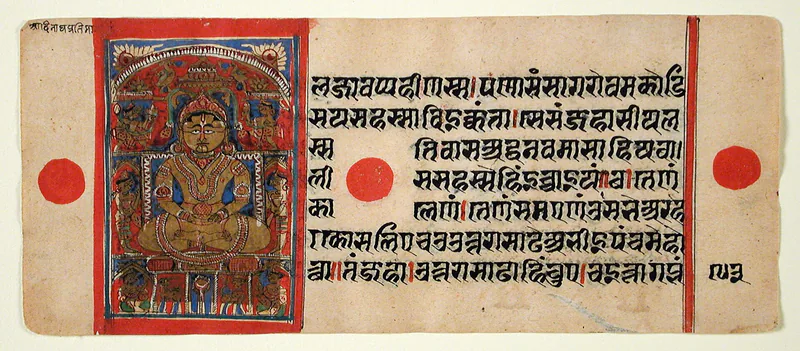
The Jain biographies, most fully the Sanskrit Adishvaracharita that opens Hemachandra's twelfth-century Trishashtishalakapurushacharitra ("Lives of the Sixty-Three Illustrious Persons") and the Digambara Adipurana of Jinasena (ninth century), describe Rishabha as the first king, consecrated by the god Indra. He divided society into occupational groups, taught people to cook, to farm and to build, and introduced trade, pottery, weaving and the arts of government. A familiar Jain summary is the triad asi, masi, krishi — the sword, the ink and the plough — standing for defence, writing and agriculture.
He is also remembered as the teacher of learning. He taught the script called Brahmi to his daughter Brahmi, which is why Jain tradition associates the name of India's ancient script with her, and he taught arithmetic to Sundari. The seventy-two arts for men and sixty-four arts for women, standard lists in Indian literature, are traced to his instruction. For Jains, worldly order is thus itself a gift of the first Tirthankara, given before he showed the way to leave the world.
Renunciation, the First Alms and Akshaya Tritiya§
After a long reign, Rishabha decided to renounce. He divided his kingdom among his sons, giving Ayodhya to Bharata and Takshashila (or Podanapura, in Digambara accounts) to Bahubali, and took initiation as a wandering ascetic. Jain tradition says that he plucked out his hair in four handfuls rather than the usual five, leaving locks falling to his shoulders at the request of Indra. These shoulder-length locks became his chief identifying feature in sculpture.
Because no one in that age had ever seen a mendicant, people did not know how to give alms. They offered the naked ascetic jewels, horses, elephants and daughters in marriage, but nothing he could accept. Rishabha therefore went without food for about a year. The fast ended when Prince Shreyamsa of Hastinapura, recognising from a memory of a former life how an ascetic should be fed, offered him sugar-cane juice, which Rishabha received in his cupped hands.
This event is the origin of the Jain observance of Akshaya Tritiya, the third day of the bright half of the month of Vaishakha (April–May), discussed among the Jain festivals. Many Shvetambara Jains undertake the varshitap, a year of alternate-day fasting in imitation of Rishabha, and break it on Akshaya Tritiya with sugar-cane juice, often at Palitana in Gujarat or Hastinapur near Delhi. The story also gave the Jain community its model of the ideal gift: pure, freely given food offered to a worthy ascetic.
Omniscience and Liberation on Mount Ashtapada§
After a long period of austerity Rishabha attained kevala jnana, omniscient knowledge, under a banyan tree near Purimatala, a place later identified with Prayag (Prayagraj). The gods built a samavasarana, the circular assembly hall in which a Tirthankara preaches to gods, humans and animals, and he established the fourfold community of monks, nuns, laymen and laywomen. His daughters Brahmi and Sundari became nuns, and in Shvetambara tradition Brahmi led the order of nuns.
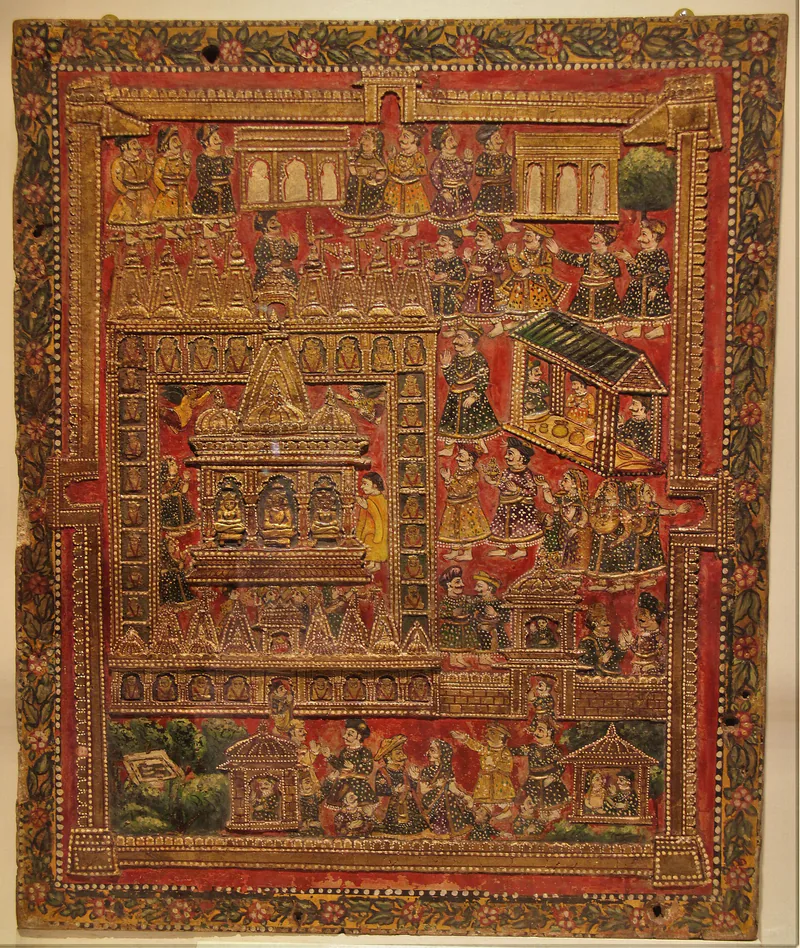
Shvetambara narratives add a striking episode about his mother. Marudevi, who had grieved for her son through the years of his austerity, went on an elephant to see him in his glory. On seeing the samavasarana she understood the nature of attachment, attained omniscience and was liberated on the spot, becoming the first soul of this age to reach liberation. Digambaras, who hold that a woman must be reborn as a man before liberation, do not accept this account, a difference explained in Digambara and Shvetambara Jainism.
Rishabha's son Bharata became the first chakravartin, or universal emperor, of the age, and Jain tradition (in agreement with several Puranic sources) holds that India, Bharatavarsha, is named after him. His conflict with his brother Bahubali is told in Bahubali and the Gommateshvara Statue. Rishabha himself attained final liberation (nirvana) on Mount Ashtapada, which many Jains identify with Mount Kailash in the Himalaya. Bharata is said to have built there a jewelled temple containing images of all twenty-four Tirthankaras, a shrine that later artists and temple builders often recreated in miniature.
Rishabha in Hindu Sources and the Question of History§
Rishabha is unusual among the Tirthankaras in also appearing in Hindu literature. The fifth book of the Bhagavata Purana tells of Rishabha, son of King Nabhi and Merudevi, a partial incarnation of Vishnu who handed his kingdom to his son Bharata and became a naked, silent wanderer indifferent to his body. The text adds that his conduct was later imitated by a heretical king, which many scholars read as an attempt to absorb or explain the Jain tradition from a Vaishnava point of view. Other Puranas mention Rishabha and Bharata in their genealogies of kings. The Puranas thus preserve a parallel memory of the same figure.
Some Jain writers have argued that Rishabha can be found in the Vedas, where the word vrishabha ("bull") occurs often, or in a naked standing figure on seals from the Indus civilisation. Most historians find these identifications unconvincing: the Vedic word is common and usually refers to bulls or gods, and the Indus images are open to many readings. The scholarly consensus is that the first twenty-two Tirthankaras belong to sacred history, that Parshva may have been a historical teacher of the eighth or seventh century BCE, and that Parshvanatha and Mahavira are the earliest figures for whom historical evidence exists. For Jains themselves, Rishabha's antiquity expresses a central conviction: that their religion is eternal and was not founded by any one teacher, but is rediscovered and proclaimed anew in each cycle of time.
Iconography and the Great Temples of Adinatha§
Images of Rishabha follow the standard forms of Tirthankara icons: seated in meditation (padmasana) or standing in the posture of abandoning the body (kayotsarga). He is distinguished by the bull emblem (lanchana) on the pedestal and, in many images, by locks of hair falling on his shoulders. His attendant yaksha is Gomukha ("cow-faced") and his yakshi is Chakreshvari, a goddess bearing discuses, who became one of the most widely worshipped Jain goddesses, as described in Jain Gods and Goddesses. Early images of Rishabha are known from Kushan-period Mathura in the first centuries CE.
Many of the greatest Jain temples are dedicated to him:
- Shatrunjaya (Palitana), Gujarat — the main temple on the summit honours Adishvara, and tradition says Rishabha visited the mountain many times. It is the foremost Shvetambara pilgrimage site, described in Jain Temples and Pilgrimage.
- Vimala Vasahi, Mount Abu — the marble temple built in 1031 by Vimala, a minister of the Chaulukya king Bhima I, is dedicated to Adinatha.
- Ranakpur, Rajasthan — the fifteenth-century four-faced (chaumukha) temple founded by the merchant Dharna Shah enshrines four images of Adinatha facing the four directions.
- Gopachal, Gwalior — rock-cut colossi of the fifteenth century include a standing Adinatha some 17 metres high.
- Bawangaja, Madhya Pradesh — a colossal rock-cut standing image, usually dated to the twelfth century.
- Mangi-Tungi, Maharashtra — a 108-foot standing image of Rishabha, consecrated in 2016 and known as the Statue of Ahimsa.
Frequently asked questions§
Who was the first Tirthankara in Jainism?§
Rishabhanatha, also called Rishabhadeva or Adinatha, is the first Tirthankara of the present cosmic age. Jains believe he lived at the end of a golden age, taught the arts of civilisation and was the first to proclaim the Jain path in this half-cycle of time.
What is the symbol of Rishabhanatha?§
His emblem is the bull, shown on the pedestal of his images. Sculptors also often show him with locks of hair falling to his shoulders, recalling the tradition that he left some hair unplucked when he renounced the world.
Why is Akshaya Tritiya important to Jains?§
It commemorates the day Rishabha broke his first year-long fast when Prince Shreyamsa offered him sugar-cane juice. Many Jains complete a year of alternate-day fasting, the varshitap, on this date.
Is Rishabhanatha mentioned in Hindu texts?§
Yes. The Bhagavata Purana describes a Rishabha, son of Nabhi, who renounced his kingdom and lived as a naked ascetic, and treats him as a partial incarnation of Vishnu. Scholars generally see this as a Hindu retelling of a figure shared with the Jain tradition.
Sources and further reading§
- The Lives of Sixty-Three Illustrious Persons, Volume I: Adisvaracaritra — Hemacandra, 1931
- Jaina Sutras — Hermann Jacobi, 1884
- The Jains — Paul Dundas, 1992
- The Jaina Path of Purification — Padmanabh S. Jaini, 1979
- Jaina Iconography — Jyotindra Jain & Eberhard Fischer, 1978
- The Peaceful Liberators: Jain Art from India — Pratapaditya Pal, 1994