Liber XIV · Hinduism · Chapter V: The Puranas
The Puranas: Hindu Mythology, Cosmology and Sacred History
The Puranas explained: the eighteen great Puranas and their dating, the myths of Vishnu, Shiva and the Goddess, the four yugas and Hindu cosmology.

The Puranas, "ancient lore," are a large body of Sanskrit texts, composed and expanded mainly between the fourth century CE and the middle of the second millennium, that tell the myths of the Hindu gods, describe the creation and destruction of the universe, record the genealogies of gods, sages and kings, and prescribe worship, vows and pilgrimage. Eighteen "great" Puranas are traditionally recognised, and together with the epics they are the main source of the stories of Vishnu, Shiva, the Goddess and their devotees that Hindus know and tell today.
What Is a Purana? Definition and Character§
The word purana means "old" and, as a noun, an ancient narrative. Like the epics, the Puranas are smriti, remembered tradition, but they present themselves as a fifth Veda for those who could not hear the Veda itself, including women and Shudras. The Bhagavata Purana calls itself the ripened fruit of the wish-fulfilling tree of the Veda. They were originally the repertoire of bards (sutas) and were later reshaped by Brahmin authors, and their usual frame is a recitation by a bard to an assembly of sages in the Naimisha forest.
A widely quoted definition gives a Purana five marks (pancha-lakshana): primary creation (sarga), secondary creation after a dissolution (pratisarga), genealogies of gods and sages (vamsha), the cosmic periods ruled by successive Manus (manvantara), and the histories of royal dynasties (vamshanucharita). Few Puranas keep to this pattern. Most are encyclopaedic, covering theology, ritual, temple building, vows (vrata), the merits of holy places (mahatmya), rites for the dead, law, medicine, astrology and even grammar and poetics. Their style is narrative and conversational, and their purpose is to teach dharma and devotion through stories.
The Eighteen Great Puranas and Their Dating§
Lists vary slightly, but the eighteen mahapuranas are usually named as the Brahma, Padma, Vishnu, Shiva (sometimes replaced by the Vayu), Bhagavata, Naradiya, Markandeya, Agni, Bhavishya, Brahmavaivarta, Linga, Varaha, Skanda, Vamana, Kurma, Matsya, Garuda and Brahmanda Puranas. A later sectarian scheme, found in the Padma Purana, classifies them by the three qualities (gunas): the Vishnu Puranas as luminous (sattvic), the Brahma Puranas as passionate (rajasic) and the Shiva Puranas as dark (tamasic), a ranking that Shaivas understandably do not share. Beyond them lie the "secondary" upapuranas, such as the Devi Bhagavata and Kalika Puranas, hundreds of local temple chronicles (sthala-puranas) and caste histories, and the Jain Puranas, which retell the same stories from a Jain perspective.
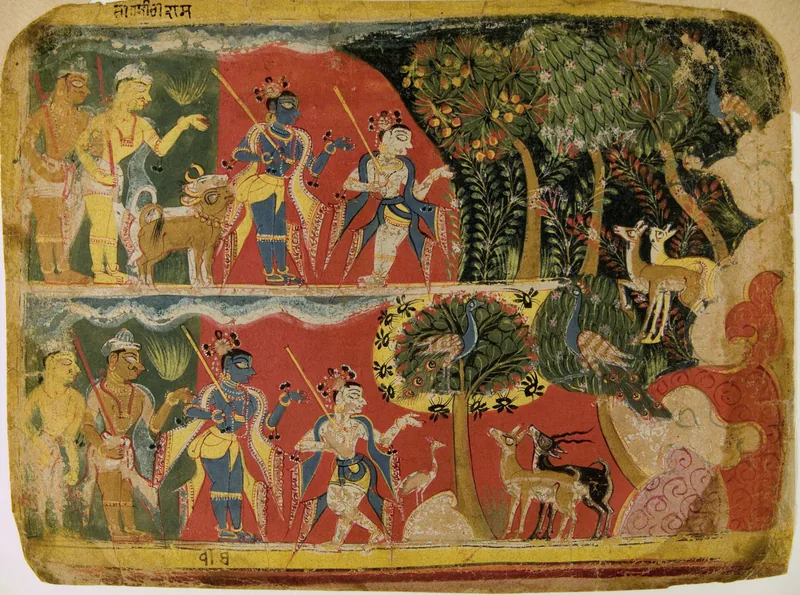
Dating Puranas is notoriously difficult because each was revised many times. Most scholars place the oldest core material, in works such as the Vayu, Brahmanda, Matsya and Vishnu, in roughly the fourth to sixth centuries CE, with additions continuing well into the second millennium. A manuscript of an early Skanda Purana preserved in Nepal is dated to the ninth century and is very different from the huge printed Skanda Purana of today. The Bhagavata Purana is usually placed around the ninth or tenth century, probably in south India, where its passionate devotion echoes the Tamil poet-saints. The Devi Mahatmya, embedded in the Markandeya Purana, is generally dated to about the fifth or sixth century.
Puranic Cosmology: Ages, Worlds and Cycles of Time§
The Puranas describe a universe of immense scale in time and space. Time moves in cycles of four ages (yugas): the Krita or Satya Yuga, an age of truth, followed by the Treta, Dvapara and Kali ages, in which dharma progressively declines, like a bull that stands on four legs, then three, two and one. The four ages together last 4,320,000 human years, and a thousand such cycles make a single day of the creator Brahma, a kalpa, followed by a night of equal length in which the worlds are dissolved. According to a widely used traditional reckoning, the present Kali Yuga began in 3102 BCE, at the end of the Mahabharata war and the departure of Krishna. Each kalpa is divided among fourteen Manus, progenitors of humanity, of whom the present is the seventh.
In Vaishnava accounts Vishnu sleeps on the coils of the cosmic serpent Shesha upon the ocean of dissolution; a lotus grows from his navel, and in it Brahma is born to create the world anew. Space is equally vast: Mount Meru stands at the centre of the world, surrounded by seven ring-shaped continents and seven oceans of salt, sugar-cane juice, wine, ghee, curds, milk and fresh water. India, Bharatavarsha, lies in the southern part of the innermost continent, Jambudvipa. Above and below lie heavens, netherworlds and hells, where beings reap the results of their karma before returning to birth. These ideas framed Hindu conceptions of history, astrology and the afterlife; see Reincarnation and the Afterlife.
Great Myths of the Puranas§
The Puranas are best known for their stories, many of which have become the common inheritance of Hindus everywhere.
Vishnu and His Avatars§
Vaishnava Puranas recount the descents (avatara) of Vishnu to restore dharma. The standard list of ten includes the Fish (Matsya), who saves Manu from the flood; the Tortoise (Kurma), who supports the mountain used to churn the ocean of milk; the Boar (Varaha), who lifts the earth from the waters; the Man-Lion (Narasimha), who kills the demon Hiranyakashipu to protect his devotee Prahlada; the Dwarf (Vamana); Parashurama; Rama; Krishna; the Buddha (or, in some lists, Balarama); and Kalki, who will come at the end of the Kali Yuga. The tenth book of the Bhagavata Purana, telling Krishna's childhood among the cowherds of Vraja and his circle dance (rasa-lila) with the cowherd women, became the scripture of Krishna devotion; see Vaishnavism.
Shiva, the Goddess and the Churning of the Ocean§
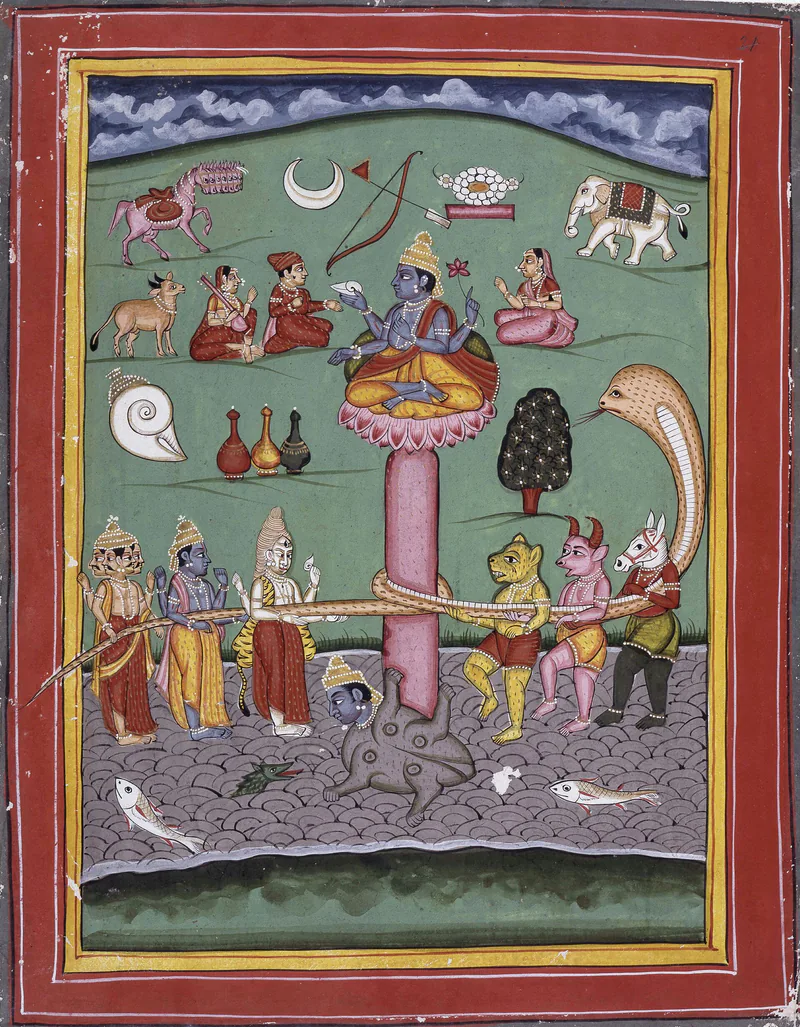
Shaiva Puranas tell how Brahma and Vishnu quarrelled over who was supreme until an endless pillar of fire appeared between them, which neither could measure: the first linga of Shiva. They tell of the destruction of Daksha's sacrifice after the self-immolation of Shiva's wife Sati, of Shiva's marriage to Parvati after her long asceticism, and of the births of their sons Skanda and Ganesha; see Shaivism. In the shared myth of the churning of the ocean of milk, gods and demons use a mountain as a churning stick to obtain the nectar of immortality; when a deadly poison rises first, Shiva drinks it, and it stains his throat blue. The Devi Mahatmya tells how the gods pooled their energies to create the Goddess Durga, who slew the buffalo demon Mahisha, as explained in Shaktism.
The Puranas in Worship, Pilgrimage and History§
The Puranas were never only books of myth. Their mahatmya chapters glorify particular rivers, cities and shrines, and much of the Skanda Purana consists of such sections, including the long Kashi Khanda on Varanasi. Many describe vows and fasts on particular lunar days, the festivals of the year and the correct forms of temple and image worship, discussed in Hindu Temples, Rituals and Festivals. The Garuda Purana contains a section on death, the journey of the soul and funeral rites that is still recited in many households during mourning. The Agni Purana is a compendium touching on architecture, iconography, medicine, astrology and poetics.
Public recitation and exposition of Puranas (katha) by trained storytellers remains a living art, and a seven-day recitation of the Bhagavata Purana is a popular religious event. Historians use the Puranas' king-lists with caution: they become more precise as they approach the Gupta period, and the scholar F. E. Pargiter collected their dynastic accounts in 1913. The Puranas also contain the earliest systematic accounts of many deities described in Hindu Gods and Goddesses, and their imagery underlies classical Indian sculpture and painting.
Frequently asked questions§
How many Puranas are there?§
Tradition recognises eighteen major Puranas (mahapuranas) and, by convention, eighteen minor ones (upapuranas), though in reality the minor and local Puranas number in the hundreds. Lists of the eighteen major Puranas differ slightly from source to source.
Which is the most important Purana?§
The Bhagavata Purana is the most influential, above all for its account of Krishna, and is the central scripture of several Vaishnava traditions. The Vishnu Purana is often regarded as the closest to the classical model, and the Devi Mahatmya within the Markandeya Purana is the core scripture of Goddess worship.
Are the Puranas older than the Vedas?§
No. Although "purana" means "ancient," and the Puranas claim great antiquity, scholars date them well after the Vedas, mostly from the first millennium CE onward. Some of their stories, however, develop themes already present in the Vedas and the epics.
Sources and further reading§
- The Purāṇas — Ludo Rocher, 1986
- Classical Hindu Mythology: A Reader in the Sanskrit Purāṇas — Cornelia Dimmitt & J. A. B. van Buitenen, 1978
- Hindu Myths: A Sourcebook Translated from the Sanskrit — Wendy Doniger O'Flaherty, 1975
- The Vishnu Purana — H. H. Wilson (trans.), 1840
- Myths and Symbols in Indian Art and Civilization — Heinrich Zimmer, 1946
- The Purana Text of the Dynasties of the Kali Age — F. E. Pargiter, 1913