Liber XIV · Hinduism · Chapter V: The Puranas
Hindu Cosmology: Yugas, Kalpas and the Cycles of Time
Hindu cosmology explained: the four yugas and Kali Yuga, manvantaras, the kalpa as a day of Brahma, pralaya, the fourteen worlds and Mount Meru at the centre.

Hindu cosmology describes a universe without absolute beginning or end, created, sustained and dissolved in vast repeating cycles. In the classical Puranic scheme, time is measured in four ages (yugas) of declining virtue, grouped into great ages, the reigns of the Manus and the kalpa, a single day of the creator Brahma lasting 4.32 billion human years, after which the worlds dissolve and are reborn. Space is pictured as a cosmic egg containing fourteen worlds stacked around a central mountain, Meru.
Creation Hymns of the Rigveda§
The earliest Indian cosmological thought appears in the hymns of the Rigveda, discussed in The Vedas and Upanishads. Three late hymns of the tenth book are especially important. The Nasadiya Sukta (Rigveda 10.129) begins with a time when there was neither being nor non-being, and ends by wondering whether even the highest overseer in heaven knows how creation came about, a passage often admired for its open questioning. The Purusha Sukta (10.90) describes the world as arising from the sacrifice of a cosmic person, whose body becomes the sky, the earth, the gods and the four social classes. The hymn to Hiranyagarbha (10.121), the "golden embryo," pictures creation emerging from a primordial germ floating on the waters.
These hymns do not yet present a theory of repeating ages. Later texts gathered their images, the cosmic waters, the golden egg and the sacrificial person, into a cyclical framework. The Upanishads and Brahmanas speak of the creator Prajapati, and by the time of the Mahabharata and the early Puranas the idea of periodic creation and destruction had become the standard picture.
The Four Yugas and the Decline of Dharma§
The best-known element of Hindu cosmology is the sequence of four ages, named after the throws of an ancient dice game. The Krita or Satya Yuga is the age of truth, in which dharma stands firm like a bull on four legs; people live long, are virtuous and need no laws. In the Treta Yuga dharma stands on three legs and sacrifice becomes necessary. In the Dvapara Yuga it stands on two, and in the Kali Yuga, the present age, it totters on one.
In the classical Puranic reckoning the ages last 1,728,000, 1,296,000, 864,000 and 432,000 human years. These figures come from a scheme of "divine years," each equal to 360 human years: the four ages last 4,800, 3,600, 2,400 and 1,200 divine years including their twilights (sandhya), making 12,000 divine years, or 4,320,000 human years, for the whole cycle of four, called a mahayuga or chaturyuga.
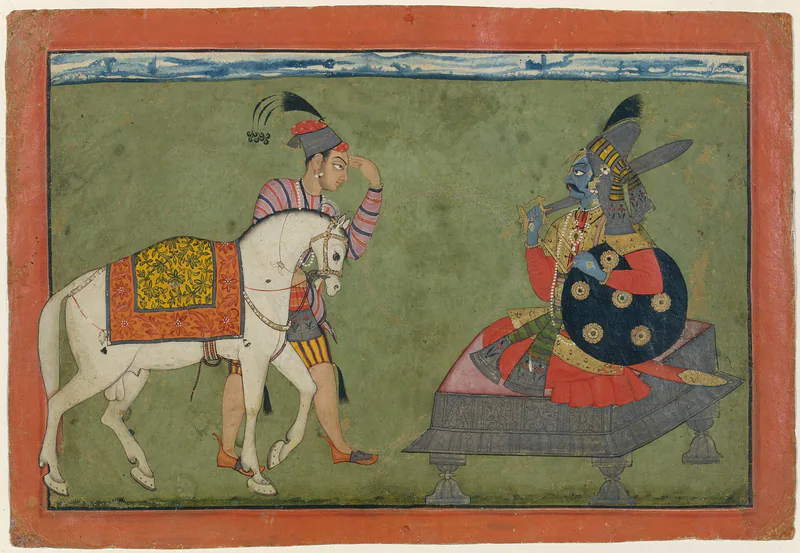
The Puranas describe the Kali Yuga in sober colours: rulers become thieves, wealth alone confers status, truthfulness and compassion decline and lives grow short. Yet devotional texts add a note of hope. The Bhagavata Purana, discussed in The Bhagavata Purana, says that in this age liberation, attained with great effort in earlier ages, can be reached simply by singing the names of God. The age ends with the coming of Kalki, the last of the ten avatars of Vishnu, and a new Krita Yuga begins.
Manvantaras, Kalpas and the Life of Brahma§
The yugas are nested within larger units. Seventy-one mahayugas form a manvantara, the reign of a Manu, the progenitor and lawgiver of humankind for that period; each manvantara has its own Indra, its own seven sages and its own descent of Vishnu. Fourteen manvantaras, with intervening junctions, make up a kalpa, defined as a thousand mahayugas, or 4,320,000,000 years. A kalpa is one day in the life of Brahma, the creator god.
During Brahma's day the worlds exist; during his night, of equal length, they are withdrawn. Brahma lives for a hundred years of such days and nights, a total of over three hundred trillion human years, after which he too dies and the entire universe returns to its source. Then another Brahma arises and the process begins again. Puranic texts also say that there are countless universes, each with its own Brahma, floating like bubbles in the infinite being of God.
According to traditional reckoning, we live in the first day of the fifty-first year of the present Brahma, in the kalpa called Shveta-Varaha, "the white boar," during the seventh manvantara, that of Vaivasvata Manu, in the Kali Yuga of the twenty-eighth mahayuga. Temple priests recite this location in time at the start of formal rituals, so that each act of worship is placed within cosmic history.
Dissolution and Renewal: Pralaya and the Sleeping Vishnu§
The Puranas distinguish several kinds of dissolution (pralaya). The occasional dissolution comes at the end of each day of Brahma: fire and flood destroy the lower worlds, and the cosmos rests in the waters through the night. The elemental dissolution, at the end of Brahma's life, returns everything, even the elements, into primal matter (prakriti). Some texts add a constant dissolution, the ceaseless passing away of beings from moment to moment, and a final dissolution, which is the individual soul's liberation from the cycle of rebirth discussed in Dharma, Karma, Samsara and Moksha.
In Vaishnava mythology, the night of dissolution is imaged as Vishnu sleeping on the coils of the serpent Ananta ("endless") or Shesha ("remainder," what is left when all else is gone), floating on the cosmic ocean. When the new day dawns a lotus grows from his navel, and in it sits Brahma, who sets about creation once more. A famous story tells of the sage Markandeya, who survives the dissolution and wanders the dark waters until he sees a small child resting on a banyan leaf, who draws him into his body and shows him the whole universe within.
Shaiva traditions express the same rhythm through Shiva as Nataraja, the lord of dance, whose dance both creates and destroys the world; the drum in one hand sounds creation and the flame in another consumes it. For Shakta texts such as the Devi Mahatmya, it is the Goddess who presides over the cycles, as described in Shaktism and the Hindu Goddess.
The Shape of the Universe: Lokas, Meru and the Seven Continents§
Puranic cosmology is spatial as well as temporal. The universe is a brahmanda, a "Brahma's egg," enclosed in layers of the elements. Within it are fourteen worlds (lokas). Seven rise above: bhur (the earth), bhuvar (the atmosphere), svar (heaven), and the higher realms mahar, janas, tapas and satya, the last being Brahma's own world. Seven lie below, named atala, vitala, sutala, rasatala, talatala, mahatala and patala; these are not hells but subterranean worlds of serpents and demons of great beauty. The hells (narakas) are placed separately, below or within the lower regions.
At the centre of the earth stands Mount Meru, a golden mountain around which the sun and stars revolve. Around it lie seven ring-shaped continents (dvipas), separated by seven oceans, of salt water, sugarcane juice, wine, clarified butter, curds, milk and fresh water. The innermost continent, Jambudvipa, contains the land of Bharata, or India, to the south of Meru. This mythic geography is shared, with differences, by Buddhist and Jain cosmology; see Buddhist Cosmology and Jain Cosmology for comparison.
Astronomy, the Kali Yuga Epoch and Modern Readings§
Indian mathematical astronomy took over the yuga framework and gave it precision. The Surya Siddhanta, a classic astronomical text whose surviving form is usually dated to the middle or later first millennium CE, expresses the motions of the planets as whole numbers of revolutions within a mahayuga or kalpa. The astronomer Aryabhata, writing in 499 CE, used the start of the Kali Yuga as an epoch for his calculations, while dividing the mahayuga into four equal parts rather than the Puranic proportions. Traditional reckoning, based on such astronomy, dates the beginning of the Kali Yuga to midnight between 17 and 18 February 3102 BCE, a moment associated with the death of Krishna and the end of the age of the Mahabharata. The same astronomy underlies the calendars and charts of Vedic astrology, whose sign pages are found under Vedic horoscopes.
Modern readers have interpreted the cycles in several ways. Historians of religion such as Mircea Eliade used the Indian yugas as a classic example of cyclical, as opposed to linear, conceptions of time. Some modern teachers have revised the numbers: the Bengali teacher Sri Yukteswar, in The Holy Science (1894), proposed a much shorter cycle of 24,000 years and argued that humanity had already left the Kali Yuga, an idea later spread by his disciple Paramahansa Yogananda. Theosophical writers built their own scheme of cosmic rounds partly on Puranic models, and European Traditionalists such as René Guénon used the Kali Yuga as a frame for criticising the modern world. Popular science writers, finally, have noted that the immense spans of the kalpa are closer in scale to the age of the universe estimated by modern cosmology than are the timescales of most ancient traditions, a parallel that is suggestive but not evidence of scientific knowledge.
Frequently asked questions§
Which yuga are we in now?§
According to traditional Hindu reckoning, we live in the Kali Yuga, which began in 3102 BCE and lasts 432,000 years, so that most of it lies in the future. A minority view derived from Sri Yukteswar holds that the Kali Yuga has already ended, but this is not the position of the Puranas or of traditional astronomers.
How long is a day of Brahma?§
A day of Brahma, or kalpa, lasts a thousand mahayugas, that is 4,320,000,000 human years. It is followed by a night of the same length, during which the worlds are dissolved.
Do Hindus believe the universe will end?§
Hindu texts describe periodic dissolutions rather than a single final end. Each kalpa ends with a partial dissolution, and the end of Brahma's life brings a complete return of the universe to its source, but new creations follow without end.
Sources and further reading§
- The Vishnu Purana: A System of Hindu Mythology and Tradition — H. H. Wilson, 1840
- Classical Hindu Mythology: A Reader in the Sanskrit Purāṇas — Cornelia Dimmitt and J. A. B. van Buitenen, 1978
- Myths and Symbols in Indian Art and Civilization — Heinrich Zimmer, 1946
- Ancient Indian Cosmogony — F. B. J. Kuiper, 1983
- Translation of the Sûrya-Siddhânta, a Text-Book of Hindu Astronomy — Ebenezer Burgess, 1860
- The Myth of the Eternal Return — Mircea Eliade, 1954
- The Holy Science — Swami Sri Yukteswar, 1894