Liber IV · Buddhism · Chapter II: Buddhist Cosmology
Buddhist Cosmology: Mount Meru, the Six Realms and Many Worlds
Buddhist cosmology explained: samsara, the three realms and thirty-one planes, the six realms and the wheel of life, Mount Meru, kalpas and countless worlds.

Buddhist cosmology is the traditional Buddhist picture of the universe: a beginningless cycle of rebirth (samsara) through hells, ghost and animal realms, the human world and many heavens, arranged around a central world-mountain, Mount Meru, and repeated across countless world systems that arise and dissolve over immense periods called kalpas. It is both a map of where beings can be reborn according to their karma and a map of states of mind, since the higher heavens correspond to levels of meditation.
Samsara: The Round of Rebirth§
The starting point of Buddhist cosmology is samsara, literally "wandering on", the cycle of birth, death and rebirth without any discoverable beginning. The Buddha is reported to have said that a first point of this wandering cannot be found, and that the tears shed by a single being over its many lives would exceed the waters of the oceans. Beings move through this cycle according to their karma, the intentional actions described in the core teachings of Buddhism. No state within it, not even the highest heaven, is permanent; only nirvana lies outside it.
Buddhist cosmology shares much with the cosmology of ancient Indian religion in general, including the world-mountain Meru, the gods of the Vedic pantheon and the cycles of cosmic time also known in Hindu thought. But Buddhism places all these within samsara: the great god Brahma, for example, appears in the scriptures as a powerful but mortal being who mistakenly believes he created the world. The wider history of rebirth beliefs is discussed in reincarnation and the afterlife.
The Three Realms and Thirty-One Planes of Existence§
The classical systems divide the universe into three realms (dhatus), worked out in the Abhidharma literature, above all Vasubandhu's Abhidharmakosha (fourth or fifth century) in the northern traditions and the Pali commentaries in Theravada.

The realm of desire§
The lowest realm, kamadhatu, contains beings driven by sense desire. It includes the hells, the realms of animals and of hungry ghosts, the demigods (asuras), the human world, and six heavens of the sense-sphere gods. Among these heavens are that of the Four Great Kings, guardians of the four directions; the Heaven of the Thirty-Three on the summit of Meru, ruled by Shakra (Indra); and the Tushita heaven, where the future buddha Maitreya waits, as the historical Buddha did before his last birth. The highest desire heaven is associated with Mara, the tempter.
The realm of form§
Above it lies the rupadhatu, inhabited by Brahma gods with subtle bodies of light and without sensual desire. Its heavens correspond to the four meditative absorptions (jhanas or dhyanas): a person who masters a given level of meditation may be reborn in the matching heaven. Its highest levels are the "Pure Abodes", reserved for "non-returners" who will attain nirvana there.
The formless realm§
At the top is the arupadhatu, where beings exist as pure mind in four states named after the formless meditative attainments: infinite space, infinite consciousness, nothingness, and neither perception nor non-perception. Even these, the texts insist, are within samsara; the Buddha's early teachers had reached them without finding liberation.
In Theravada reckoning these levels add up to thirty-one planes of existence. Northern traditions count slightly differently, but the structure is the same: a vertical scale that is at once a hierarchy of worlds and a hierarchy of mental states.
The Six Realms of Rebirth and the Wheel of Life§
Popular teaching simplifies the realm of desire into five or six "destinies" (gati): gods, humans, animals, hungry ghosts (pretas), hell beings, and, in many traditions, the warlike demigods or asuras. Human birth is considered especially precious, because humans experience enough suffering to seek liberation and enough freedom to pursue it.
These realms are pictured in the "wheel of life" (bhavachakra), a painting found at the entrance of many Tibetan monasteries. A monastic legal text tells how the Buddha himself ordered such a wheel to be painted at a monastery gateway, and fragments of an early version survive in the Ajanta caves. The wheel is held in the jaws and claws of a fearsome figure, usually identified as Yama, lord of death, or as impermanence. At its hub a pig, a snake and a rooster stand for delusion, hatred and greed; around them beings rise and fall; the six realms fill the main segments; and the rim shows the twelve links of dependent origination. Outside the wheel, a buddha points to the way of release. Teachers have long interpreted the realms psychologically as well — the hell of hatred, the hungry ghost's insatiable craving — without denying their reality as places of rebirth.
Mount Meru and the Shape of the World§
Each world system has a physical structure. At its centre rises Mount Meru (also called Sumeru), a vast mountain surrounded by seven concentric rings of golden mountains and seas, the whole enclosed by a ring of iron mountains. In the outer ocean lie four continents, one in each direction. Humans live on the southern continent, Jambudvipa, named after the rose-apple (jambu) tree; its shape, wide at the north and narrow to the south, resembles the Indian subcontinent. The sun and moon circle Meru's flanks, and the hells lie beneath the earth.
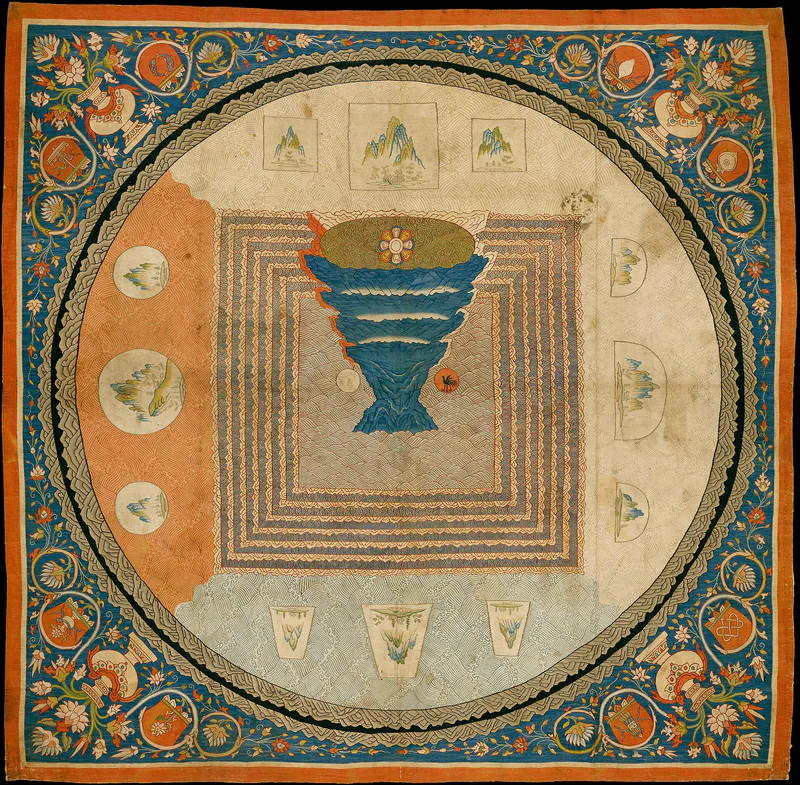
This image of the world shaped Buddhist art and architecture across Asia. Stupas and temple-mountains, such as the great monument of Borobudur in Java, have been interpreted as models of the cosmos, and the Tibetan ritual of offering a mandala represents the whole universe, with Meru and the four continents, as a gift to the buddhas. In Thailand, the fourteenth-century Traiphum or "Three Worlds" treatise, attributed to King Lithai of Sukhothai, became the classic statement of Buddhist cosmology and was illustrated in many manuscripts and temple murals.
Cosmic Time: Kalpas, World Cycles and Many Buddhas§
Buddhist time is measured in kalpas (Pali kappa), aeons of almost unimaginable length. The scriptures describe them by similes: a kalpa is longer than the time it would take to wear away a mountain of solid rock by brushing it with a piece of fine cloth once a century. A "great kalpa" passes through four phases — formation, duration, destruction by fire, water or wind, and a period of emptiness — after which the cycle begins again.
Within these cycles, buddhas appear at long intervals, when the teaching of the previous buddha has been entirely forgotten. The Pali texts name six buddhas before Gautama, including Vipassi and Kassapa, and later lists name twenty-four or more, beginning with Dipankara, before whom the future Gautama is said to have first vowed to become a buddha. Gautama's teaching, the texts predict, will gradually decline and vanish, after which Maitreya will appear. These ideas about decline inspired movements in many parts of Asia, from the Japanese teaching of Pure Land Buddhism to messianic movements around Maitreya in China and Southeast Asia.
Buddha-Fields, Multiple Worlds and Cosmology in Practice§
Early texts already speak of "thousandfold" world systems, and the developed tradition describes a "great trichiliocosm" of a thousand to the third power — a billion — world systems, each with its own Meru, sun and moon. Mahayana sutras multiply worlds without limit, filling every direction with buddhas and their buddha-fields, and the Flower Garland Sutra imagines entire universes contained within a single atom. The Vajrayana Kalachakra Tantra adds its own detailed cosmology and astronomy, including the hidden kingdom of Shambhala.
For Buddhists this cosmology is not merely speculation. It underlies rituals for the dead, such as feeding hungry ghosts at the Ghost Festival in China and the Obon season in Japan; it gives meaning to merit-making aimed at a better rebirth; and it frames meditation, since the jhanas lead the mind through the same levels that the heavens embody. Modern Buddhist teachers vary in how literally they take it: many read the realms chiefly as states of mind, others as real places, and most see no need to choose between the two. Tibetan teachings on the intermediate state between death and rebirth are discussed in Tibetan Buddhism.
Frequently asked questions§
What are the six realms of Buddhism?§
The six realms are the possible destinations of rebirth within the realm of desire: gods, demigods (asuras), humans, animals, hungry ghosts and hell beings. Some traditions count five, merging the demigods with the gods. All six are impermanent, and beings move between them according to their karma.
What is Mount Meru in Buddhism?§
Mount Meru is the vast mountain at the centre of each world system in Buddhist and other Indian cosmologies. The heavens of the Four Great Kings and of the Thirty-Three gods are located on its slopes and summit, and the four human continents lie around it in the surrounding ocean.
Do Buddhists believe in heaven and hell?§
Buddhist texts describe many heavens and hells, but none is eternal. Beings are reborn there as a result of their karma and leave when that karma is exhausted. The final goal, nirvana, lies beyond all of them.
Sources and further reading§
- Three Worlds According to King Ruang: A Thai Buddhist Cosmology — Frank E. Reynolds & Mani B. Reynolds (trans.), 1982
- Buddhist Cosmology: Philosophy and Origins — Akira Sadakata, 1997
- Abhidharmakosabhasyam — Vasubandhu, 1988
- Reinventing the Wheel: Paintings of Rebirth in Medieval Buddhist Temples — Stephen F. Teiser, 2006
- The Foundations of Buddhism — Rupert Gethin, 1998