Liber IV · Buddhism · Chapter VIII: Pure Land
Pure Land Buddhism: Amitabha, the Nembutsu and Sukhavati
Pure Land Buddhism explained: Amitabha Buddha and his vows, the Pure Land sutras, Chinese masters, Honen and Shinran in Japan, and reciting the Buddha's name.

Pure Land Buddhism is a family of Mahayana traditions centred on devotion to Amitabha, the Buddha of Infinite Light, and on the hope of rebirth in his "Pure Land" of Sukhavati, the Land of Bliss, where awakening can be attained without the obstacles of this world. Its main practice is reciting the Buddha's name — nianfo in Chinese, nembutsu in Japanese — and it is one of the most widely practised forms of Buddhism in China, Japan, Korea and Vietnam.
Amitabha and the Pure Land Sutras§
The foundation of the tradition is three Mahayana scriptures. The Larger Sukhavativyuha Sutra, or Sutra of Immeasurable Life, tells how, aeons ago, a monk named Dharmakara made a series of vows before a past buddha, promising that when he attained buddhahood he would create a perfect land and receive into it all beings who called on him with faith; in the best-known Chinese version there are forty-eight vows. Having fulfilled them, he became the Buddha Amitabha ("Infinite Light"), also called Amitayus ("Infinite Life"), who presides over Sukhavati in the west. The Smaller Sukhavativyuha, or Amitabha Sutra, describes the land's jewelled trees, lotus ponds and birds that sing the Dharma. The third, the Contemplation Sutra (Guan Wuliangshou jing), teaches a series of visualisations of the land and its buddha; it survives only in Chinese, and many scholars think it was composed in Central Asia or China.
Amitabha appears in Chinese translations by the late second century CE, and devotion to him was widespread in India and Central Asia, though without forming a separate school there. The two Sukhavati sutras survive in Sanskrit as well as Chinese and Tibetan, and Amitabha is honoured in Tibetan Buddhism as well, where prayers for rebirth in Sukhavati are part of ordinary practice.
Buddha-Fields and the Idea of a Pure Land§
Pure Land devotion grows out of the wider Mahayana vision of a universe of countless worlds, each the "buddha-field" (buddhakshetra) of a particular buddha, described in Buddhist cosmology. Our own world, Saha, the "world of endurance", is Shakyamuni's field, impure and full of suffering. Other buddhas, through the power of their vows and merit, have purified their fields, making them ideal places for practice: Akshobhya's Abhirati in the east and Bhaishajyaguru's lapis-lazuli land are other examples.
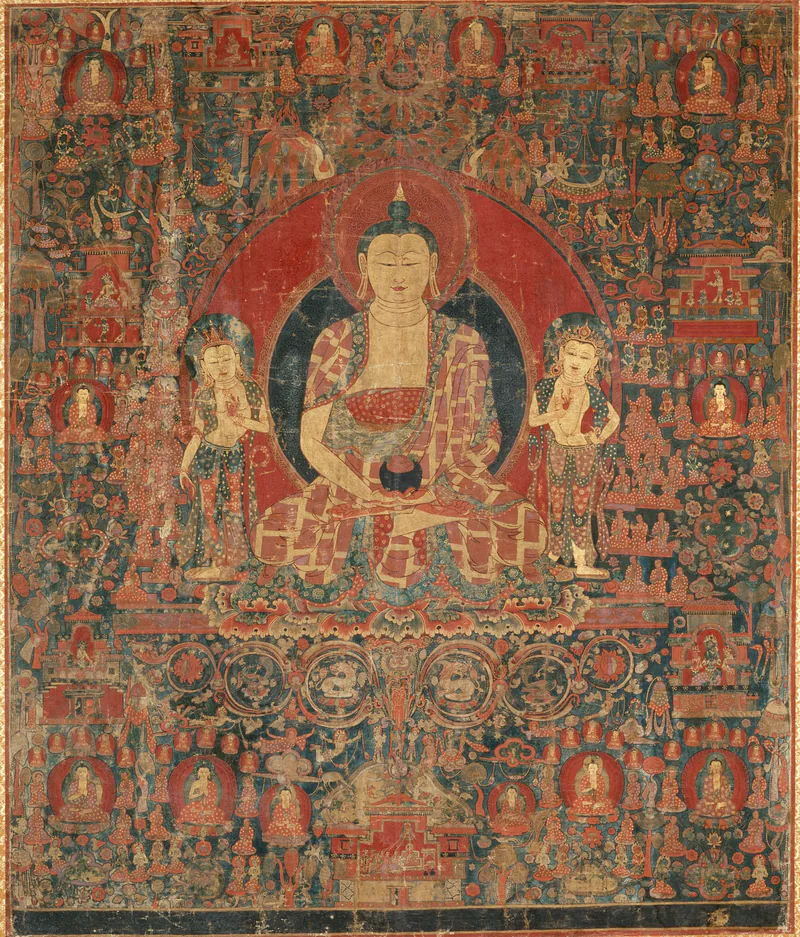
It is important to understand that, in Buddhist terms, the Pure Land is not the final goal. Beings reborn there are born from lotuses in Amitabha's presence, hear the Dharma constantly, cannot fall back into lower realms and progress steadily to buddhahood, after which, as bodhisattvas, they return to help others. Some Mahayana thinkers also interpreted the Pure Land as a state of mind: as the Vimalakirti Sutra puts it, the purity of a buddha-land follows from the purity of the mind. This "mind-only" view was especially popular among Chan writers.
Pure Land Teachers in China§
In China, Pure Land practice developed over several centuries. Tradition regards the monk Huiyuan (334–416) as the first patriarch, because in 402 he gathered a group of monks and laymen on Mount Lu to vow rebirth in Amitabha's land, a group later idealised as the "White Lotus Society". His practice, however, centred on meditative visualisation. The decisive shift came with Tanluan (476–542), who emphasised faith in Amitabha's vows; Daochuo (562–645), who taught that in the present degenerate age the path of the Pure Land is the only practical one; and Shandao (613–681), who made the vocal recitation of the name the primary practice and whose commentary on the Contemplation Sutra became authoritative.
The formula Namo Amituofo ("Homage to Amitabha Buddha") spread throughout Chinese society. Rather than forming a distinct institution, Pure Land practice in China became part of the shared repertoire of almost every monastery. From the Song dynasty onward, many Chinese teachers combined it with Chan meditation in a "dual practice" of meditation and recitation, a synthesis that remains characteristic of Chinese and Vietnamese Buddhism. The modern monk Yinguang (1862–1940) was an influential advocate of Pure Land practice in the twentieth century.
Honen, Shinran and Pure Land in Japan§
In Japan, Pure Land devotion spread first within the Tendai school. The monk Genshin (942–1017) wrote the Ojoyoshu, "Essentials of Rebirth", in 985, with vivid descriptions of the hells and of Amida's paradise that shaped Japanese religious imagination and art; the Phoenix Hall of the Byodo-in at Uji, dedicated in 1053, is one of the best-known Pure Land buildings. Wandering holy men such as Kuya popularised the nembutsu among ordinary people.
Belief that the world had entered mappo, the final age of the decline of the Dharma, gave Pure Land teaching urgency. Honen (1133–1212), a Tendai monk, concluded that in such an age only the recitation of Namu Amida Butsu, relying on Amida's eighteenth or "primal" vow, could save beings, and he founded the Jodo ("Pure Land") school, setting out his view in the Senchakushu (1198). His disciple Shinran (1173–1263) went further, teaching that even the act of faith is a gift of Amida's "other power" (tariki) rather than one's own effort (jiriki), and that the nembutsu is an expression of gratitude for a salvation already assured. Exiled in 1207 with Honen and laicised, Shinran married and lived as "neither monk nor layman". The Jodo Shinshu ("True Pure Land") school that grew from his teaching became, through the organising work of Rennyo (1415–1499), one of the largest religious bodies in Japan. Its clergy marry, and its temples are often passed down in families. A further movement, the Ji school, was founded by the itinerant Ippen (1234–1289).
Practice: Reciting the Name and Deathbed Rites§
The core practice of Pure Land Buddhism is the recitation of the Buddha's name, often counted on prayer beads and sometimes continued for days in special retreats. It is complemented by chanting the Pure Land sutras, making offerings before images of Amitabha flanked by the bodhisattvas Avalokiteshvara and Mahasthamaprapta, and, in some traditions, visualisation of the Pure Land.
Death has always been a focus of the tradition. In medieval China and Japan, deathbed rites aimed to keep the dying person's mind fixed on Amitabha: the dying might hold coloured cords attached to an image of the Buddha while companions chanted, in the hope that Amitabha and his retinue would come to welcome them. Paintings of Amida's descent (raigo) were made for such occasions. The Shin tradition, by contrast, teaches that rebirth is settled at the moment of genuine faith, so that deathbed practices are unnecessary. The broader history of beliefs about death and rebirth is discussed in reincarnation and the afterlife.
Pure Land Today and Its Place in the Wider Tradition§
Pure Land practice is found today throughout East Asia and its diasporas. In Japan, the Jodo and Jodo Shinshu schools together count millions of adherents; Shin Buddhist temples established by Japanese immigrants in Hawaii and California from the 1890s became the Buddhist Churches of America, one of the oldest Buddhist organisations in the West. In Taiwan and mainland China, Pure Land recitation is central to popular lay Buddhism, and twentieth-century reformers reinterpreted the tradition as the task of building a "pure land on earth".
Western observers have sometimes compared Pure Land faith with Protestant Christianity's emphasis on grace, a comparison that Shin Buddhists have both explored and qualified. Within Buddhism, Pure Land has been contrasted with self-reliant traditions such as Zen, though in practice the two have often been combined.
Frequently asked questions§
What is the Pure Land in Buddhism?§
The Pure Land, or Sukhavati, is the world created by the Buddha Amitabha through his vows, described in the sutras as a place of perfect conditions for attaining awakening. Many Buddhists understand it as a real realm of rebirth; others interpret it as a symbol of the purified mind.
What is the nembutsu?§
The nembutsu (Chinese nianfo) is the practice of calling to mind or reciting the name of Amitabha Buddha, usually in the formula Namu Amida Butsu in Japan or Namo Amituofo in China. In Pure Land Buddhism it is the principal practice leading to rebirth in Amitabha's land.
Is Pure Land Buddhism the same as Zen?§
No. Pure Land emphasises faith in Amitabha's vows and recitation of his name, while Zen emphasises meditation and direct insight into one's own nature. Both are Mahayana traditions, however, and in China and Vietnam many Buddhists practise them together.
Sources and further reading§
- The Land of Bliss: The Paradise of the Buddha of Measureless Light — Luis O. Gómez, 1996
- The Pure Land Tradition: History and Development — James Foard, Michael Solomon & Richard K. Payne (eds.), 1996
- Chinese Pure Land Buddhism: Understanding a Tradition of Practice — Charles B. Jones, 2019
- Shinran: An Introduction to His Thought — Yoshifumi Ueda & Dennis Hirota, 1989
- Honen's Senchakushu: Passages on the Selection of the Nembutsu in the Original Vow — Senchakushu English Translation Project, 1998
- Mahayana Buddhism: The Doctrinal Foundations — Paul Williams, 1989