Liber IV · Buddhism · Chapter VII: Monastic Life
Nalanda: The Great Buddhist Monastic University of India
Nalanda Mahavihara explained: the great Buddhist monastery of Bihar, its Gupta and Pala patrons, Xuanzang and Yijing, its scholars, its decline and its ruins.

Nalanda was a great Buddhist monastery (mahavihara) in what is now Bihar, north-eastern India, which flourished from about the fifth to the twelfth century CE as the most renowned centre of Buddhist learning in Asia. Often called the world's first residential university, it housed thousands of monks who studied philosophy, logic, grammar and medicine, attracted pilgrims from China, Korea and Tibet, and shaped the Buddhism later carried to Tibet. Its ruins are a UNESCO World Heritage Site.
Origins of Nalanda Under the Guptas§
The area of Nalanda, a few miles from Rajagriha (modern Rajgir), appears in early Buddhist texts as a village the Buddha passed through, and tradition associates it with the birthplace of his chief disciple Shariputra. The great monastery, however, is a later foundation. According to Xuanzang, its first buildings were endowed by a king he calls Shakraditya, usually identified with the Gupta emperor Kumaragupta I (reigned about 415–455), and successive kings added further monasteries and temples. Archaeology broadly confirms a fifth-century beginning for the main complex.
Over the following centuries Nalanda grew into a planned campus: a long row of brick monasteries on the east, each a square of cells around a courtyard with a shrine facing the entrance, and a parallel row of temples and stupas on the west. The largest, known to archaeologists as Site 3, is a stupa-temple enlarged in at least seven building phases. Clay seals found on the site carry the monastery's emblem — the Wheel of the Dharma flanked by two deer, recalling the Buddha's first sermon in the deer park at Sarnath — and its corporate name, the community of noble monks of the great monastery of Nalanda.
Xuanzang, Yijing and Life at the Mahavihara§
The most vivid accounts of Nalanda come from Chinese pilgrims. Xuanzang (602–664) arrived in the 630s and spent several years there studying Yogacara philosophy under the aged abbot Shilabhadra, before returning to China with hundreds of texts. His travel record and the biography written by his disciple describe towers and pavilions rising into the mists, deep pools of blue lotus, and a community said to number ten thousand — a figure most historians regard as exaggerated. He also reports that the gatekeepers examined would-be students in debate and that most were turned away.
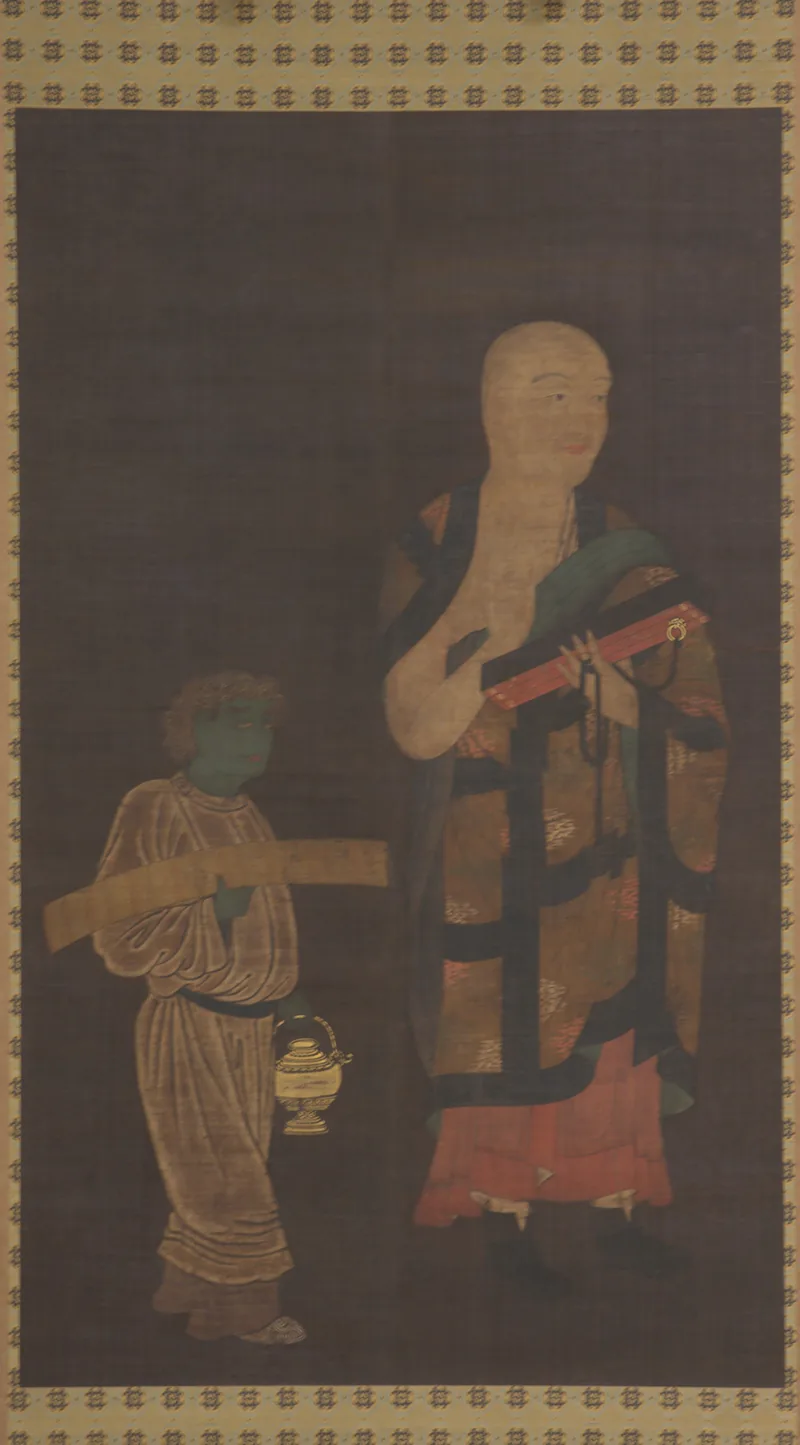
Yijing (635–713) lived at Nalanda for about a decade from the 670s and wrote a detailed account of Indian monastic practice. He describes some 3,000 monks, a figure more often accepted, and records the daily round: bathing at fixed times, chanting processions in the evening, the administration of the monastery's estates — Nalanda was supported by the revenues of some two hundred villages — and the strict observance of the monastic code. His account is one of the best sources for the daily realities of Buddhist monastic life in early medieval India.
Monks from Korea and Central Asia also studied at Nalanda, and several Chinese and Korean pilgrims are known to have died there. For many visitors the monastery was also a base for visiting the holy places nearby, including Bodh Gaya and Rajgir, described in the pilgrimage sites of the Buddha.
Learning at Nalanda: Curriculum and Great Scholars§
Nalanda was a Mahayana institution, but its curriculum was broad. Xuanzang says that students studied the scriptures of the "eighteen schools" of mainstream Buddhism as well as Mahayana texts, together with logic (hetuvidya), grammar (shabdavidya), medicine and even the Vedas and other non-Buddhist works, since debate with rival schools required knowing their positions. Learning proceeded through memorisation, commentary and formal debate.
Tibetan historians later drew up lists of the great masters of Nalanda, now often called the "Seventeen Pandits of Nalanda". They include Nagarjuna and Aryadeva, the Yogacara brothers Asanga and Vasubandhu, the logicians Dignaga and Dharmakirti, Chandrakirti and Shantideva, and Shantarakshita and Kamalashila. Several of these figures lived before the monastery existed in its known form, so the list is better understood as a statement of intellectual lineage than as a historical record of residents. For the seventh century and after, however, associations are firmer: Shilabhadra was abbot in Xuanzang's day, and in the eleventh century the tantric master Naropa is said to have served as one of the monastery's gatekeeper-scholars before leaving to follow his guru Tilopa.
Tradition also speaks of a great library, the "Mart of the Dharma", housed in buildings with poetic names such as "Ocean of Jewels". The description comes from the seventeenth-century Tibetan historian Taranatha, writing long after Nalanda's fall, and cannot be checked against archaeology; but there is no doubt that the monastery held and produced large collections of manuscripts.
Patrons, Rivals and the Pala Monasteries§
Nalanda depended on royal and lay patrons. After the Guptas, King Harsha of Kanauj (reigned 606–647) supported it; from the eighth to the twelfth century the Pala kings of Bengal and Bihar were its principal protectors. A copper-plate grant of the Pala king Devapala records that Balaputradeva, a Shailendra king of Sumatra, built a monastery at Nalanda around the mid-ninth century and asked Devapala to endow it with villages — evidence of the monastery's international reach.
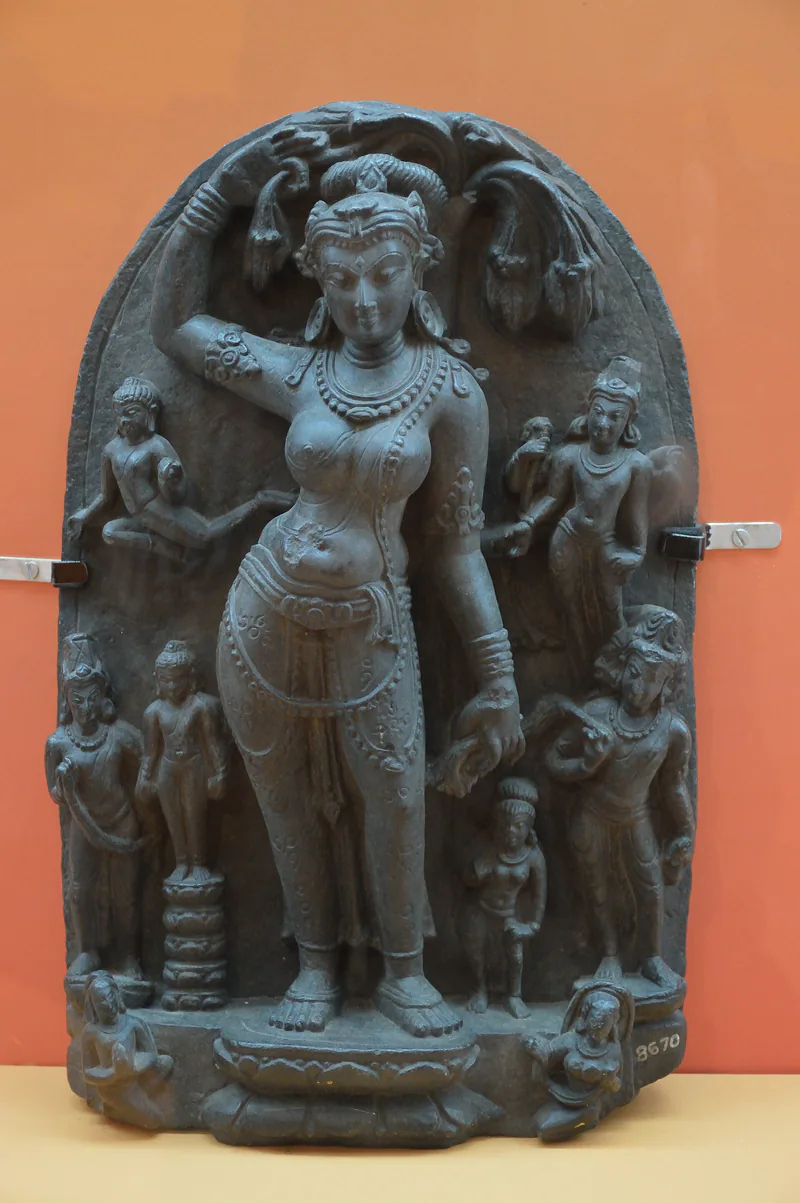
The Palas also founded new monasteries, including Vikramashila, Odantapuri and Somapura (Paharpur, in modern Bangladesh). These became important rivals, and by the eleventh century Vikramashila had perhaps overtaken Nalanda in prestige; the scholar Atisha, who went to Tibet in 1042, was associated with it. In this period Vajrayana studies and rituals became prominent in all the great monasteries, as finds of tantric images and manuscripts at Nalanda confirm.
The Decline and Destruction of Nalanda§
The end of Nalanda is often told as a single catastrophe: the burning of the monastery and its library by the forces of Bakhtiyar Khalji around 1200. The Persian chronicler Minhaj-i Siraj describes the sack of a fortified Buddhist monastery in Bihar at about this time, whose shaven-headed inhabitants were killed and whose books no one remained to read; many historians think the site he describes was Odantapuri, though Nalanda was certainly attacked in the same campaigns.
The fuller picture is of gradual decline. Royal patronage weakened with the collapse of the Palas; the larger political and economic world that had sustained Buddhist institutions in north India was changing; and fires and raids had damaged the site before. The Tibetan monk Dharmasvamin, who visited in the 1230s, found Nalanda still inhabited by a small community under an aged teacher, Rahulashribhadra, teaching amid damaged buildings and under threat of further raids. Within a few generations the monastery was abandoned. Its heritage survived elsewhere, above all in Tibet, which had received its texts, curriculum and debate culture through scholars trained in these institutions.
Rediscovery, the Ruins and the Modern Nalanda§
In the nineteenth century the British surveyor Francis Buchanan-Hamilton noted the mounds near the village of Baragaon, and Alexander Cunningham identified them as Nalanda in the 1860s, using Xuanzang's description. Systematic excavation by the Archaeological Survey of India began in 1915 and continued until 1937, with further campaigns later in the century, revealing monasteries, temples, stupas, inscriptions, bronzes and seals now displayed in the site museum. In 2016 the "Archaeological Site of Nalanda Mahavihara" was inscribed on the UNESCO World Heritage List.
Nalanda has also become a powerful symbol. The Nava Nalanda Mahavihara, a research institute for Pali and Buddhist studies, was founded nearby in 1951, and a new Nalanda University was established by the Indian parliament in 2010, with a campus near Rajgir. In Tibetan Buddhism, the Dalai Lama and other teachers describe their tradition as the "Nalanda tradition", emphasising its combination of reasoning, debate and contemplative practice.
Frequently asked questions§
Where was Nalanda?§
Nalanda was in the state of Bihar in north-eastern India, about 90 kilometres south-east of Patna and a short distance north of Rajgir, the ancient Rajagriha. Bodh Gaya, the site of the Buddha's awakening, lies some 80 kilometres to the south-west.
Who destroyed Nalanda?§
Nalanda was damaged during the Turkic campaigns in Bihar led by Bakhtiyar Khalji around 1200, an event often described as its destruction. Historians stress that the monastery was already in decline and that a small community survived there into the 1230s before the site was abandoned.
Was Nalanda really a university?§
Nalanda was a Buddhist monastery whose monks devoted themselves to study, debate and teaching, with selective admission and a broad curriculum. It was not a university in the modern institutional sense, but the comparison is widely used because of its size, organisation and international student body.
What subjects were taught at Nalanda?§
Monks studied Buddhist scriptures and philosophy, especially Madhyamaka and Yogacara, together with logic, grammar, medicine and the doctrines of rival Indian schools. In later centuries tantric Buddhism was also studied and practised there.
Sources and further reading§
- Buddhist Monks and Monasteries of India — Sukumar Dutt, 1962
- Si-Yu-Ki: Buddhist Records of the Western World — Samuel Beal, 1884
- A Record of the Buddhist Religion as Practised in India and the Malay Archipelago — I-Tsing, 1896
- Biography of Dharmasvamin, a Tibetan Monk Pilgrim — George Roerich, 1959
- Indian Esoteric Buddhism: A Social History of the Tantric Movement — Ronald M. Davidson, 2002
- Indian Buddhism — A. K. Warder, 1970