Liber IV · Buddhism · Chapter V: The Life of the Buddha
Buddhist Pilgrimage: The Four Holy Sites of the Buddha's Life
The four great Buddhist pilgrimage sites explained: Lumbini, Bodh Gaya, Sarnath and Kushinagar, their history, Ashoka's pillars, ruins and the modern revival.

The four great pilgrimage sites of Buddhism are Lumbini, where the Buddha was born; Bodh Gaya, where he attained awakening; Sarnath, where he gave his first sermon; and Kushinagar, where he died and passed into final nirvana. Early texts record the Buddha himself recommending these places to his followers, and for more than two thousand years pilgrims — from the emperor Ashoka to Chinese monks and modern travellers — have journeyed to them across the plains of northern India and southern Nepal.
The Buddha's Instruction: Four Places to Visit§
The Mahaparinibbana Sutta, the long account of the Buddha's last journey in the Pali Canon's Long Discourses, includes a scene in which his attendant Ananda worries that after the Teacher's death the monks will no longer be able to see him. The Buddha replies that there are four places a faithful person should see and be moved by: where the Tathagata was born, where he attained supreme awakening, where he set the wheel of the Dharma in motion, and where he passed away into final nirvana. He adds that those who die with a serene mind while on such a pilgrimage will be reborn in a heavenly world.
Whether or not the passage records the Buddha's own words, it shows that such visits were established practice when the text took shape. Pilgrimage joined recollection of the Buddha, merit-making through offerings and circumambulation of stupas, and the veneration of relics. The events themselves are told in the life of the Buddha; this article follows the places.
Lumbini: The Birthplace of the Buddha§
According to tradition, Queen Maya gave birth to Prince Siddhartha in a grove at Lumbini, while travelling from Kapilavastu to her parents' home, standing and holding the branch of a sal tree. Lumbini lies today in the Terai of southern Nepal, close to the Indian border.
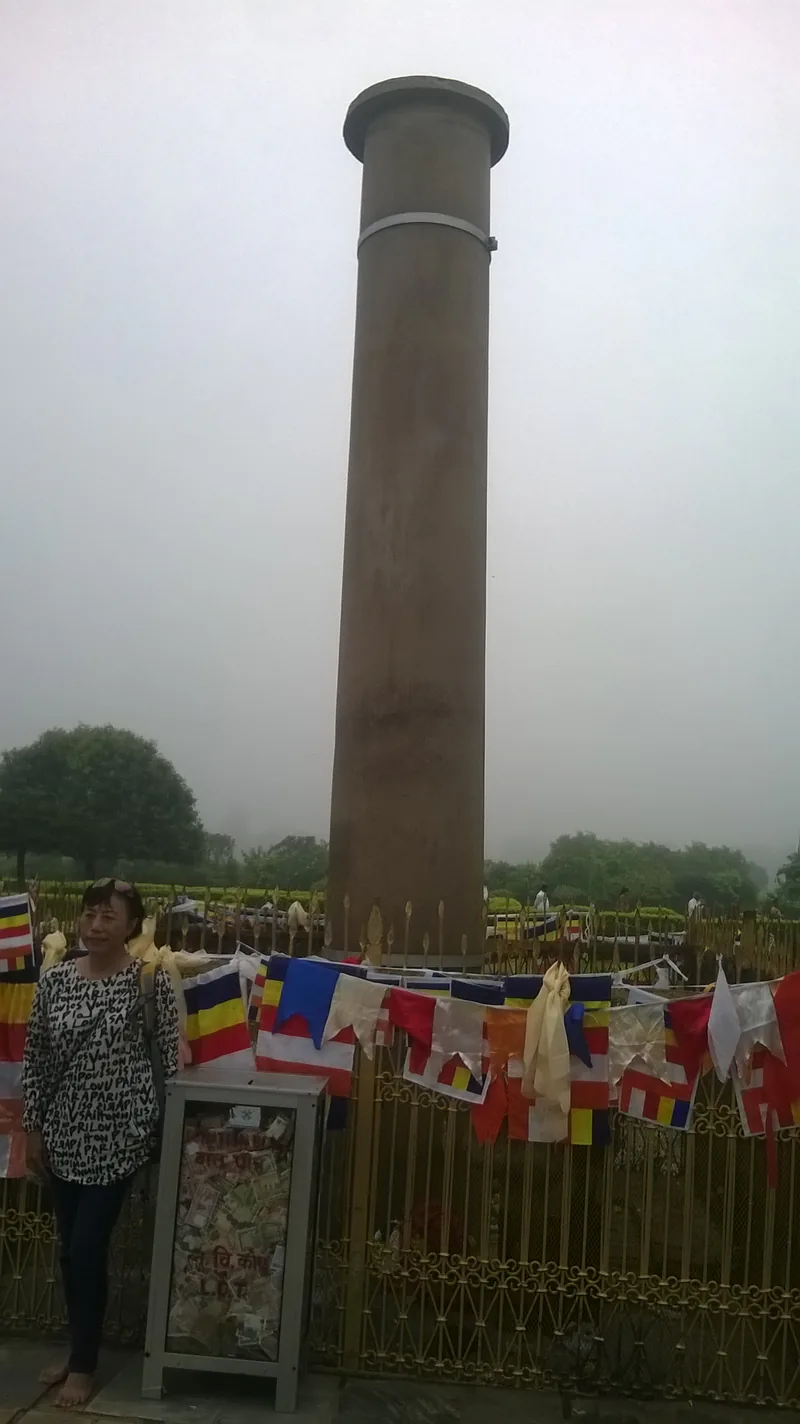
Its identification rests on unusually strong evidence. In 1896 a stone pillar was uncovered there bearing an inscription of the Mauryan emperor Ashoka. It records that in the twentieth year after his consecration, usually dated around 249 BCE, the king came in person and worshipped, because here the Buddha Shakyamuni was born; that he had a stone pillar set up; and that he reduced the village's tax. The inscription is one of the earliest datable witnesses to Buddhist pilgrimage anywhere.
The modern Maya Devi Temple stands over the excavated remains of earlier shrines beside a sacred pool. Excavations in the 2010s reported traces of a timber structure beneath the brick temples, which the excavators interpreted as a very early shrine, though its dating and significance remain debated. The site of Kapilavastu itself is disputed between Tilaurakot in Nepal and Piprahwa in India. Lumbini was inscribed as a World Heritage Site in 1997, and a large development zone of monasteries built by Buddhist countries now surrounds the sacred garden.
Bodh Gaya and the Mahabodhi Temple§
Bodh Gaya, in Bihar, is the most important of the four places, for it was there, beneath a fig tree beside the Niranjana river, that Siddhartha is said to have attained awakening and become the Buddha. Tradition calls the spot the vajrasana, the "diamond seat", the one immovable point of the world on which every buddha attains enlightenment.
A stone slab identified as the vajrasana is usually dated to Ashoka's time, and carved stone railings around the site go back to roughly the first century BCE. The towering Mahabodhi Temple, a pyramidal brick structure some fifty metres high, took its basic form around the fifth or sixth century CE and has been repaired many times, including by Burmese missions in the eleventh and nineteenth centuries and a major British restoration under Alexander Cunningham in the 1880s. The present bodhi tree is regarded as a descendant of the original; the famous tree at Anuradhapura in Sri Lanka is held to have grown from a cutting brought there in the third century BCE.
In the modern period Bodh Gaya became the focus of a long struggle. The temple had for centuries been in the custody of a Hindu Shaiva abbot. In 1891 the Sri Lankan reformer Anagarika Dharmapala founded the Maha Bodhi Society to restore it to Buddhist care, beginning decades of litigation and campaigning. The Bodh Gaya Temple Act of 1949 placed the temple under a joint committee of Buddhists and Hindus, an arrangement that some Buddhist groups continue to campaign to change. Today monasteries built by Tibetan, Thai, Japanese, Bhutanese, Burmese and many other communities surround the temple, and major ceremonies, including Kalachakra initiations given by the Dalai Lama, have drawn hundreds of thousands. The temple complex became a World Heritage Site in 2002.
Sarnath and the First Sermon§
After his awakening, according to the texts, the Buddha walked to the deer park at Isipatana near Varanasi to find the five ascetics who had once practised with him. There he gave his first discourse, "Setting in Motion the Wheel of the Dharma", which set out the Middle Way and the Four Noble Truths, and the first members of the monastic community were ordained. The place is now called Sarnath.
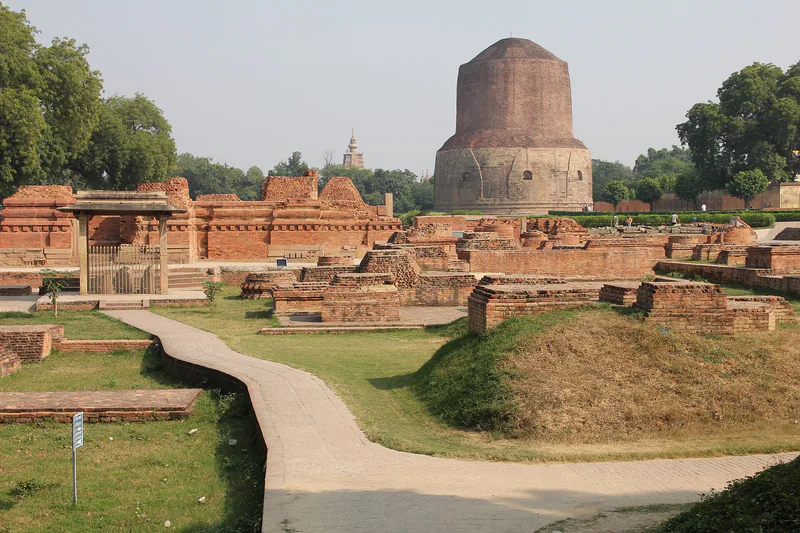
Sarnath became a major monastic centre. Ashoka erected a polished sandstone pillar crowned by four lions standing back to back above a wheel; the lion capital, found in excavations in 1905, is today the national emblem of India, and the wheel appears on the Indian flag. The great Dhamek Stupa, in its present form largely of the Gupta period around the fifth or sixth century CE, still rises over the ruins of monasteries, and the Gupta-period seated Buddha "turning the wheel of the Dharma", now in the Sarnath museum, is one of the masterpieces of Indian art.
Not every monument survived: in 1794 workmen of a local official dismantled the Dharmarajika stupa for bricks, finding a relic casket inside. In 1931 the Maha Bodhi Society completed the Mulagandhakuti Vihara, a new temple decorated with murals of the Buddha's life by the Japanese painter Kosetsu Nosu.
Kushinagar and the Final Nirvana§
The Buddha died, according to the Mahaparinibbana Sutta, at Kusinara, a minor town of the Malla people, lying on his right side between two sal trees, at about the age of eighty. His last words urged his disciples to strive on with diligence, for all conditioned things are subject to decay. The modern town of Kushinagar in Uttar Pradesh has been identified with Kusinara since the nineteenth century, on the basis of Chinese pilgrims' descriptions and inscriptions found at the site.
The Mahaparinirvana Temple, a modern reconstruction, shelters a large reclining image of the dying Buddha excavated in 1876. An inscription records it as the gift of a monk named Haribala, and it is usually dated to the fifth century. Behind the temple stands the main stupa, and a short distance away the Ramabhar stupa marks the traditional site of the cremation, after which, the sutta relates, the relics were divided among eight claimants, each of whom built a stupa over their share.
The Eight Great Places, Relics and the Modern Revival§
Later tradition added four sites associated with miracles: Shravasti, where the Buddha performed the "twin miracle" of fire and water; Sankasya, where he descended from the heaven of the thirty-three gods after teaching his mother; Rajagriha, where he tamed a maddened elephant; and Vaishali, where a monkey offered him honey. Together with the original four these formed the "eight great places" (ashtamahasthana), often shown together on stone steles and in manuscript paintings of the Pala period in eastern India.
Relics gave pilgrimage a further dimension. Legend credits Ashoka with redistributing the Buddha's relics into 84,000 stupas across his empire. In 1898 a relic deposit with an inscribed urn was excavated at Piprahwa, which some scholars associate with the Buddha's own Shakya clan; in 2025 a planned auction of gems from that deposit was halted after objections from the Indian government, and they were returned to India.
Chinese pilgrims such as Faxian in the early fifth century and Xuanzang in the seventh described the holy places in detail, often while studying at monasteries such as Nalanda. After Buddhism declined in north India, many sites were abandoned or absorbed into other uses, though Burmese and Tibetan pilgrims never entirely ceased to come. Their recovery in the nineteenth century, through British archaeology, Sri Lankan and Burmese activism and popular works such as Edwin Arnold's poem The Light of Asia (1879), was part of the wider modern reshaping of Buddhism described in Buddhism in the West. Comparable pilgrimage networks in a neighbouring tradition are discussed in Jain temples and pilgrimage.
Frequently asked questions§
What are the four holy places of Buddhism?§
They are Lumbini in Nepal, the Buddha's birthplace; Bodh Gaya in Bihar, India, the place of his awakening; Sarnath near Varanasi, where he gave his first sermon; and Kushinagar in Uttar Pradesh, where he died and attained final nirvana.
Why is Bodh Gaya important?§
Bodh Gaya is where, according to tradition, Siddhartha Gautama attained awakening under the bodhi tree and became the Buddha. Its Mahabodhi Temple and the descendant of the bodhi tree make it the most important pilgrimage site in the Buddhist world.
How do we know Lumbini was the Buddha's birthplace?§
The main evidence is a pillar erected by the emperor Ashoka, found in 1896, whose inscription states that the Buddha Shakyamuni was born at that spot and that Ashoka visited it in person. It shows that the site was identified as the birthplace by the third century BCE.
What are the eight great places of Buddhism?§
They are the four main sites — Lumbini, Bodh Gaya, Sarnath and Kushinagar — together with Shravasti, Sankasya, Rajagriha and Vaishali, each associated with a miracle of the Buddha. The group became a standard theme in Indian Buddhist art from around the eighth century.
Sources and further reading§
- The Long Discourses of the Buddha: A Translation of the Digha Nikaya — Maurice Walshe, 1987
- A Record of Buddhistic Kingdoms — James Legge, 1886
- Si-Yu-Ki: Buddhist Records of the Western World — Samuel Beal, 1884
- Bodhgaya: The Site of Enlightenment — Janice Leoshko (ed.), 1988
- The Revival of Buddhist Pilgrimage at Bodh Gaya (1811–1949): Anagarika Dharmapala and the Mahabodhi Temple — Alan Trevithick, 2006
- The Buddha and the Sahibs: The Men Who Discovered India's Lost Religion — Charles Allen, 2002