Liber IV · Buddhism · Chapter V: The Life of the Buddha
The Life of the Buddha: Siddhartha Gautama in History and Legend
The life of the Buddha, Siddhartha Gautama: birth at Lumbini, the renunciation, awakening at Bodh Gaya, the first sermon, his death and the debated dates.

The Buddha was Siddhartha Gautama, the founder of Buddhism and a man of the Shakya clan who, according to tradition, renounced a princely life, attained awakening (bodhi) at Bodh Gaya in northern India, taught for about forty-five years and died at Kushinagar at the age of eighty. Historians accept that he was a real person, but his exact dates are disputed — most now place his death around 400 BCE — and the familiar story of his life was assembled gradually from early discourses and later devotional biographies.
Dating the Buddha and the Sources for His Life§
No biography of the Buddha survives from his own lifetime. The oldest sources are the discourses (suttas or sutras) and monastic rules (vinaya) preserved by the early schools, which were transmitted orally for several centuries before being written down. They contain scattered episodes — his going forth, his ascetic practice, his awakening, his last journey — but no continuous life. Connected biographies appear later: the Sanskrit poem Buddhacarita ("Acts of the Buddha") by Ashvaghosha, usually dated to the first or second century CE; the Lalitavistara, a Mahayana-influenced account of his early life; the Mahavastu; and the Pali Nidanakatha, the introduction to the commentary on the Jataka tales of his former lives.
The dates of his life are uncertain. Theravada tradition places his final nirvana in 544 or 543 BCE, a reckoning still used for the Buddhist era in Sri Lanka and Southeast Asia. Older Western scholarship, working from Ashoka's reign and the Sri Lankan chronicles, favoured a death around 486–483 BCE. A major conference organised by the German scholar Heinz Bechert in 1988 helped popularise a "short chronology", and many historians today place his death within a few decades of 400 BCE. All accounts agree that he lived about eighty years.
Birth at Lumbini and the Young Prince§
Siddhartha ("he whose aim is accomplished") was born, the tradition says, to Suddhodana, chief of the Shakya clan, and his wife Maya, in the grove of Lumbini near the Shakya town of Kapilavastu. Historians point out that the Shakyas were probably governed by an assembly of leading families rather than by a king in the later sense, so his "princely" status was likely that of a noble clan's son. In 1896 an inscribed pillar of the emperor Ashoka was identified at Lumbini; it records the emperor's visit and states that the Buddha was born there, making it one of the earliest firm points in Buddhist history.
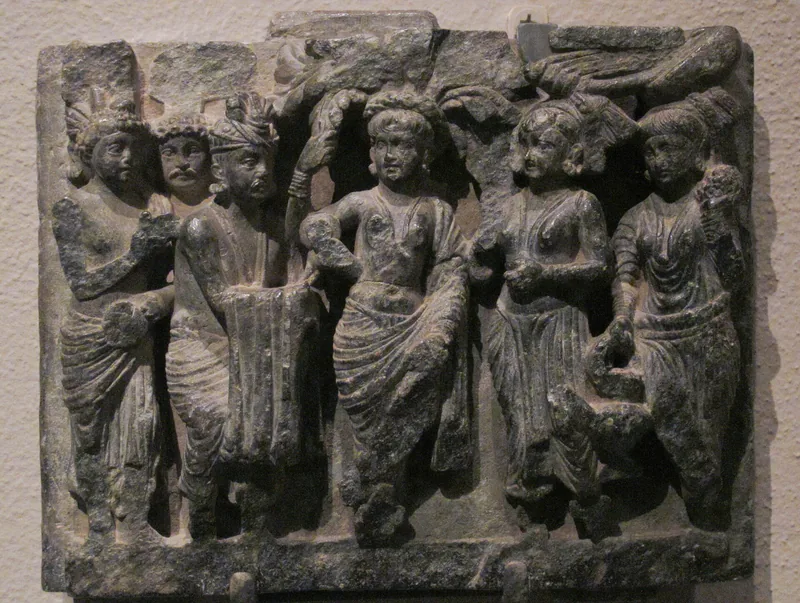
The later biographies surround the birth with wonders: the mother's dream of a white elephant entering her side, the child born from her right side while she stood holding a branch, his first seven steps and declaration that this would be his last birth. The sage Asita predicted that the child would become either a universal monarch or a buddha. Maya died seven days after the birth, and Siddhartha was raised by her sister Mahaprajapati Gotami, who would later become the first Buddhist nun. He married Yashodhara, and their son was named Rahula.
The Four Sights and the Great Renunciation§
In the best-known version of the story, Suddhodana, determined that his son should become a ruler rather than a renunciant, kept him in luxury and shielded him from every sign of suffering. On excursions from the palace, however, Siddhartha saw in turn an old man, a sick man, a corpse and a wandering ascetic. Shaken by the first three and inspired by the fourth, he left the palace at night on his horse Kanthaka, accompanied by his charioteer Channa, cut off his hair and put on the robe of a mendicant. This "Great Renunciation" is traditionally placed when he was twenty-nine.
Scholars note that the Pali canon tells the Four Sights not of Siddhartha but of Vipassi, a buddha of a remote past age, in a discourse that presents the events as the pattern followed by every buddha. In the discourses that speak of Gautama himself, the departure is told simply: he shaved his head and went forth while his mother and father wept. The difference illustrates how the biography grew, as a model life common to all buddhas was attached to the historical teacher.
Ascetic Years and Awakening at Bodh Gaya§
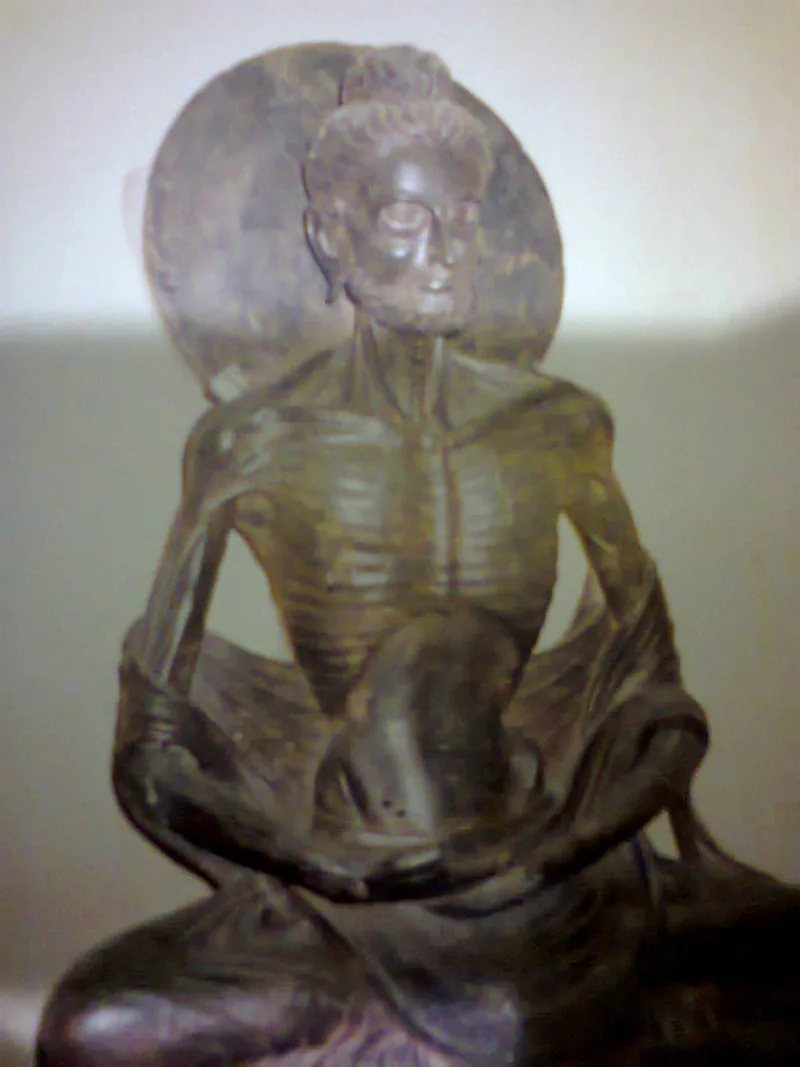
As a wandering shramana — one of many renunciants of the age, among them the followers of Mahavira, whose tradition became Jainism — Siddhartha studied meditation under two teachers, Alara Kalama and Uddaka Ramaputta, mastering the highest formless states they taught, but he judged that these did not lead to final liberation. He then practised extreme austerities with five companions, fasting until, the texts say, his body was reduced to skin and bone. Concluding that self-mortification was as fruitless as indulgence, he accepted a meal of milk-rice from a young woman named Sujata. His companions left him in disgust. This rejection of both extremes became the "middle way" that he later taught.
He then sat beneath an ashvattha tree — a sacred fig, later called the bodhi tree — at the place now known as Bodh Gaya in Bihar, resolved not to rise until he had understood. The biographies describe an assault by Mara, the deity of desire and death, with armies and seductive daughters; Siddhartha touched the earth to call it to witness his past merit, a gesture (the bhumisparsha mudra) that became one of the most common forms of the Buddha image. During the three watches of the night he recalled his past lives, saw beings dying and being reborn according to their karma, and realised the destruction of the defilements and the Four Noble Truths. He was then, by tradition, thirty-five years old.
The First Sermon and Forty-Five Years of Teaching§
The texts say that the Buddha hesitated to teach, thinking the truth too subtle for others, until the god Brahma Sahampati begged him to do so. He went to the Deer Park at Isipatana, now Sarnath near Varanasi, and taught his five former companions the middle way and the Four Noble Truths. This discourse, the Dhammacakkappavattana Sutta, "setting in motion the wheel of the Dharma", is the foundation of the core teachings of Buddhism. One of the five, Kondanna, understood at once and became the first disciple; the community of monks, the Sangha, began that day.
For the rest of his life the Buddha walked the roads of the Ganges plain, staying in one place only during the three months of the monsoon rains. Kings such as Bimbisara of Magadha and Pasenadi of Kosala became his patrons, and wealthy lay followers donated parks for the community, most famously the Jetavana at Shravasti given by the merchant Anathapindika. His chief disciples included Shariputra and Maudgalyayana, and his cousin Ananda served as his attendant. At Ananda's request, according to the texts, he agreed to ordain women, beginning with his foster-mother Mahaprajapati. The story of his cousin Devadatta, who sought to lead the order and plotted against him, shows that the early community also knew conflict.
The Final Nirvana at Kushinagar and the Relics§
The Mahaparinibbana Sutta describes the Buddha's last journey in unusual detail. At about eighty, ill and frail, he travelled north with Ananda, taught the monks that they should take the Dharma and the discipline as their guide after his death, and ate a last meal offered by Cunda, a smith; the dish, sukaramaddava, has been interpreted both as a kind of pork and as a mushroom, and the question remains unresolved. Seriously ill, he lay down between two sal trees at Kushinagar. His last words, in the Pali tradition, were roughly: "Conditioned things are subject to decay; strive on with heedfulness." He passed into final nirvana (parinirvana), a state from which, in Buddhist understanding, there is no further rebirth.
His body was cremated and the relics divided into eight portions among the peoples and kings who claimed them, each enshrining a share in a stupa. In 1898 an inscribed relic casket was excavated at Piprahwa in northern India; its Brahmi inscription has been read as identifying the remains as relics of the Buddha of the Shakyas, though the reading and date are debated. Relic veneration spread across Asia and remains central to Buddhist devotion.
The Buddha's Life in Art and Pilgrimage§
Early Buddhist art at sites such as Bharhut and Sanchi represented the Buddha by symbols — a footprint, an empty seat, a tree, a wheel — rather than in human form. Anthropomorphic images appear around the first century CE in Gandhara and Mathura, and scenes of the life story became a staple of reliefs, murals and paintings throughout Asia. The four places associated with his birth, awakening, first sermon and death, recommended as places of pilgrimage in the Mahaparinibbana Sutta itself, are still visited by Buddhists from every tradition. Mahayana thought later reinterpreted the life as a display performed by an already awakened being for the benefit of the world, a view explored in Mahayana Buddhism; the many previous lives and other buddhas belong to the vast time-scale of Buddhist cosmology.
Frequently asked questions§
Was the Buddha a real historical person?§
Most historians accept that the Buddha was a real teacher of the fifth or fourth century BCE. The Lumbini pillar of Ashoka, the consistency of the early texts about places and people, and the existence of the community he founded all point to a historical founder. Many details of the traditional biography, however, are later elaborations.
Was the Buddha a god?§
In early Buddhism the Buddha is a human being who achieved complete awakening, superior even to the gods but not a creator deity. Later Mahayana traditions describe buddhas with transcendent, cosmic dimensions, and Buddhists across Asia venerate his images and relics. He is nonetheless not understood as a god in the sense of a creator or ruler of the world.
What does "Buddha" mean?§
"Buddha" is a Sanskrit and Pali title meaning "awakened" or "one who has woken up". It is not a personal name. The historical Buddha is also called Shakyamuni, "sage of the Shakyas", and Tathagata, "thus-gone", the title he used of himself in the texts.
Where was the Buddha born?§
Tradition and the Ashokan inscription place his birth at Lumbini, in the Terai of southern Nepal near the border with India. The location of his home town Kapilavastu is disputed between sites in Nepal and India.
Sources and further reading§
- The Life of the Buddha According to the Pali Canon — Bhikkhu Ñāṇamoli, 1972
- Life of the Buddha (Buddhacarita) — Ashvaghosha, 2008
- The Buddha — Michael Carrithers, 1983
- Buddha — Karen Armstrong, 2001
- The Long Discourses of the Buddha: A Translation of the Digha Nikaya — Maurice Walshe, 1987
- Greater Magadha: Studies in the Culture of Early India — Johannes Bronkhorst, 2007