Liber IV · Buddhism · Chapter III: Buddhist Scriptures
Buddhist Scriptures: The Pali Canon, Mahayana Sutras and Tantras
A guide to Buddhist scriptures: the Pali Canon or Tipitaka, the Agamas, Mahayana sutras such as the Lotus and Heart Sutras, the tantras and the Asian canons.

Buddhist scriptures are the collections of the Buddha's teachings and related works preserved by the different schools: the Pali Canon or Tipitaka of Theravada Buddhism, the parallel early texts preserved in Chinese and other languages, the Mahayana sutras such as the Lotus, Heart and Diamond Sutras, and the Vajrayana tantras. Unlike the Bible or the Qur'an, there is no single Buddhist scripture accepted by all Buddhists; each tradition has its own canon, and the Chinese and Tibetan canons alone run to hundreds of volumes.
From Oral Recitation to Written Text§
Buddhist tradition holds that soon after the Buddha's death five hundred senior monks met at Rajagriha in the First Council. The Buddha's attendant Ananda recited the discourses and the monk Upali recited the monastic rules, which the assembly then chanted together. Modern historians regard the account as an idealised foundation story, but it reflects a real practice: the teachings were preserved by groups of monks who specialised in memorising and reciting particular collections. The repetitive style of the early texts, with its stock phrases and numbered lists, is characteristic of oral literature.
The Sri Lankan chronicles report that the Pali scriptures were first committed to writing at the Aluvihara monastery in the first century BCE, during a time of famine and war when monks feared that the oral tradition might be lost. The oldest surviving Buddhist manuscripts, however, come from the north-west of the subcontinent: birch-bark scrolls in the Gandhari language, written in Kharoshthi script, which have come to light since the 1990s and are dated to roughly the first century BCE to the third century CE. They show that several early schools had their own textual traditions, in several Indian languages, of which the Pali Canon is the only one to survive complete.
The Pali Canon: The Tipitaka§
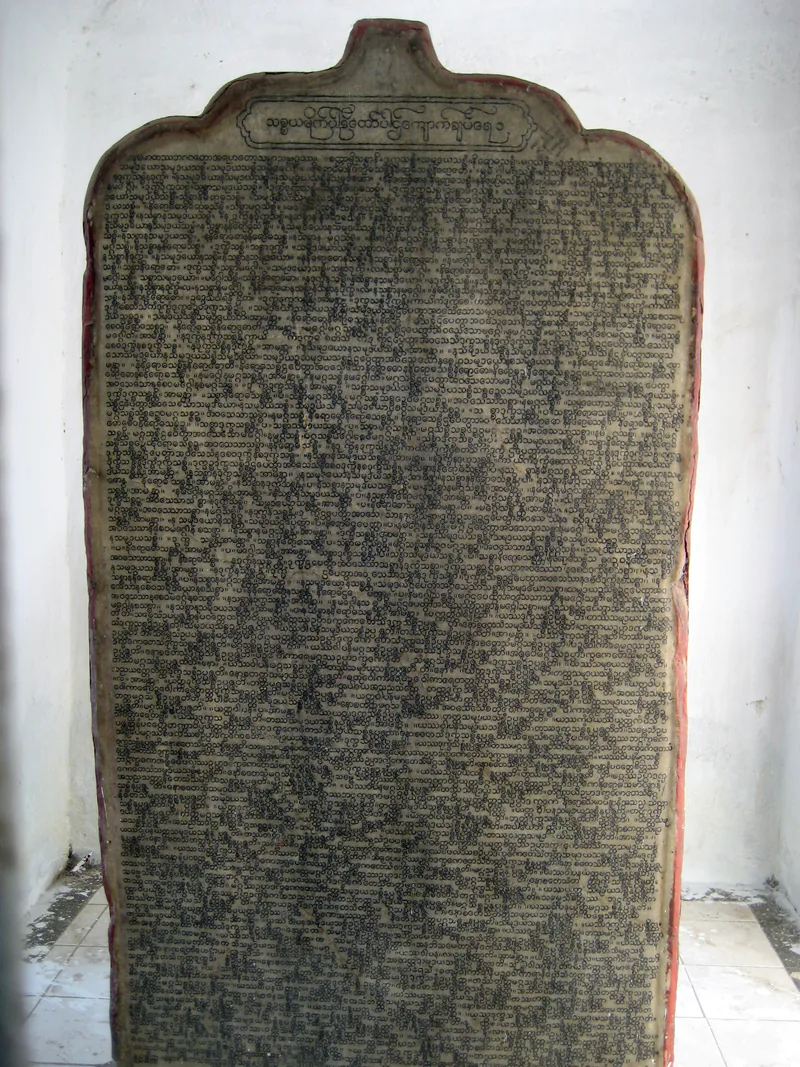
The canon of the Theravada school is called the Tipitaka, "three baskets", and is preserved in Pali, a Middle Indo-Aryan language related to the dialects the Buddha spoke.
The Vinaya Pitaka§
The "basket of discipline" contains the rules of the monastic order, with the story of the incident that led the Buddha to lay down each rule, and the procedures for ordination, the rains retreat and the resolution of disputes. It is a rich source for the history of early monasticism, described further in our article on Buddhist monastic life.
The Sutta Pitaka§
The "basket of discourses" is divided into five collections (nikayas): the Long Discourses (Digha Nikaya), the Middle-Length Discourses (Majjhima Nikaya), the Connected Discourses (Samyutta Nikaya), grouped by theme, the Numerical Discourses (Anguttara Nikaya), arranged by the number of items discussed, and the Minor Collection (Khuddaka Nikaya). The last is a miscellany that includes some of the most loved Buddhist works: the Dhammapada, a collection of 423 verses on the moral and spiritual life; the Sutta Nipata, which contains some of the oldest poetry in the canon; the Theragatha and Therigatha, verses of the early monks and nuns; and the Jataka, stories of the Buddha's former lives.
The Abhidhamma Pitaka§
The "basket of higher teaching" consists of seven treatises that analyse experience into its smallest constituents (dhammas) and classify their relationships. Most scholars consider it later than the discourses, compiled over the last centuries BCE.
Around the canon grew a vast commentarial literature, much of it edited or composed in Pali by Buddhaghosa, who worked in Sri Lanka in the fifth century CE; his Visuddhimagga ("Path of Purification") is the classic summary of Theravada doctrine and meditation. Modern Western study of the canon was shaped by the Pali Text Society, founded in London by T. W. Rhys Davids in 1881, which published the texts in roman script and in translation.
Other Early Canons: The Agamas§
Other early schools had their own collections of discourses, called agamas. Four of these survive almost complete in Chinese translations made between the fourth and fifth centuries CE, and they correspond broadly to the first four Pali nikayas. Comparing the Pali and Chinese versions, along with fragments in Sanskrit, Gandhari and Tibetan, allows scholars to identify a common core of doctrine that probably goes back to the earliest generations of the community. These comparative studies have reinforced the view that the core teachings of Buddhism — the Four Truths, the Eightfold Path, not-self and dependent origination — belong to that early layer.
The Mahayana Sutras§
From around the first century BCE new scriptures appeared that also presented themselves as teachings of the Buddha, often set before vast assemblies of bodhisattvas and gods. Their followers called their movement the Mahayana, the "Great Vehicle". Earlier Buddhists generally did not accept these texts, and Mahayana authors defended them by arguing that whatever is well spoken is the word of the Buddha, or that they had been hidden until people were ready for them.
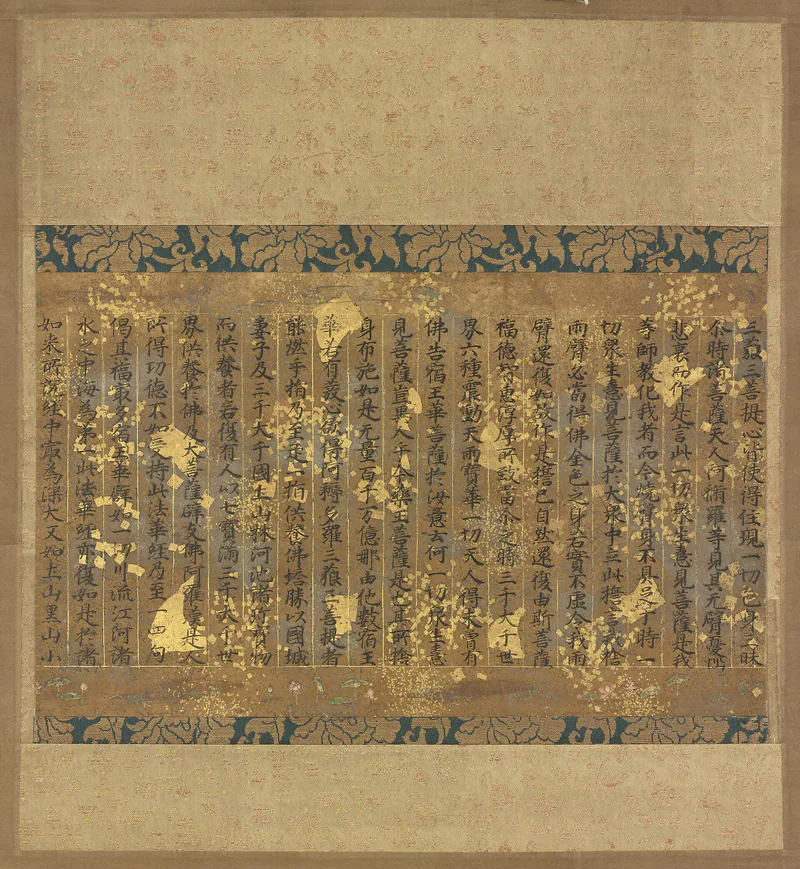
Among the most important are:
- The Perfection of Wisdom (Prajnaparamita) sutras, which teach emptiness and the bodhisattva path. The earliest is usually thought to be the version in 8,000 lines; later came longer and shorter versions, including the Diamond Sutra and the very short Heart Sutra, chanted daily across East Asia.
- The Lotus Sutra (Saddharmapundarika), which teaches that the three vehicles are skilful means leading to a single vehicle of buddhahood, and that the Buddha's life span is immeasurable. It became the central text of the Tiantai and Tendai schools and of Nichiren Buddhism.
- The Vimalakirti Sutra, in which a wise layman outshines the Buddha's monastic disciples.
- The Avatamsaka or Flower Garland Sutra, a vast vision of interpenetrating worlds, the basis of the Huayan school.
- The Pure Land sutras, which describe the land of the Buddha Amitabha and are the foundation of Pure Land Buddhism.
- The Lankavatara and the tathagatagarbha sutras, which teach mind-only and buddha-nature doctrines.
The earliest datable evidence for Mahayana sutras comes from Chinese translations made by the Central Asian monk Lokakshema in the second half of the second century CE, and from Gandhari manuscripts, including a fragment of the 8,000-line Perfection of Wisdom that radiocarbon dating places in roughly the first or second century CE.
The Buddhist Tantras§
From about the seventh century a further class of scriptures, the tantras, taught ritual methods involving mantra, mandala, initiation and the visualisation of deities. Important examples include the Mahavairocana Sutra, central to Japanese Shingon, and the Guhyasamaja, Hevajra, Chakrasamvara and Kalachakra tantras, the last usually dated to the early eleventh century. These texts are the basis of Vajrayana Buddhism and were traditionally studied only after initiation and with a qualified teacher.
The Chinese and Tibetan Canons§
The Chinese canon grew through a thousand years of translation, from the second century to the eleventh, carried out by figures such as Kumarajiva (344–413 or 350–409) and the pilgrim Xuanzang (c. 602–664). It also includes works composed in China and treatises by East Asian masters. One of the world's earliest dated printed books is a copy of the Diamond Sutra found at Dunhuang, dated 868 CE. The Korean Tripitaka Koreana, carved in the thirteenth century on more than 80,000 woodblocks, is preserved at the Haeinsa temple, and the modern standard edition, the Japanese Taisho canon (1924–1934), fills a hundred volumes.
The Tibetan canon has two parts: the Kangyur, the "translated word" of the Buddha, including sutras, tantras and Vinaya, and the Tengyur, translated treatises by Indian masters. It was organised in its classic form in the fourteenth century, associated with the scholar Buton Rinchen Drub, and preserves many Indian works lost in Sanskrit. It is described further in Tibetan Buddhism.
Frequently asked questions§
What is the Buddhist holy book?§
There is no single holy book shared by all Buddhists. Theravada Buddhists follow the Pali Canon; East Asian Buddhists use the Chinese canon and often focus on particular sutras such as the Lotus or Heart Sutra; Tibetan Buddhists follow the Kangyur and Tengyur. The Dhammapada is often recommended as a short introduction.
How long is the Pali Canon?§
The Pali Canon is very large: the Pali Text Society's roman-script edition of the canon alone fills several dozen volumes, and complete English translations run to many thousands of pages. It is often said to be several times the length of the Bible.
Did the Buddha write any scriptures?§
No. The Buddha taught orally, and his teachings were memorised and recited by his disciples. Writing came centuries later. Scholars therefore study the scriptures as records of a community's memory, in which the Buddha's own words are embedded in later editing and expansion.
Sources and further reading§
- Buddhist Scriptures — Donald S. Lopez Jr. (ed.), 2004
- In the Buddha's Words: An Anthology of Discourses from the Pali Canon — Bhikkhu Bodhi, 2005
- The Middle Length Discourses of the Buddha — Bhikkhu Ñāṇamoli & Bhikkhu Bodhi, 1995
- The Lotus Sutra — Burton Watson (trans.), 1993
- The Perfection of Wisdom in Eight Thousand Lines and Its Verse Summary — Edward Conze (trans.), 1973
- The Path of Purification (Visuddhimagga) — Buddhaghosa, 1956