Liber IV · Buddhism · Chapter IV: Core Teachings
Dependent Origination: The Twelve Links in Buddhist Teaching
Dependent origination explained: the twelve links from ignorance to death, their place in the Pali suttas, the Abhidharma, Nagarjuna and the Wheel of Life.

Dependent origination (Pali paticca-samuppada, Sanskrit pratityasamutpada) is the Buddhist teaching that everything arises in dependence on conditions and ceases when those conditions cease. Its best-known form is a chain of twelve links (nidanas) running from ignorance to ageing and death, which explains how suffering and rebirth come about without a permanent self — and how, by removing ignorance, the whole chain can be brought to an end.
What Dependent Origination Means§
At its simplest, dependent origination is a statement about causality. The early discourses give it in a compact, almost abstract formula, which may be rendered: when this exists, that comes to be; with the arising of this, that arises; when this does not exist, that does not come to be; with the cessation of this, that ceases. Nothing, on this view, exists by itself or arises from a single first cause such as a creator god, a fixed self or blind chance. Everything is a process sustained by other processes.
The teaching sits at the heart of the core teachings of Buddhism because it answers two questions at once: it explains in detail how suffering originates, the second Noble Truth, and how karma and rebirth can work if, as the doctrine of not-self holds, no unchanging soul passes from life to life. What continues is a stream of conditioned events, not a thing.
The early tradition regarded this insight as decisive. In the Mahahatthipadopama Sutta (Middle Length Discourses 28) Sariputta quotes the Buddha as saying that one who sees dependent origination sees the Dharma. A story in the monastic code tells how Sariputta himself was converted when the monk Assaji summed up the teaching in one verse: the Buddha has explained the cause of things that arise from causes, and also their cessation. That verse, in its Sanskrit form beginning ye dharma hetuprabhava, was later inscribed on clay seals, images and stupas across Asia, almost as a relic of the Dharma itself.
The Twelve Links of Dependent Origination§
The most common presentation lists twelve conditions, each giving rise to the next:
- Ignorance (avijja) — not understanding the Four Noble Truths and the true nature of experience.
- Volitional formations (sankhara) — intentional actions of body, speech and mind, that is, karma.
- Consciousness (viññana) — the six types of sense consciousness, and in rebirth the consciousness that "descends" into a new existence.
- Name-and-form (namarupa) — the mental and physical constituents of a living being.
- The six sense bases (salayatana) — eye, ear, nose, tongue, body and mind.
- Contact (phassa) — the meeting of sense organ, object and consciousness.
- Feeling (vedana) — pleasant, painful or neutral tone of experience.
- Craving (tanha) — thirst for sense pleasures, for existence and for non-existence.
- Clinging (upadana) — attachment that hardens craving into grasping.
- Becoming (bhava) — the process of coming into a new state of existence.
- Birth (jati) — the arising of a being in a particular realm.
- Ageing-and-death (jaramarana) — together with sorrow, lamentation, pain, grief and despair.
The sequence can be read forwards (anuloma), showing how suffering arises, or backwards (patiloma), showing how it ceases: with the cessation of ignorance, formations cease, and so on down to the cessation of ageing and death. Tradition holds that the Buddha contemplated the chain in both directions in the weeks after his awakening at Bodh Gaya, as described in the opening of the Udana and of the Vinaya's Great Chapter.
The links are not a mechanical series. Teachers often stress that the turning point lies between feeling and craving: feeling follows from contact, but whether craving follows depends on understanding — the point at which mindfulness intervenes in practice.
Dependent Origination in the Pali Discourses§
The Nidana Samyutta, the twelfth collection of the Connected Discourses, gathers dozens of short suttas on the subject, and the variety among them suggests the twelve-link list was one formulation among several. The Mahanidana Sutta (Long Discourses 15), the "Great Discourse on Causation", gives a version with fewer links in which consciousness and name-and-form condition each other. It opens with the Buddha's disciple Ananda remarking that the teaching, though deep, seems clear to him — and the Buddha replying that he should not say so, because it is precisely through failing to understand it that beings remain tangled in rebirth.
Another discourse pictures this mutual dependence as two sheaves of reeds leaning against each other: remove one and the other falls. In the Nagara Sutta the Buddha compares his discovery to a traveller who finds an overgrown path to an ancient, forgotten city — an order of things rediscovered rather than invented.
The suttas also present a "transcendental" or liberating sequence. The Upanisa Sutta (Connected Discourses 12.23) continues beyond suffering: suffering conditions faith, faith conditions gladness, then joy, tranquillity, happiness, concentration, knowledge and vision of things as they are, disenchantment, dispassion, liberation and finally the knowledge that the defilements are destroyed. Conditionality, in other words, describes the path out as well as the way in.
The Three-Lives Interpretation in the Abhidharma§
The scholastic traditions of the Abhidharma systematised the twelve links into a scheme spanning three lifetimes, an interpretation that became standard in both Theravada and Sarvastivada Buddhism. In the version given by Buddhaghosa in the Visuddhimagga, chapter seventeen:
- Past life: ignorance and formations are the causes laid down in a previous existence.
- Present life (results): consciousness, name-and-form, the six senses, contact and feeling are the fruits of those past causes, arising from the moment of conception.
- Present life (causes): craving, clinging and becoming are new causes generated now.
- Future life: birth and ageing-and-death are their results in the next existence.
The scheme thus shows two sets of causes and two sets of effects linking three lives, and illustrates how karma operates without a self. Vasubandhu's Abhidharmakosha (fourth or fifth century) records that the Sarvastivada also knew other readings — within a single moment, or across long periods — but treated the twelve links primarily as phases in a being's passage through successive lives.
The three-lives reading ties dependent origination to Buddhist cosmology and its realms of rebirth, within the wider Indian framework of karma, samsara and liberation. Some modern teachers object that it turns a teaching about present experience into a theory of reincarnation; defenders reply that the early discourses clearly speak of rebirth.
Nagarjuna, Emptiness and Mahayana Readings§
For the Mahayana, dependent origination became the key to emptiness (shunyata). The philosopher Nagarjuna, probably active in the second century CE, opened his Mulamadhyamakakarika by praising the Buddha for teaching dependent origination as free of eight extremes: no cessation and no arising, no annihilation and no permanence, no coming and no going, no identity and no difference. In its twenty-fourth chapter he declared that dependent origination is what he calls emptiness, that emptiness is itself a dependent designation, and that this is the Middle Way.
Nagarjuna's argument is that a thing which depended on conditions could not possess an independent nature (svabhava); precisely because things arise dependently, they are empty of such a nature. Far from being nihilism, emptiness is what makes change, causation and the path possible.
Other Mahayana texts developed the doctrine in their own ways. The Shalistamba Sutra ("Rice Seedling Sutra") sets outer dependent origination — a seed growing into a plant through earth, water, warmth and time — beside the inner chain of twelve links. In China, the Huayan school spoke of the dependent origination of the whole universe, in which every phenomenon reflects every other, like the jewels of Indra's net. Within the Mahayana the teaching thus grew from an account of suffering into a vision of the interrelatedness of all things.
The Wheel of Life and Modern Interpretations§
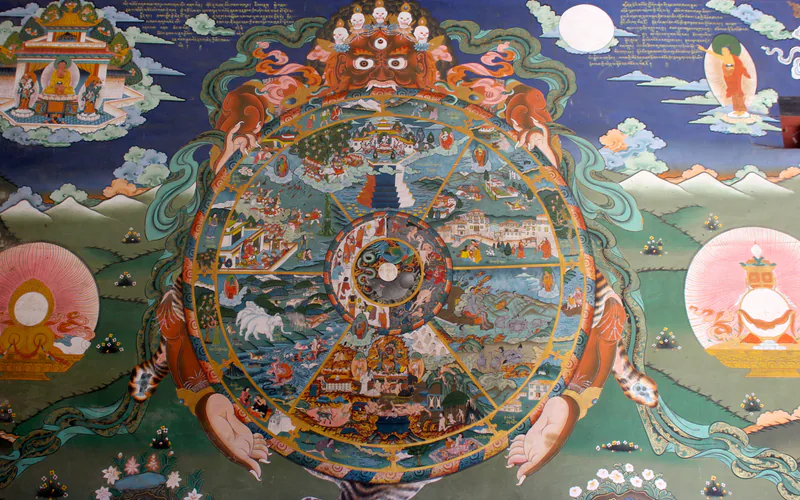
In Tibetan and Himalayan monasteries the twelve links are depicted on the outer rim of the Wheel of Life (bhavachakra), painted in the grip of Yama, lord of death. Each link has a conventional image: a blind person for ignorance, a potter shaping pots for formations, a monkey leaping between branches for consciousness, people in a boat for name-and-form, a house with six openings for the senses, an embracing couple for contact, an arrow in the eye for feeling, a person drinking for craving, someone gathering fruit for clinging, a pregnant woman or couple for becoming, a birth, and a corpse being carried away for ageing and death. The image, still painted in Tibetan Buddhism, makes the doctrine visible to all.
Modern interpretation has taken several directions. The Thai reformer Buddhadasa Bhikkhu (1906–1993) argued that the links describe the arising of "I" and "mine" in a single episode of experience rather than over three lives, a reading still controversial in Theravada circles. Scholars such as Joanna Jurewicz and Richard Gombrich have argued that the chain was formulated in dialogue with Vedic creation myths, in which a primordial being desires and creates name and form. Thich Nhat Hanh popularised the term "interbeing" for a broadly Huayan vision of interdependence, and the doctrine is now often invoked in environmental ethics — an extension that historians of Buddhist modernism regard as new as well as rooted in tradition.
Frequently asked questions§
What are the twelve links of dependent origination?§
They are ignorance, volitional formations, consciousness, name-and-form, the six sense bases, contact, feeling, craving, clinging, becoming, birth, and ageing-and-death. Each is a condition for the next, and together they describe how suffering and rebirth arise and how they can cease.
Is dependent origination the same as karma?§
Not exactly. Karma, intentional action, appears within the chain as the second link (formations) and again as becoming, but dependent origination is a wider account of conditionality. It explains how karma produces results without requiring a permanent self that performs and receives them.
Why is dependent origination important in Mahayana Buddhism?§
Nagarjuna identified it with emptiness: because things arise in dependence on conditions, they lack independent existence. This equation made dependent origination the philosophical basis of Madhyamaka and, through it, of much Tibetan and East Asian Buddhist thought.
Sources and further reading§
- The Connected Discourses of the Buddha: A Translation of the Samyutta Nikaya — Bhikkhu Bodhi, 2000
- The Long Discourses of the Buddha: A Translation of the Digha Nikaya — Maurice Walshe, 1987
- The Path of Purification (Visuddhimagga) — Buddhaghosa, 1956
- The Fundamental Wisdom of the Middle Way: Nagarjuna's Mulamadhyamakakarika — Jay L. Garfield, 1995
- What the Buddha Thought — Richard Gombrich, 2009
- An Introduction to Buddhism: Teachings, History and Practices — Peter Harvey, 1990