Liber IV · Buddhism · Chapter IV: Core Teachings
Core Teachings of Buddhism: Four Noble Truths, Karma and Nirvana
The core teachings of Buddhism explained: the Four Noble Truths, the Eightfold Path, not-self, dependent origination, karma and rebirth, and nirvana.

The core teachings of Buddhism are the Four Noble Truths — suffering, its origin in craving, its cessation, and the path to that cessation — together with the doctrines of impermanence, not-self, dependent origination, karma and rebirth, and the goal of nirvana. Shared in some form by every Buddhist school, these ideas go back to the earliest layer of the scriptures, though each tradition has interpreted and developed them in its own way.
The Four Noble Truths§
The Buddha's first discourse at Sarnath, described in the life of the Buddha, presents his insight as four "noble truths" (Pali ariya-sacca). Commentators have long compared their structure to the practice of a physician, who identifies a disease, its cause, the possibility of cure and the remedy.
- The truth of suffering (dukkha). Birth, ageing, sickness and death are suffering; so are separation from what is loved, union with what is disliked, and not getting what one wants. In brief, the five "aggregates" that make up a person are themselves dukkha. The word means more than pain: it covers the unsatisfactoriness and instability of even pleasant experience.
- The truth of the origin of suffering. Suffering arises from craving or "thirst" (tanha): craving for sense pleasures, craving for existence and craving for non-existence.
- The truth of the cessation of suffering. When craving is completely abandoned, suffering ceases. This cessation is nirvana.
- The truth of the path. The way to cessation is the Noble Eightfold Path.
The texts say that each truth requires a different response: suffering is to be fully understood, its origin abandoned, its cessation realised, and the path developed. The teaching is framed as a "middle way" between indulgence in sense pleasure and harsh self-mortification, both of which the Buddha had tried.
The Noble Eightfold Path§
The fourth truth is set out as eight factors, each described as "right" or "complete" (samma). They are not steps to be taken in sequence but aspects of a single training, traditionally grouped under three heads.
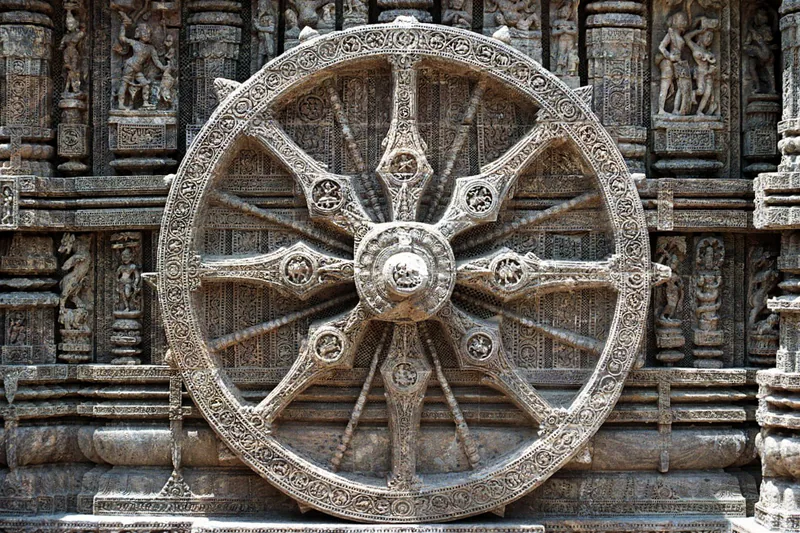
- Wisdom (panna): right view — understanding the Four Truths and the working of karma — and right intention, the resolve toward renunciation, goodwill and harmlessness.
- Ethical conduct (sila): right speech, right action and right livelihood — refraining from lying, harsh and divisive speech, from killing, stealing and sexual misconduct, and from trades that harm others.
- Concentration (samadhi): right effort, right mindfulness and right concentration, the cultivation of the mind through meditation, culminating in the meditative absorptions called jhanas.
For lay people the ethical side is summarised in the five precepts. Monastics follow the much more detailed code of the vinaya. Throughout the tradition the three trainings are seen as mutually supporting: ethical restraint calms the mind, a calm mind can see clearly, and clear seeing transforms conduct.
The Three Marks of Existence and Not-Self§
Buddhist analysis holds that all conditioned things share three characteristics (tilakkhana): they are impermanent (anicca), unsatisfactory (dukkha) and not-self (anatta). The third is the most distinctive Buddhist doctrine and the one that most sharply separated the Buddha from the Upanishadic teachers of his day, who sought liberation through knowledge of an eternal self, the atman.
In a famous early discourse, the Buddha examines the five aggregates (khandhas) that constitute a person — physical form, feeling, perception, mental formations and consciousness — and asks of each whether it is permanent, whether what is impermanent is satisfactory, and whether what is impermanent and unsatisfactory is fit to be regarded as "mine", "I" or "my self". The answer in each case is no. A person, on this view, is a constantly changing process, like a flame or a river, not an unchanging entity.
Interpreters differ on how far the doctrine goes. Some read it as a denial that any self exists; others, noting that the Buddha refused to answer certain metaphysical questions, read it as a practical method for dissolving attachment rather than as a metaphysical thesis. Steven Collins's study Selfless Persons explores how the Theravada tradition handled the tension between the doctrine and the everyday language of persons, which the texts treat as a valid "conventional truth".
Dependent Origination§
If there is no self, what is reborn, and how does suffering arise? The Buddhist answer is dependent origination (Pali paticca-samuppada, Sanskrit pratitya-samutpada): everything arises in dependence on conditions and ceases when those conditions cease. The general principle is often summarised in a simple formula: when this exists, that comes to be; with the arising of this, that arises; when this does not exist, that does not come to be.
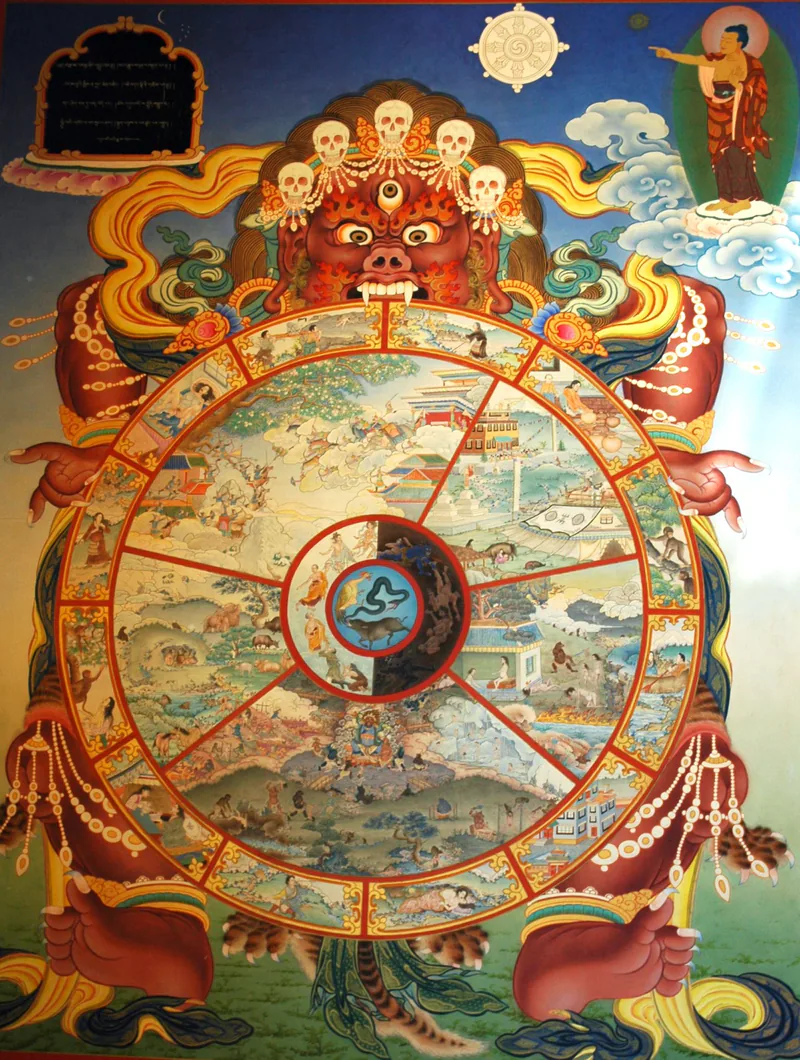
Applied to human existence, the principle takes the form of a chain of twelve links: ignorance conditions mental formations; these condition consciousness; consciousness conditions "name-and-form" (mind and body); these condition the six sense bases; these condition contact; contact conditions feeling; feeling conditions craving; craving conditions clinging; clinging conditions becoming; becoming conditions birth; and birth conditions ageing and death, with all their sorrow. Theravada commentators interpreted the chain as spanning three lives, and it is painted on the rim of the Tibetan wheel of life described in Buddhist cosmology. Breaking the chain at its weakest points — ignorance and craving — is the work of the path.
Karma and Rebirth§
Karma (Pali kamma) means "action". The Buddha defined it as intention: it is the intention behind deeds of body, speech and mind that produces results (vipaka), pleasant or painful, in this life or in future lives. This ethical, psychological understanding distinguished Buddhist karma from the Vedic idea of correct ritual action and from the Jain view of karma as a subtle matter adhering to the soul. Wholesome actions are rooted in generosity, kindness and understanding; unwholesome actions in the three "roots" or "poisons" of greed, hatred and delusion.
Beings are reborn according to their karma in a beginningless cycle called samsara, in realms ranging from hells to heavens. Since Buddhism denies a permanent self, rebirth is not the transmigration of a soul but the continuation of a causal process; the classical image is of one candle lit from another, where the second flame is neither the same as nor different from the first. Buddhism also teaches that not everything that happens to a person is the result of past karma. The wider history of rebirth beliefs in India and beyond is discussed in reincarnation and the afterlife.
Nirvana: The Goal of the Path§
Nirvana (Pali nibbana) means "blowing out" or "extinguishing", the image being of a fire that goes out when its fuel is exhausted. The early texts describe it as the destruction of greed, hatred and delusion, and as the unconditioned: unborn, unageing and deathless. One who attains it in life — an arahant in early Buddhism — lives on with body and mind until death, a state called nirvana "with remainder"; at death comes final nirvana "without remainder", after which there is no further rebirth.
The Buddha declined to say whether an awakened person exists, does not exist, both or neither after death, describing such questions as unhelpful to the path. The early texts therefore describe nirvana mostly in negative terms or by metaphors — the far shore, the island, peace, coolness — and Western debates in the nineteenth century about whether nirvana meant annihilation largely misread this reticence.
Later Developments: Emptiness and Buddha-Nature§
The Mahayana schools reinterpreted these teachings without abandoning them. The Madhyamaka philosopher Nagarjuna (perhaps second century CE) identified dependent origination with emptiness (shunyata): because everything arises dependently, nothing has independent "own-being". Yogacara thinkers analysed the workings of consciousness, and the doctrine of buddha-nature (tathagatagarbha) taught that every being has the potential, or even the hidden reality, of awakening. In East Asia this last idea shaped Zen and Chan and much else. Despite their differences, all schools continue to regard the Four Noble Truths as the foundation of the Dharma.
Frequently asked questions§
What are the Four Noble Truths in simple terms?§
They are four statements: life involves suffering and dissatisfaction; this suffering is caused by craving; suffering can come to an end; and the Noble Eightfold Path leads to its end. Together they form the Buddha's first sermon and the framework of Buddhist teaching.
If there is no self, what is reborn?§
Buddhism teaches that rebirth is the continuation of a stream of causes, not the passage of an unchanging soul. The karma and mental tendencies of one life condition the arising of the next, much as one flame can light another. The new being is neither entirely the same as nor entirely different from the old.
Is karma the same as fate?§
No. In Buddhist teaching karma is intentional action, and present intentions shape the future just as past ones shape the present. The texts explicitly reject the idea that everything experienced is caused by past deeds, and they stress that a person can change direction through ethical effort and understanding.
Sources and further reading§
- What the Buddha Taught — Walpola Rahula, 1959
- In the Buddha's Words: An Anthology of Discourses from the Pali Canon — Bhikkhu Bodhi, 2005
- The Foundations of Buddhism — Rupert Gethin, 1998
- Selfless Persons: Imagery and Thought in Theravada Buddhism — Steven Collins, 1982
- Nirvana and Other Buddhist Felicities — Steven Collins, 1998
- How Buddhism Began: The Conditioned Genesis of the Early Teachings — Richard Gombrich, 1996