Liber VIII · Eastern Mysticism · Chapter XIII: Zen & Chan
Zen and Chan Buddhism: History, Koans and Seated Meditation
Zen and Chan Buddhism explained: Bodhidharma, Huineng and the Platform Sutra, the five houses, koans and silent illumination, Dogen, Hakuin and Zen in the West.

Zen, known in China as Chan, in Korea as Seon and in Vietnam as Thien, is a school of Mahayana Buddhism that arose in China around the sixth to eighth centuries and presents itself as a "special transmission outside the scriptures" from mind to mind. It emphasises seated meditation (zazen), direct insight into one's own Buddha-nature and, in many lineages, the contemplation of paradoxical teaching cases called koans.
The Origins of Chan and the Legend of Bodhidharma§
Chan tradition traces itself to the Buddha, who is said to have held up a flower before his assembly; only the disciple Mahakashyapa smiled, receiving the wordless transmission. Through a line of Indian patriarchs the teaching passed to Bodhidharma, a monk from India or Central Asia who came to China around the late fifth or early sixth century. Legends describe him sitting facing a wall for nine years and telling the Emperor Wu of Liang that building temples earned "no merit." His disciple Huike is said to have cut off his own arm to show his sincerity.
Historians read these stories differently. The discovery in the early twentieth century of manuscripts sealed in a cave at Dunhuang revealed early Chan texts showing a far more varied movement, the "East Mountain" community of Daoxin and Hongren in the seventh century among its roots. John McRae put the scholarly view provocatively: Chan's genealogies are not historically true, and for that very reason they matter, because they show how the tradition understood itself. The lineage served to authorise teachers and to claim that awakening could be transmitted directly.
Huineng, the Platform Sutra and Sudden Awakening§
The central figure of Chan legend is Huineng (638–713), the Sixth Patriarch. In the Platform Sutra he appears as an illiterate woodcutter from the south who hears the Diamond Sutra recited and awakens. At Hongren's monastery the senior monk Shenxiu writes a verse comparing the mind to a mirror that must be constantly wiped clean; Huineng replies that there is no mirror and nothing on which dust could alight, and secretly receives the patriarch's robe.
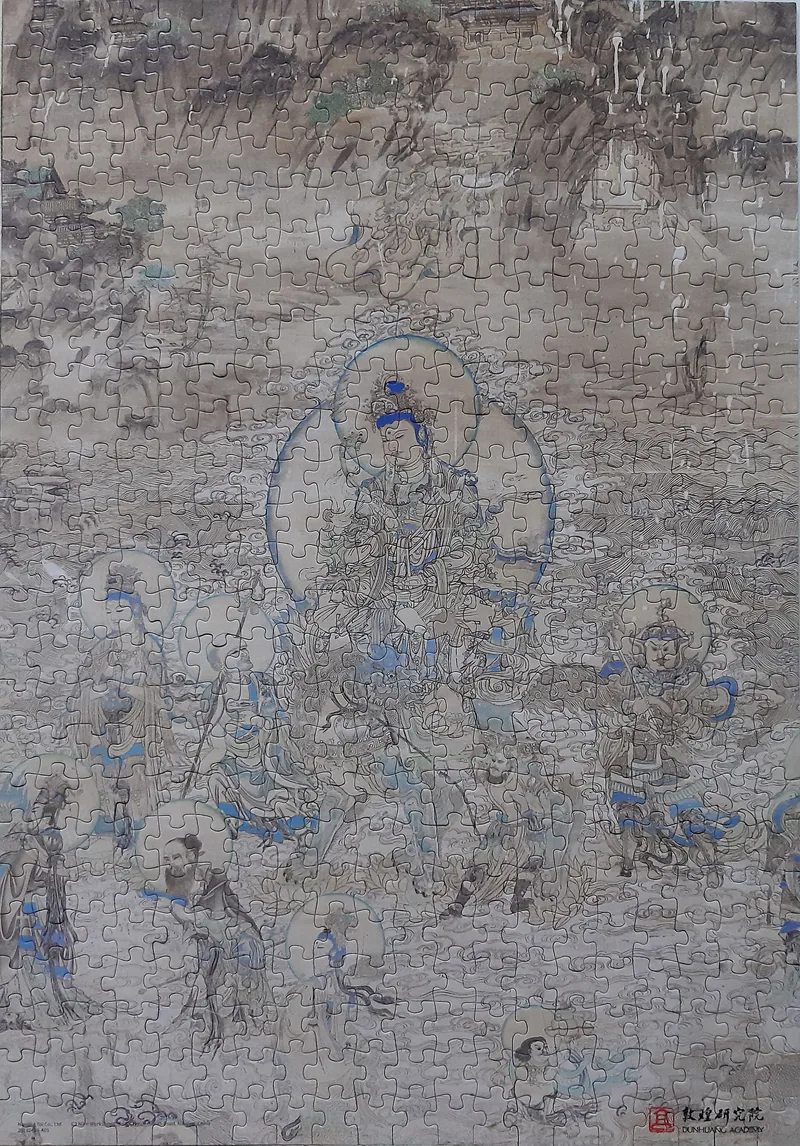
The story reflects a real controversy. In the 730s the monk Shenhui attacked Shenxiu's "Northern school" as teaching gradual awakening and championed Huineng's "Southern school" of sudden awakening. Shenhui's polemics succeeded so well that later Chan traced itself almost entirely through Huineng. The Platform Sutra, which survives in an early Dunhuang version and later expanded editions, is unusual among works by Chinese teachers in bearing the title sutra (jing), a word normally reserved for the Buddha's own discourses.
The Golden Age of Chan and the Five Houses§
In the eighth and ninth centuries masters such as Mazu Daoyi (709–788), Baizhang Huaihai, Zhaozhou Congshen and Linji Yixuan (d. 866) became famous for unconventional teaching: shouts, blows, paradoxical answers and everyday speech. "Encounter dialogue" records preserved these exchanges. Baizhang is credited, perhaps legendarily, with a monastic rule requiring manual work, summed up in the saying "a day without work, a day without food." Chan's reliance on monastic communities rather than texts may have helped it survive the persecution of Buddhism in 845.
By the Song dynasty (960–1279) Chan was organised into "Five Houses": Linji, Caodong, Yunmen, Guiyang and Fayan. Chan monasteries became the dominant Buddhist institutions, closely tied to the state and to literati culture. Scholars now stress that the spontaneous "golden age" was partly a creation of Song editors, who polished the records of Tang masters into literary classics.
Koans and Silent Illumination§
A koan (Chinese gong'an, "public case") is a story or saying from the records of the masters, used as an object of contemplation. The most famous concerns Zhaozhou, who when asked whether a dog has Buddha-nature answered wu, "no" or "not." Song collections such as the Blue Cliff Record (1125) and the Gateless Barrier (Wumenguan, 1228) gathered cases with verses and commentary.
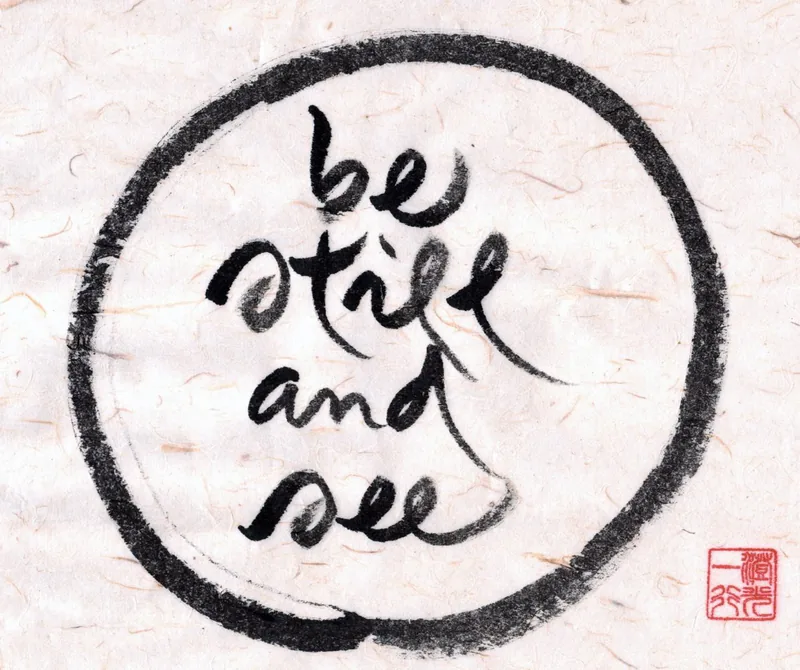
Two methods emerged in twelfth-century debate. Dahui Zonggao (1089–1163) of the Linji line taught "observing the phrase" (kanhua): concentrating on the key word of a koan, such as wu, until a great doubt breaks open into awakening. Hongzhi Zhengjue (1091–1157) of the Caodong line taught "silent illumination" (mozhao), resting in luminous, objectless awareness. The two approaches shaped Rinzai and Soto Zen respectively, and they illustrate the wider spectrum of techniques described in meditation in Eastern traditions.
Zen in Japan: Eisai, Dogen and Hakuin§
Japanese monks brought Chan to Japan in the twelfth and thirteenth centuries. Myoan Eisai (1141–1215) returned from China in 1191 with the Linji (Rinzai) teaching and is also credited with popularising tea. Eihei Dogen (1200–1253) studied the Caodong (Soto) line in China, founded Eiheiji, and wrote the Shobogenzo, a profound and difficult work in Japanese. He taught shikantaza, "just sitting," holding that practice and awakening are one, not means and end.
Rinzai flourished in the Five Mountains monasteries of Kamakura and Kyoto, patronised by the warrior class, and influenced ink painting, gardens, poetry and the tea ceremony. In the eighteenth century Hakuin Ekaku (1686–1769) revitalised Rinzai with a systematic koan curriculum, including his own famous question about the sound of one hand. Korean Seon, shaped by Jinul (1158–1210), and Vietnamese Thien developed their own distinct forms.
Zen in the Modern West§
Zen reached Western audiences chiefly through D. T. Suzuki (1870–1966), whose Essays in Zen Buddhism (1927 onward) presented it as a pure experience beyond religion and culture. The Beat writers, Alan Watts and later teachers such as Shunryu Suzuki, who founded the San Francisco Zen Center in the early 1960s, made Zen a feature of Western counterculture. Scholars such as Robert Sharf have since argued that this "experience"-centred Zen owed much to modern Japanese nationalism and Western philosophy, and Brian Victoria's Zen at War (1997) documented Zen institutions' support for Japanese militarism.
These critiques have not diminished the tradition's appeal, but they invite readers to see Zen as a historical religion with ritual, liturgy, monastic discipline and institutions, not only a philosophy of spontaneity. For its relation to Tibetan Vajrayana, see Tibetan Buddhism; for its Daoist neighbours, see Taoist internal alchemy.
Frequently asked questions§
What is the difference between Zen and Chan?§
They are the same tradition under different names. Chan is the Chinese pronunciation of the character for meditation, from Sanskrit dhyana; Zen is its Japanese pronunciation. Over centuries, Chinese, Japanese, Korean and Vietnamese forms developed their own practices and institutions.
What is a koan?§
A koan is a case from the recorded sayings of Chan masters, such as Zhaozhou's answer wu to the question whether a dog has Buddha-nature. Students contemplate it under a teacher's guidance, not to solve it logically but to break through conceptual thinking.
What is the difference between Rinzai and Soto Zen?§
Rinzai emphasises koan practice and sudden breakthrough (kensho), while Soto emphasises shikantaza, "just sitting," as the expression of awakening itself. Both practise zazen and share monastic forms.
Was Bodhidharma a real person?§
A monk of that name probably existed in fifth- or sixth-century China, and a few early sources mention him. Most of the famous stories, including the nine years facing a wall and the founding of Shaolin martial arts, are later legends.
Sources and further reading§
- The Platform Sutra of the Sixth Patriarch — Philip B. Yampolsky (trans.), 1967
- Seeing Through Zen: Encounter, Transformation, and Genealogy in Chinese Chan Buddhism — John R. McRae, 2003
- Zen Buddhism: A History — Heinrich Dumoulin, 1988
- The Gateless Barrier: The Wu-men Kuan (Mumonkan) — Robert Aitken (trans.), 1990
- Moon in a Dewdrop: Writings of Zen Master Dogen — Kazuaki Tanahashi (ed.), 1985
- Essays in Zen Buddhism — D. T. Suzuki, 1927
- Zen at War — Brian Victoria, 1997