Liber VIII · Eastern Mysticism · Chapter V: Meditation
Meditation in Eastern Traditions: History, Methods and Aims
A history of meditation in Hindu, Buddhist, Daoist and Zen traditions: dhyana, jhana, samatha and vipassana, mantra, zazen, Transcendental Meditation and mindfulness.

Meditation is the disciplined training of attention and awareness, practised in the religions of India and East Asia for well over two thousand years. Hindu, Buddhist and Daoist traditions developed methods ranging from one-pointed concentration and mantra repetition to insight into impermanence and "just sitting," each embedded in a distinct view of the self and of liberation.
The Language of Meditation: Dhyana, Jhana, Chan and Zen§
The English word "meditation" comes from Latin meditatio, which in Christian usage meant reflective pondering on scripture. Asian traditions have many more precise terms. The Sanskrit dhyana, "contemplation" or "absorption," became jhana in Pali, was transliterated into Chinese as chan, and was pronounced zen in Japanese and seon in Korean. A single word thus links the forest hermitages of ancient India to the meditation halls of medieval Kyoto. Other key terms include samadhi (absorption), bhavana (cultivation), smriti or sati (mindfulness, literally "remembering") and japa (repetition of a mantra).
Posture was part of the vocabulary from the beginning. Seated figures with crossed legs appear throughout early Buddhist and Jain sculpture, and the cross-legged "lotus" seat (padmasana) became the classic posture of meditating Buddhas, Jain tirthankaras and yogis alike. Walking meditation, prostration and the slow recitation of texts were equally recognised forms of practice. Jainism, whose founder Mahavira was a contemporary of the Buddha, developed its own disciplines of motionless standing or sitting meditation (kayotsarga) as part of its path of renunciation. The background of the Buddhist forms is introduced in what is Buddhism?.
These words name techniques, but in their original settings meditation was never a technique alone. It was framed by ethics, ritual, a teacher's guidance, monastic or ascetic life and a view of what liberation means. The same practice of watching the breath could serve to still the mind in yoga, to see the absence of a self in Buddhism, or to nourish vital energy in Daoism.
Meditation in the Upanishads and Classical Yoga§
The Upanishads describe sitting upright, controlling the senses and meditating on the syllable Om as a means to realise the self. The Katha Upanishad compares the senses to horses that a disciplined mind must rein in, and the Shvetashvatara Upanishad gives some of the earliest descriptions of a suitable place and posture for meditation. These teachings fed into the Bhagavad Gita, which describes the yogi seated on a firm seat, gaze steady, mind fixed on God.
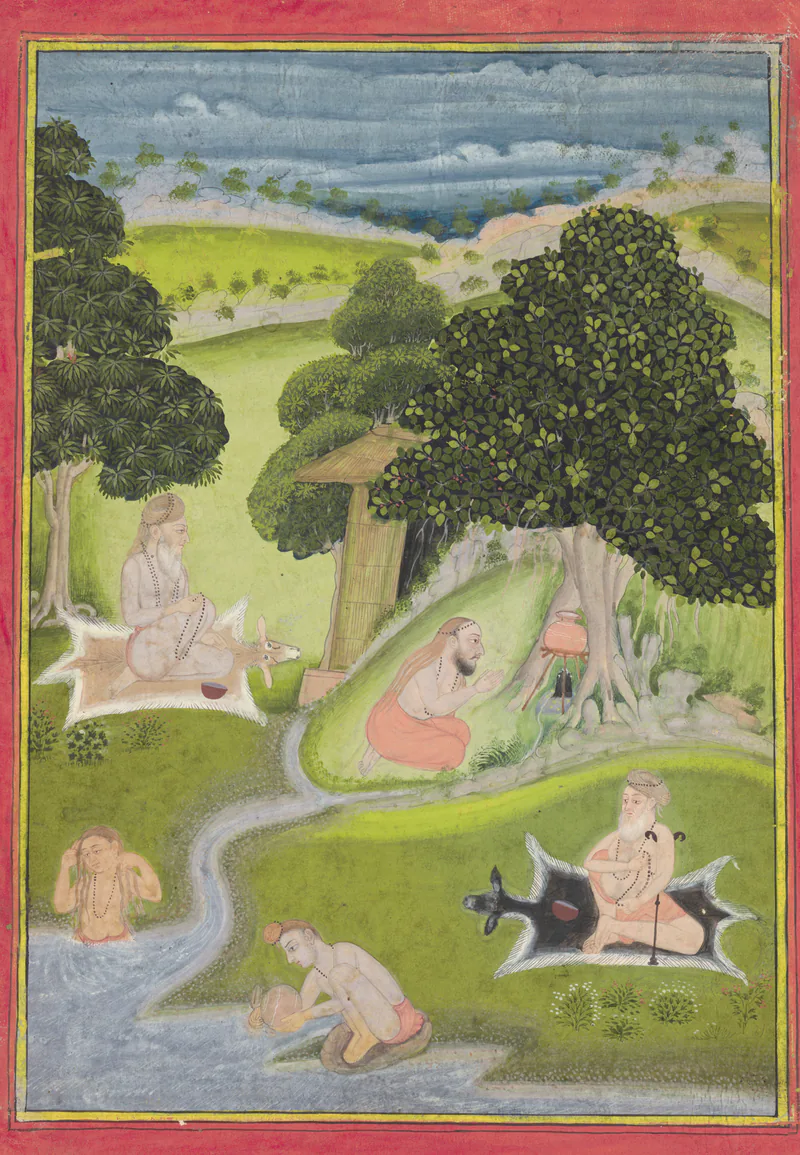
Patanjali's Yoga Sutras (c. 400 CE) systematised the process. Concentration (dharana) binds attention to one point; meditation (dhyana) is the unbroken flow of attention toward it; absorption (samadhi) arises when the object alone remains. The yoga philosophy and samadhi guide explains these stages in detail. In Vedanta, by contrast, meditation (nididhyasana) is the deepening of scriptural knowledge that the self is brahman, as set out in the guide to Hinduism and Vedanta.
Buddhist Meditation: Calm, Insight and the Jhanas§
Early Buddhist texts describe a sequence of four jhanas, absorptions of increasing stillness and equanimity, which the Buddha is said to have attained on the night of his awakening. They also teach the four foundations of mindfulness (satipatthana): attention to the body, to feelings, to states of mind and to mental phenomena, together with mindfulness of breathing (anapanasati). Later systematisers distinguished two complementary aspects of practice: samatha, the calming and unifying of the mind, and vipassana, insight into impermanence, unsatisfactoriness and not-self.
Buddhaghosa's Visuddhimagga ("Path of Purification"), composed in Sri Lanka in the fifth century, lists forty meditation subjects, among them coloured discs (kasinas), contemplations of the body and of death, and the four "divine abidings" of loving-kindness, compassion, sympathetic joy and equanimity. Mahayana schools added meditations on emptiness and on the bodhisattva's compassion, and the Tiantai master Zhiyi (538–597) wrote extensive Chinese manuals on calming and contemplation.
Mantra, Visualisation and Tantric Meditation§
Tantric traditions, Hindu and Buddhist, gave meditation a ritual and visionary dimension. The practitioner, after initiation, recites a mantra received from the guru, visualises a deity and its mandala in detail, and identifies with the deity's enlightened body, speech and mind. Subtle-body meditations direct attention and breath through the channels and chakras, sometimes with the aim of awakening kundalini. In Tibetan Buddhism these methods are combined with formless practices such as Mahamudra and Dzogchen, which point directly to the nature of mind.

Mantra repetition (japa) also became central in devotional Hinduism, often counted on a string of beads (mala), a device that spread to Buddhist and, by some accounts, to Islamic and Christian prayer.
Chinese and Japanese Paths: Daoist Stillness, Chan and Zen§
China had its own meditative traditions before Buddhism arrived. The Neiye ("Inward Training"), a short text probably of the fourth century BCE preserved in the Guanzi, describes aligning the body, breath and mind to retain vital essence. The Zhuangzi speaks of "fasting of the mind" and "sitting and forgetting" (zuowang). Later Daoists practised "guarding the One" and the visualisation of inner deities, and developed internal alchemy, which uses meditation and breath to refine essence, energy and spirit.
Chan Buddhism, emerging in China from about the sixth and seventh centuries, made meditation its defining practice and its name. In Japan, Rinzai Zen emphasised koan practice, while Dogen (1200–1253), founder of the Soto school, taught shikantaza, "just sitting," as the direct expression of awakening rather than a means to it. See Zen and Chan for this history.
Modern Meditation Movements and the Question of Safety§
In the late nineteenth and twentieth centuries, Burmese monks such as Ledi Sayadaw and Mahasi Sayadaw promoted vipassana for laypeople, a movement continued by S. N. Goenka's ten-day courses and by Western teachers. Maharishi Mahesh Yogi introduced Transcendental Meditation, a simplified mantra technique, to the West from the late 1950s; it became famous when the Beatles visited his ashram in 1968. In 1979 Jon Kabat-Zinn founded the Mindfulness-Based Stress Reduction programme in Massachusetts, presenting mindfulness in a secular, clinical form that has since spread into medicine, education and business.
Scientific research on meditation has grown enormously, though findings vary in quality. Researchers have also documented that intensive practice occasionally brings difficult experiences, including anxiety, depersonalisation or the resurfacing of trauma. Traditional teachers recognised such hazards and emphasised gradual training under guidance; people with a history of serious mental illness are generally advised to consult a professional before attending long retreats.
Frequently asked questions§
What is the oldest form of meditation?§
The earliest clear textual descriptions come from the Upanishads and early Buddhist texts of roughly the mid-first millennium BCE, and from early Chinese texts such as the Neiye. Claims that meditation is shown on Indus Valley seals (c. 2500 BCE) are speculative and debated.
What is the difference between samatha and vipassana?§
Samatha is the development of calm and concentration, leading to states of absorption. Vipassana is insight into the impermanent, unsatisfactory and selfless nature of experience. Most Buddhist schools regard both as necessary, though they combine them differently.
Is mindfulness the same as Buddhist meditation?§
Modern mindfulness programmes draw on Buddhist practices of sati, especially awareness of breath and body, but present them in a secular framework aimed at well-being. Traditional Buddhist mindfulness is part of an ethical and religious path aimed at liberation.
What is Transcendental Meditation?§
It is a mantra-based technique taught by Maharishi Mahesh Yogi (c. 1918–2008), learned through a paid course from certified teachers and practised twice daily. It draws on Hindu mantra traditions but is presented by its organisation as a non-religious method.
Sources and further reading§
- The Path of Purification (Visuddhimagga) — Buddhaghosa, 1956
- The Origin of Buddhist Meditation — Alexander Wynne, 2007
- Original Tao: Inward Training and the Foundations of Taoist Mysticism — Harold D. Roth, 1999
- The Birth of Insight: Meditation, Modern Buddhism, and the Burmese Monk Ledi Sayadaw — Erik Braun, 2013
- The Yoga Sutras of Patanjali — Patanjali, c. 400 CE
- Zen Mind, Beginner's Mind — Shunryu Suzuki, 1970
- Full Catastrophe Living — Jon Kabat-Zinn, 1990