Liber VIII · Eastern Mysticism · Chapter IV: Kundalini
Sir John Woodroffe: Arthur Avalon, Tantra and The Serpent Power
Sir John Woodroffe, the Calcutta judge who wrote as Arthur Avalon: his life, his Bengali collaborators, The Serpent Power and his influence on kundalini.

Sir John Woodroffe (1865–1936) was a British judge of the Calcutta High Court who, mostly under the pen name Arthur Avalon, published the first substantial English translations and studies of Hindu tantra. His book The Serpent Power (1919) became the source of almost every Western account of kundalini and the chakras, and recent scholarship has shown that the "Avalon" works were the product of close collaboration with Bengali scholars and practitioners.
Early Life and a Legal Career in Calcutta§
John George Woodroffe was born in Calcutta on 15 December 1865, the son of James Tisdall Woodroffe, a barrister who later served as Advocate-General of Bengal. He was educated in England, at Woburn Park School and at University College, Oxford, where he read law, and he was called to the bar in 1889. Returning to India, he practised as an advocate at the Calcutta High Court and became known as a legal scholar: with Syed Ameer Ali he wrote a commentary on the law of evidence in British India that went through many editions and remained a standard work for decades.
In 1904 he was appointed a judge of the Calcutta High Court, a post he held until 1922, serving for a period in 1915 as officiating Chief Justice; he was knighted in the same year. Calcutta was then the intellectual capital of British India and the centre of the Bengal renaissance, and Woodroffe moved in circles that included Indian nationalists, artists and religious teachers as well as colonial officials. He was among the founders of the Indian Society of Oriental Art in 1907, alongside Abanindranath Tagore and E. B. Havell, a body that promoted Indian artistic traditions against the prevailing preference for European academic styles. His wife, Ellen Elizabeth Grimson, whom he married in 1902, shared his interests and is credited as co-translator of some of the early hymn collections.
After retiring from the bench, Woodroffe returned to England and from 1923 to 1930 was Reader in Indian Law at Oxford. He spent his last years in France and died at Beaulieu-sur-Mer on 16 January 1936.
Who Was Arthur Avalon? Collaboration and Authorship§
The pen name Arthur Avalon, which probably evokes the Isle of Avalon of Arthurian legend, first appeared on books in 1913. For most of the twentieth century readers assumed that Avalon was simply Woodroffe, and that he was a gifted Sanskritist who had penetrated a secret tradition. Both assumptions have been revised.

Kathleen Taylor's study Sir John Woodroffe, Tantra and Bengal (2001), based on correspondence and archival research, argues that Woodroffe's own Sanskrit was limited and that much of the translation was done by Atal Behari Ghose, a Bengali lawyer and scholar of tantra who remained deliberately in the background. Other Bengali pandits contributed texts, commentaries and explanations. Taylor proposes that "Arthur Avalon" should be understood as a collaborative identity rather than a single author, and that books published under Woodroffe's own name, often essays and lectures, represent his distinctive voice more directly. She also discusses evidence that Woodroffe received tantric initiation, probably from the Bengali teacher Shiva Chandra Vidyarnava, whose treatise Tantratattva the Avalon circle translated as Principles of Tantra (1914–1916).
This reassessment matters because it restores Indian agency to a body of work long credited to a single Englishman. The tantra that reached the West through Avalon was not raw material gathered by a colonial outsider but a self-presentation of Bengali Shakta tradition, mediated by educated Bengalis who wanted it understood and respected. The religious background of that tradition, centred on the Goddess as power, is described in the article on Shaktism and the Hindu goddess.
The Avalon Books: From the Great Liberation to The Garland of Letters§
The first major Avalon publication was Tantra of the Great Liberation (1913), a translation of the Mahanirvana Tantra, followed in the same year by Hymns to the Goddess and the opening volumes of the Tantrik Texts series, which printed Sanskrit editions for scholars. The choice of the Mahanirvana Tantra was revealing. It is a moderate, ethically oriented text that presents tantric worship in a form congenial to reformers, and many scholars now regard it as a comparatively late composition, perhaps of the eighteenth century, rather than an ancient scripture.
The works that followed included Principles of Tantra, Wave of Bliss (a translation of the Anandalahari hymn), Shakti and Shakta (1918), a widely read collection of essays explaining Shakta doctrine and ritual, and The Serpent Power (1919). In the early 1920s Woodroffe issued a series of short philosophical books under the general heading The World as Power, and The Garland of Letters (1922), a study of the tantric theory of sound, mantra and the Sanskrit alphabet as the body of the Goddess. Taken together, these books built an image of tantra as a sophisticated metaphysics, a "Shakta Vedanta" in which the world is the real manifestation of conscious power rather than an illusion.
The Serpent Power and the Western Idea of Kundalini§
The Serpent Power contains translations of two Sanskrit works: the Ṣaṭ-cakra-nirūpaṇa ("Description of the Six Centres"), composed in 1577 by the Bengali tantric Purnananda as part of a larger work, and the short Paduka-pancaka ("Five-fold Footstool"), with the Sanskrit commentary of Kalicharana. A long introduction of several hundred pages explains the philosophy of Shakti, the elements, mantra and the subtle body, and the volume was illustrated with coloured plates of the lotuses painted for the book.
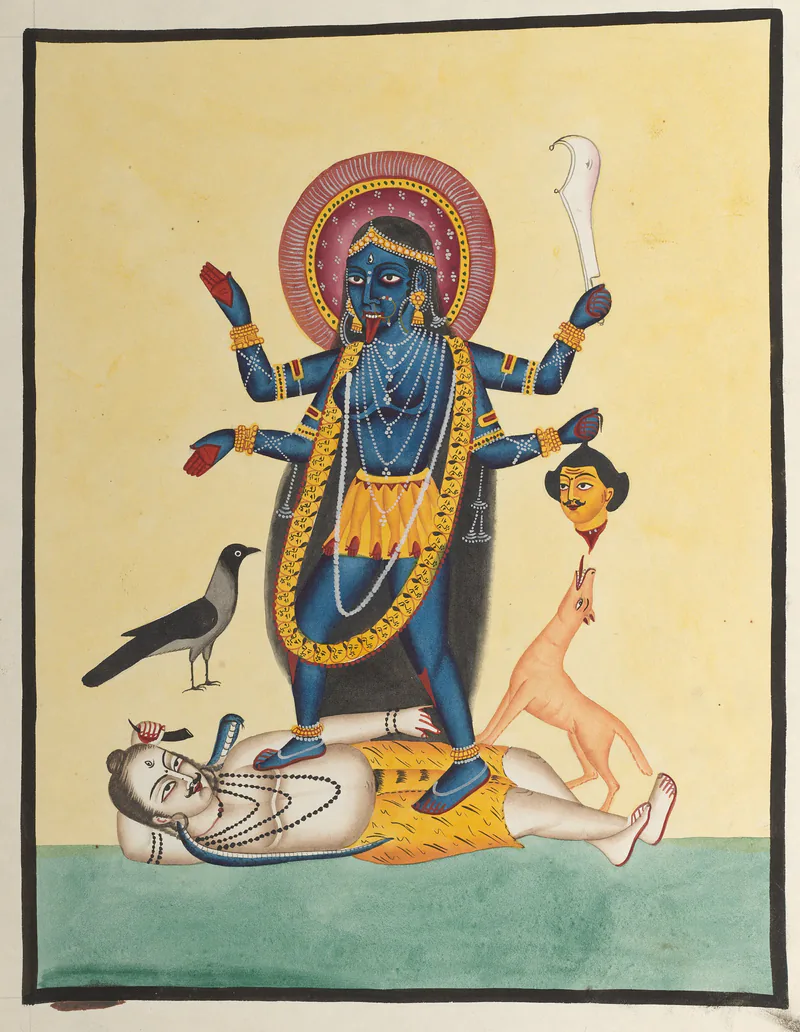
Because there was little else of comparable seriousness in English, the book acquired an authority it was never meant to claim. Its system of six centres plus the thousand-petalled lotus at the crown, with their petals, syllables, elements and deities, became for Western readers simply "the" chakra system, as the article on the history of the chakras explains, and the descriptions of Muladhara and the other centres in popular books still trace back, directly or indirectly, to its pages. Through it the image of the coiled goddess rising through the central channel, the core of kundalini yoga, entered European consciousness.
Readers of very different kinds took it up. C. G. Jung relied on it for his 1932 seminar on kundalini yoga; the Italian esotericist Julius Evola drew heavily on Avalon in his writings on tantra in the 1920s; Theosophists compared its centres with C. W. Leadbeater's clairvoyant descriptions, a meeting traced in chakras in the West. Woodroffe himself pointed out that the Theosophical accounts differed from the tantric sources, but later writers blended the two freely.
Defending Tantra: Apologetics, Politics and Critique§
Woodroffe wrote at a time when missionaries, Orientalists and many Western-educated Hindus regarded tantra as the degenerate underside of Indian religion, chiefly because of the transgressive "five Ms" (wine, meat, fish, parched grain and ritual sexual union) of left-hand practice. His books argued back. He insisted on reading tantra through its own scriptures and living practitioners, presented its doctrines as consistent with the highest Indian philosophy, and explained the controversial rites as either symbolic or as disciplined ritual restricted to qualified initiates.
His sympathy also had a political edge. In Is India Civilized? (1918) he replied to the critic William Archer's dismissive India and the Future, defending Indian culture as a whole, and his circle overlapped with Bengali nationalists for whom the Goddess as Shakti, "power", was a potent symbol of the nation. That such views came from a serving British judge gave them unusual weight.
Later scholars have admired his seriousness while noting what he left out. Hugh Urban, in Tantra: Sex, Secrecy, Politics, and Power in the Study of Religion (2003), argues that Woodroffe produced a respectable, philosophical tantra suited to an educated audience by downplaying its erotic, violent and power-seeking dimensions. The broader picture he simplified is set out in the article on tantra's history and practice.
Legacy and Reassessment§
Woodroffe's books have never gone out of print; Ganesh and Company of Madras kept them available in India, and Western reprints have followed since the 1950s. For a century they have been the bridge by which kundalini, the chakras, mantra and the Shakta philosophy of power reached Western yoga, depth psychology and occultism. Many popular writers have repeated his diagrams and names without knowing their source.
Modern scholarship treats him as a pioneer whose work must be read critically. His chosen texts were Bengali and relatively late; his presentation of tantra as a unified "Shakta Vedanta" reflected his collaborators' reformist outlook; and his authorship was shared. Yet his insistence that tantra deserved to be studied on its own terms, and in dialogue with practitioners, anticipated the approach that historians of religion now take for granted.
Frequently asked questions§
Was Arthur Avalon the same person as Sir John Woodroffe?§
Arthur Avalon was a pen name used on books associated with Woodroffe from 1913. Kathleen Taylor has argued that it stood for a collaboration, in which the Bengali scholar Atal Behari Ghose did much of the translation, while books under Woodroffe's own name are more directly his.
What is The Serpent Power about?§
Published in 1919, it translates two tantric texts on the six centres of the subtle body and the ascent of kundalini, the Ṣaṭ-cakra-nirūpaṇa and the Paduka-pancaka, with a long introduction on Shakta philosophy and coloured plates of the chakras.
Did Woodroffe practise tantra himself?§
The evidence is limited, but Taylor discusses indications that he received initiation from a Bengali teacher, probably Shiva Chandra Vidyarnava. He certainly studied with practitioners and wrote as a sympathetic insider rather than a detached observer.
Why is Woodroffe important for the chakras?§
His translation made one sixteenth-century Bengali system of six centres plus the crown lotus the standard version for Western readers. Theosophists, Jung and later New Age writers built on it, so most modern chakra imagery ultimately leads back to his book.
Sources and further reading§
- The Serpent Power — Arthur Avalon (Sir John Woodroffe), 1919
- Shakti and Shakta — Sir John Woodroffe, 1918
- Tantra of the Great Liberation (Mahanirvana Tantra) — Arthur Avalon, 1913
- Principles of Tantra — Arthur Avalon, 1914
- The Garland of Letters — Sir John Woodroffe, 1922
- Sir John Woodroffe, Tantra and Bengal: 'An Indian Soul in a European Body?' — Kathleen Taylor, 2001
- Tantra: Sex, Secrecy, Politics, and Power in the Study of Religion — Hugh B. Urban, 2003