Liber VIII · Eastern Mysticism · Chapter I: Chakras & Subtle Body
Muladhara: The Root Chakra in Tantra, Yoga and History
Muladhara, the root chakra: its meaning, four-petalled lotus, bija mantra LAM, earth element, Brahma and Dakini, and how the modern red chakra developed.

Muladhara (Sanskrit mūlādhāra, "root support") is the lowest of the six centres described in the classical tantric chakra system, a four-petalled lotus at the base of the spine that holds the element earth and the sleeping goddess Kuṇḍalinī. In the sixteenth-century Ṣaṭ-cakra-nirūpaṇa, the source of the familiar sequence, it is a crimson lotus containing a yellow square, the seed syllable laṃ, the creator god Brahmā and the goddess Ḍākinī; the modern "red root chakra of survival and grounding" is a twentieth-century Western reading built on top of that older image.
Name and Meaning of Muladhara§
The name joins mūla, "root", with ādhāra, "support" or "foundation". Several older tantric and hatha texts simply call the lowest centre the ādhāra, and the word is used in the plural for the many "supports" on which a meditator can fix attention. Muladhara is the root in two senses: it is the lowest point of the central channel, and it is the place where the power that animates the whole subtle body lies dormant.
In the standard six-centre series Muladhara is the first counting upward and the first of the five centres that each hold one of the gross elements. Above it lie Svadhisthana at the genitals, Manipura at the navel and Anahata at the heart.
Place in the Body: The Base of the Spine§
The Ṣaṭ-cakra-nirūpaṇa ("Description of the Six Centres"), composed by the Bengali Shakta teacher Pūrṇānanda in 1577, places the lotus at the mouth of the central channel (suṣumnā), in the region between the genitals and the anus, its face turned downward. Later teachers have described this point in physical terms as the perineum, and the twentieth-century Bihar School of Yoga distinguished a location at the perineum in men and near the cervix in women. These are interpretive glosses: the text itself describes a lotus within the subtle body, not an anatomical organ. For the place of this text in the wider history, see the history of the chakras.
Hatha yoga texts link the root centre with the "root lock" (mūla-bandha), a contraction of the pelvic floor described in the Haṭhayogapradīpikā as forcing the downward-moving breath (apāna) upward to meet the vital breath (prāṇa). Many modern teachers also connect Muladhara with the first of the three "knots" (granthi) that obstruct the central channel, though the texts disagree about where these knots lie; the article on nadis, prana and the subtle body explains the variations. The hatha texts treat these practices as demanding and traditionally taught under supervision, and modern clinicians have noted that intensive kundalini-oriented practice can be destabilising for some people.
The Lotus: Petals, Syllables and Bija§
Each of the six classical centres is visualised as a lotus with a fixed number of petals, and each petal carries one letter of the Sanskrit alphabet. The petals of all six together hold the fifty letters, so that the subtle body is also a body of sacred sound. Muladhara has four petals, described as red, on which shine the golden letters vaṃ, śaṃ, ṣaṃ and saṃ.
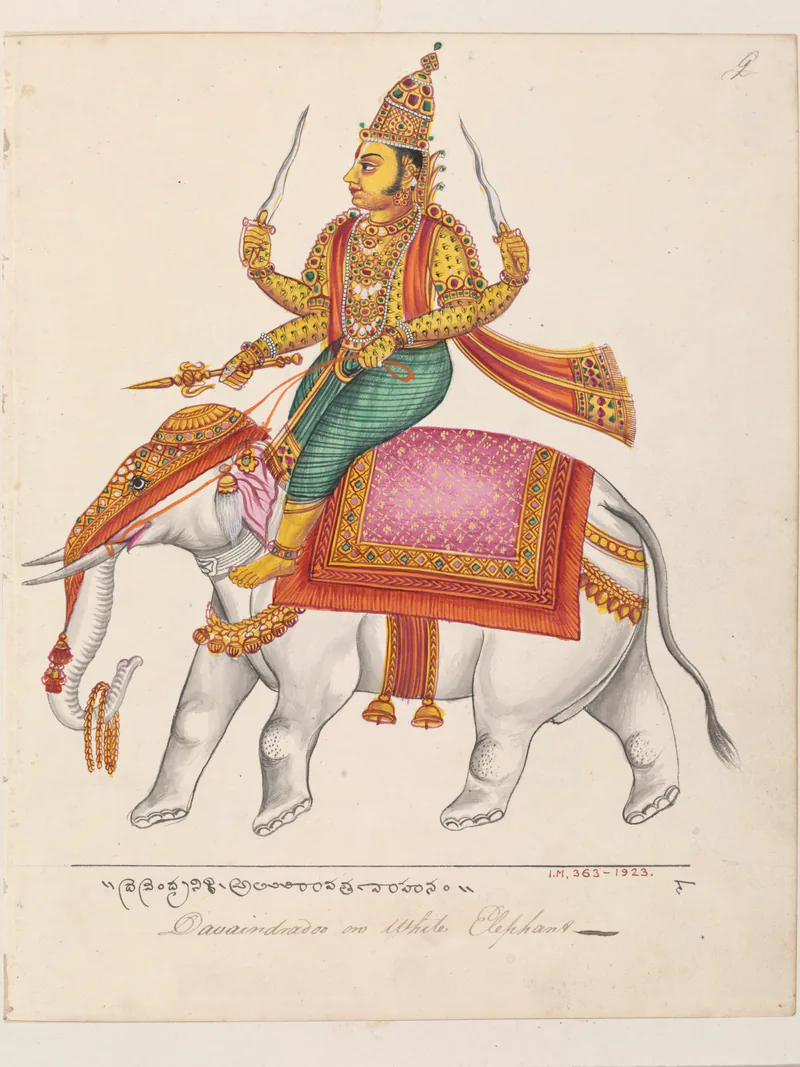
Within the pericarp of the lotus lies the square region of earth (dharā-maṇḍala), yellow and surrounded by eight shining spear-points. Its seed syllable (bīja) is laṃ, the mantra of the earth element. In the visualisation the syllable is not an abstract sound but a figure: Woodroffe's translation describes it as golden, four-armed and seated on Airāvata, the elephant of the god Indra, holding Indra's thunderbolt.
The triangle, the linga and the coiled goddess§
At the centre of the pericarp is a downward-pointing triangle, called Traipura or Kāmarūpa, associated with desire and creative power. Inside it stands the self-born liṅga of Śiva (svayambhū-liṅga), and around it, coiled three and a half times, sleeps Kuṇḍalinī, her mouth closing the entrance to the central channel. The text describes her as subtle as a lotus fibre, bright as lightning and humming softly like a swarm of bees. This image of the sleeping goddess wrapped around Śiva is the starting point of the whole practice described in kundalini yoga.
Element, Deity and Shakti§
The six-centre system assigns the five elements in ascending order, from the densest to the most subtle: earth, water, fire, air and space, with the mind at the brow. Muladhara belongs to earth (pṛthvī), whose qualities in Indian natural philosophy are solidity, weight and the sense of smell. Its geometric form is the square.
In the lap of the earth syllable sits the deity Brahmā, the creator, pictured in the Ṣaṭ-cakra-nirūpaṇa as a radiant child with four faces and four arms. Beside him is the centre's śakti or presiding goddess, Ḍākinī. She is red, with red eyes, four-armed and fierce in appearance; Woodroffe's version gives her a spear, a skull-topped staff, a sword and a drinking cup, and calls her the bearer of pure knowledge. Each of the six lotuses has such a pair: a male god associated with a function in the cosmos, and one of a set of six goddesses (Ḍākinī, Rākinī, Lākinī, Kākinī, Śākinī and Hākinī) whom some of the texts cited by Woodroffe also connect with the tissues of the body.
The text closes its description with the fruits of meditation. The practitioner who contemplates Kuṇḍalinī in Muladhara, it says, gains eloquence and learning, freedom from disease and a joyful disposition. Such statements are traditional praises (phala-śruti) attached to many Indian ritual texts and are best read as part of the liturgy rather than as promises.
In its original setting Muladhara was a station in a ritual of transformation. In the practice called bhūta-śuddhi, "purification of the elements", which precedes much tantric worship, the practitioner imagines the earth element dissolving into water at the next centre, water into fire, and so on upward, until the whole elemental body has been reabsorbed into its source. The Ṣaṭ-cakra-nirūpaṇa describes the same movement as Kuṇḍalinī's ascent: roused from her sleep, she enters the central channel and takes each centre and its element into herself as she rises, before uniting with Śiva in the thousand-petalled lotus above the head.
How the Texts Differ§
The Ṣaṭ-cakra-nirūpaṇa is one system among many, and the lowest centre is treated differently from one map of the subtle body to another.
Nath and hatha yoga lists§
Some earlier hatha yoga works associated with the Nāth tradition, such as versions of the Gorakṣaśataka, also begin with a four-petalled basal centre, but other texts count the centres differently and describe the lowest one in different terms. The Siddha Siddhānta Paddhati, attributed to Gorakṣanātha, lists nine centres, and separately uses the word ādhāra for a series of sixteen points of concentration running from the big toe to the crown of the head. Details such as petal colours and the identity of the presiding goddess vary from text to text.
Buddhist tantra§
The Buddhist tantras usually have no root centre at all. The Hevajra Tantra and related works describe four centres at the navel, heart, throat and crown, and Tibetan systems built on them sometimes add a fifth, a "bliss-sustaining" wheel at the sexual organ. Their lowest point of focus is generally the navel, where the inner fire of caṇḍālī (Tibetan gtum mo) is kindled; see Vajrayana Buddhism for that setting. The idea of a coiled serpent goddess sleeping at the base of the spine is distinctively Hindu, and specifically tantric.
The elephant in later depictions§
The elephant of the earth syllable is often shown in modern illustrated books with seven trunks, read as the seven centres or seven worlds. Woodroffe's translation of the verses names the elephant Airāvata without that detail, and the seven-trunked image is best treated as a later elaboration of the visualisation rather than part of Pūrṇānanda's text.
The Modern Western Layer§
Most readers today meet Muladhara as the "root chakra", coloured red, governing survival, safety, money, the body and a sense of belonging. Every part of this picture can be dated, as the article on chakras in the West shows in detail. C. W. Leadbeater's The Chakras (1927) described the root centre as a fiery orange-red vortex of four "spokes" that he claimed to perceive clairvoyantly. C. G. Jung, in his 1932 seminar on kundalini yoga, read Muladhara as the ordinary world of conscious, socialised life, in which the deeper self lies asleep. In the 1970s the seven chakras were mapped onto the colours of the rainbow, which made red, the first band of the spectrum, the root chakra's colour.
Anodea Judith's Wheels of Life (1987) and Eastern Body, Western Mind (1996) gave the system its now-standard psychological form, linking Muladhara with survival, the "right to be here and to have", the earliest stage of childhood development and, as its characteristic obstacle, fear. Popular books add glands (usually the adrenals, sometimes the gonads), crystals, scents and affirmations, and writers do not agree on these correspondences among themselves. None of this is found in the Sanskrit sources, which describe a meditation image rather than a personality type. There is no scientific evidence that chakras exist as physical structures in the body. The section on crystals, auras and energy follows these later developments.
Frequently asked questions§
What does Muladhara mean?§
Mūlādhāra means "root support" or "root foundation". The name reflects its place at the base of the central channel and its role as the resting place of Kuṇḍalinī, the power that the tantric texts describe as rising through the other centres.
What is the bija mantra of the root chakra?§
In the classical system the seed syllable of Muladhara is laṃ, the mantra of the earth element. Its four petals carry the letters vaṃ, śaṃ, ṣaṃ and saṃ, and the syllable is visualised riding the elephant Airāvata.
Is the root chakra really red?§
In the Ṣaṭ-cakra-nirūpaṇa the four petals are described as red, but the earth square inside them is yellow. The idea that red is the root chakra's colour because it begins a rainbow sequence is a modern Western convention from the 1970s.
Which deities belong to Muladhara?§
In the account translated by Woodroffe, the creator god Brahmā sits in the lap of the earth syllable, accompanied by the goddess Ḍākinī. The triangle at the centre contains the self-born liṅga of Śiva, around which Kuṇḍalinī lies coiled.
Sources and further reading§
- The Serpent Power — Arthur Avalon (Sir John Woodroffe), 1919
- The Chakras — C. W. Leadbeater, 1927
- The Psychology of Kundalini Yoga — C. G. Jung, ed. Sonu Shamdasani, 1996
- Roots of Yoga — James Mallinson and Mark Singleton, 2017
- The Tantric Body: The Secret Tradition of Hindu Religion — Gavin Flood, 2006
- Kundalini Tantra — Swami Satyananda Saraswati, 1984
- Wheels of Life: A User's Guide to the Chakra System — Anodea Judith, 1987
- Eastern Body, Western Mind — Anodea Judith, 1996