Liber VIII · Eastern Mysticism · Chapter I: Chakras & Subtle Body
Svadhisthana: The Sacral Chakra in Tantra, Yoga and History
Svadhisthana, the sacral chakra: its meaning, six-petalled lotus, bija mantra VAM, water element, Vishnu and Rakini, and the modern orange sacral chakra.

Svadhisthana (Sanskrit svādhiṣṭhāna, usually translated "one's own seat") is the second of the six centres of the classical tantric chakra system, a six-petalled lotus at the root of the genitals that belongs to the element water. In the Ṣaṭ-cakra-nirūpaṇa of 1577, translated by John Woodroffe, it is a vermilion lotus enclosing a white crescent moon, the seed syllable vaṃ riding a sea-creature, the god Viṣṇu and the fierce goddess Rākinī; the modern orange "sacral chakra" of creativity, pleasure and emotion is a later Western interpretation.
Name and Meaning of Svadhisthana§
The name combines sva, "own" or "self", with adhiṣṭhāna, "seat", "standing place" or "abode". Indian commentators and modern writers have explained it in different ways: as the self's own dwelling, as the seat of the liṅga of Śiva, or, in some later readings, as the proper home of the goddess before she descended to the lowest centre. A popular modern gloss deriving the name from svād, "sweet", is not supported by the standard Sanskrit analysis of the word.
In the standard six-centre series Svadhisthana is the second counting upward, the centre of water between the earth of Muladhara below and the fire of Manipura above.
Place in the Body: The Root of the Genitals§
The Ṣaṭ-cakra-nirūpaṇa, composed by the Bengali Shakta adept Pūrṇānanda, locates the lotus inside the central channel (suṣumnā) at the root of the genitals, a short distance above Muladhara. Modern teachers tend to place it at the level of the sacrum or the lower abdomen, which is the origin of the English label "sacral chakra". As with every centre in this system, the text is describing a figure to be visualised within the subtle body rather than a part of the physical anatomy. The overview of the history of the chakras explains how this single sixteenth-century text came to define the standard sequence.
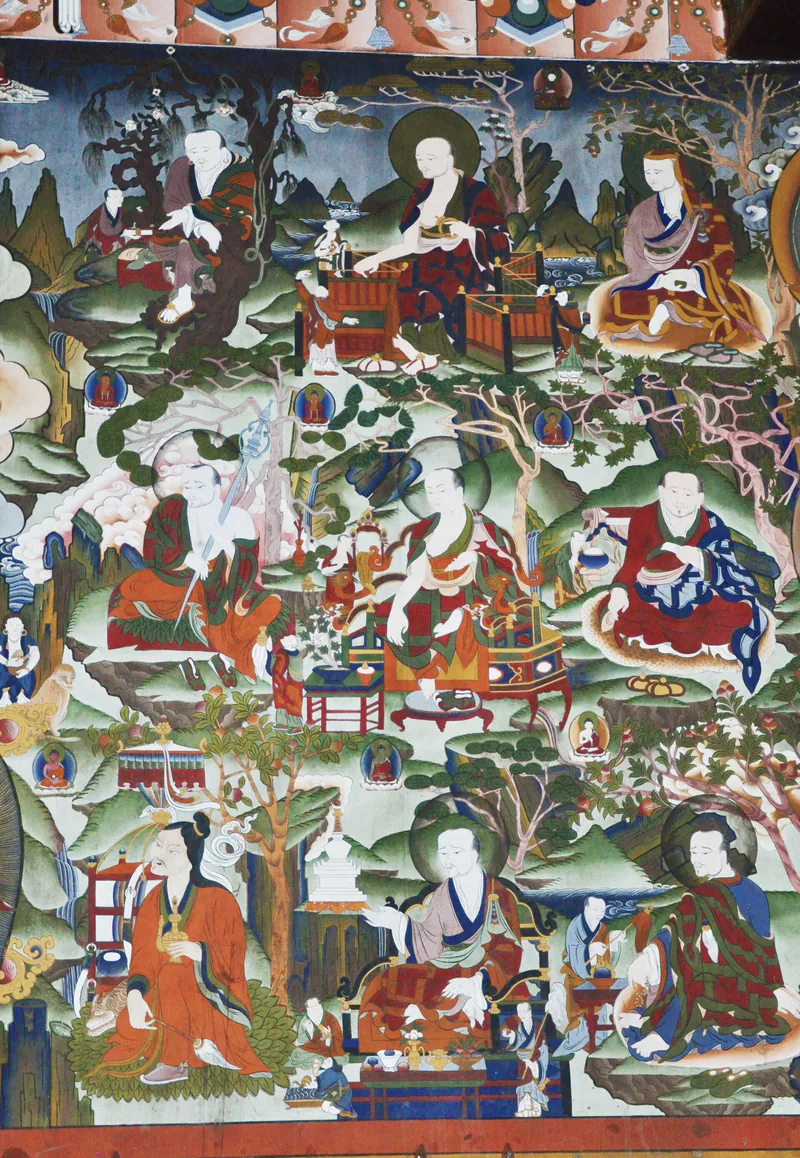
Hatha yoga literature also connects the lower abdomen and genital region with bindu, the vital essence identified with semen, whose preservation was a primary aim of the early hatha methods described by James Mallinson and Mark Singleton. Some techniques discussed in those texts concern the control of this essence; they belong to specialised, initiated lineages and are mentioned here only historically. For the channels and breaths through which these practices were understood to work, see nadis, prana and the subtle body, and for the surrounding practice of awakening, kundalini yoga.
The Lotus: Petals, Syllables and Bija§
Svadhisthana has six petals, which the text describes as vermilion. On them shine six letters, baṃ, bhaṃ, maṃ, yaṃ, raṃ and laṃ, each with the nasal dot (bindu) above it and coloured like lightning. Together with the letters of the other five lotuses they make up the fifty sounds of the Sanskrit alphabet, so that reciting the petals in order amounts to placing the whole of language, regarded in tantra as a manifestation of the goddess, along the spine.
Inside the lotus lies the region of Varuṇa, god of the waters, in the form of a white crescent moon. Its seed syllable (bīja) is vaṃ, the mantra of water, pictured as stainless and white as the autumn moon and seated on a makara, a mythical sea-creature that also serves as the mount of the river goddess Gaṅgā and of Varuṇa himself. The crescent is the geometric sign of water in many tantric diagrams, just as the square marks earth in Muladhara below. The pairing of moon and water draws on an old Indian association between the moon, the cooling fluids of the body and the nectar of immortality.
Element, Deity and Shakti§
Water (jala or ap) is the second of the five elements, more subtle than earth and associated in Indian natural philosophy with fluidity, cohesion and the sense of taste. In the ascending order of the six-centre system, each element is understood to arise from the one above it and to dissolve back into it, so the water of Svadhisthana is the source from which the earth of Muladhara condenses.
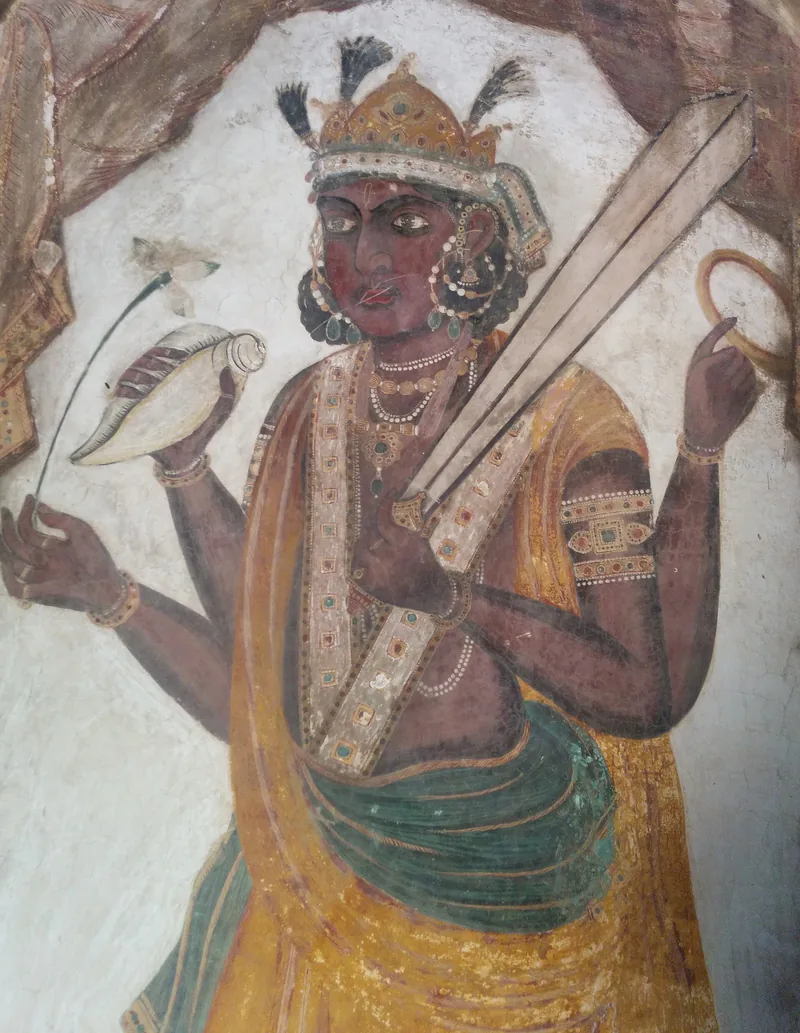
The presiding god is Hari, that is Viṣṇu, the preserver of the world. Woodroffe's translation pictures him in the bloom of youth, blue-bodied and dressed in yellow, with four arms holding the conch, discus, mace and lotus, and wearing the śrīvatsa mark and the Kaustubha jewel on his chest. His presence connects the centre with the sustaining of life, as Brahmā in Muladhara stands for creation. Readers interested in the god's wider worship can turn to Vaishnavism.
The centre's goddess is Rākinī. She is the colour of a blue lotus, has four raised arms bearing weapons (the commentary lists a spear, a lotus, a drum and a sharp axe), three red eyes and a fierce face with bared teeth, and her mind is described as exalted by drinking nectar. Her ferocity is typical of the goddesses of this series and reflects the Shakta setting of the text, in which the powers that guard the body are forms of the one Goddess; on that background see Shaktism and the Hindu goddess.
The text's praise of the fruits of meditation on this lotus says that the practitioner is freed from the "enemies" of the inner life, traditionally lust, anger, greed, delusion, pride and envy, becomes a lord among yogis, and speaks prose and verse that flow like nectar. As with all such phala-śruti passages, these are conventional praises rather than measurable claims.
In the ritual of bhūta-śuddhi, the purification of the elements, the meditator dissolves the earth of Muladhara into the water of Svadhisthana and then dissolves water into the fire of the navel, reabsorbing the body stage by stage into its source. The Ṣaṭ-cakra-nirūpaṇa describes the ascent of Kuṇḍalinī in the same terms: as she passes through the second lotus she draws its element, its letters and its deities into herself and carries them upward. Each lotus is therefore not a place to be strengthened or balanced, as in modern language, but a stage to be dissolved on the way to union with Śiva in the crown.
How the Texts Differ§
The second centre is one of the less stable points in the chakra maps, and its description varies more than most.
Nath and hatha yoga lists§
Most Hindu hatha and tantric texts that use a six-centre scheme place a centre of six petals at the genitals, but agreement stops there. Petal colours, the order of letters and the identity of the presiding goddess can differ from text to text, and some systems that count nine or more centres insert additional points around the genitals, the navel and the lower belly. The Siddha Siddhānta Paddhati, a Nāth work, gives its own sequence, and the twentieth-century Bihar School of Yoga placed the centre at the base of the spine near the coccyx rather than at the genitals.
Buddhist tantra§
The Buddhist tantras generally have no equivalent centre. Their usual lowest wheel is at the navel, though some Tibetan descriptions add a centre at the sexual organ, the "bliss-sustaining" wheel, in the context of practices concerned with the inner drops of vital essence.
Leadbeater's spleen centre§
The most striking departure came from the West. C. W. Leadbeater's The Chakras (1927) omitted the genital centre altogether and substituted one at the spleen, explaining that the lower centre was associated with practices he regarded as dangerous. His splenic centre of six "spokes" survived in some Theosophical and later energy-healing systems, so that two different "second chakras" still circulate.
The Modern Western Layer§
In contemporary books and classes Svadhisthana is the "sacral chakra", coloured orange and associated with sexuality, pleasure, emotion, creativity and relationships. The colour comes from the 1970s convention of laying the rainbow along the seven centres, which placed orange second after the red of the root. The psychological content has several sources, traced more fully in chakras in the West. C. G. Jung, in his 1932 seminar, read the watery second centre as the first descent into the unconscious, comparing it with baptism and identifying the makara with the sea-monster Leviathan. Later writers in the human potential movement linked it with sexual energy and the emotional life.
Anodea Judith's Wheels of Life (1987) and Eastern Body, Western Mind (1996) set out the form now most often taught: the second chakra governs the "right to feel" and to want, corresponds to an early stage of childhood, and is obstructed by guilt. Popular systems assign it to the reproductive glands, give it lists of crystals and scents, and sometimes call it the "navel chakra", which confuses it with Manipura above. These correspondences differ between authors and have no basis in the Sanskrit sources, and there is no scientific evidence that chakras are physical structures. The modern sacral chakra is best understood as a twentieth-century creation that borrowed an older Indian name; the New Age movement shows how such syntheses spread.
Frequently asked questions§
What does Svadhisthana mean?§
Svādhiṣṭhāna is usually translated "one's own seat" or "own abode", from sva ("own, self") and adhiṣṭhāna ("seat, dwelling"). Commentators have explained the "own" in different ways, as the self, Śiva's liṅga or the goddess.
What is the bija mantra of Svadhisthana?§
The seed syllable of the second centre is vaṃ, the mantra of the water element. Its six petals carry the letters baṃ, bhaṃ, maṃ, yaṃ, raṃ and laṃ.
Why is it called the sacral chakra?§
"Sacral" is a modern English label that reflects where twentieth-century teachers located the centre, near the sacrum and lower abdomen. The Sanskrit text places it at the root of the genitals and calls it only Svadhisthana.
Which god and goddess rule Svadhisthana?§
In the Ṣaṭ-cakra-nirūpaṇa, as translated by Woodroffe, the presiding god is Viṣṇu (Hari) and the goddess is the fierce, blue Rākinī. Other texts sometimes name different deities.
Sources and further reading§
- The Serpent Power — Arthur Avalon (Sir John Woodroffe), 1919
- The Chakras — C. W. Leadbeater, 1927
- The Psychology of Kundalini Yoga — C. G. Jung, ed. Sonu Shamdasani, 1996
- Roots of Yoga — James Mallinson and Mark Singleton, 2017
- Tantra Illuminated — Christopher D. Wallis, 2012
- Kundalini Tantra — Swami Satyananda Saraswati, 1984
- Wheels of Life: A User's Guide to the Chakra System — Anodea Judith, 1987
- Eastern Body, Western Mind — Anodea Judith, 1996