Liber XXXIII · Theosophy · Chapter VI: New Age
The New Age Movement: History, Beliefs and Key Figures
The New Age movement explained: roots in Theosophy and New Thought, the Age of Aquarius, Findhorn and Esalen, channelling, holistic healing and critics.

The New Age movement is a loose, decentralised current of Western spirituality that flourished from the 1970s onward, uniting beliefs in personal transformation, holistic healing, channelled wisdom, reincarnation and the coming of a more spiritual "Age of Aquarius". It has no founder, scripture or central organisation; historians trace its ideas mainly to Theosophy, New Thought, Spiritualism and the 1960s counterculture. Its vocabulary of energy, healing and "spiritual but not religious" seeking has become part of mainstream culture.
The Age of Aquarius and the Idea of a New Age§
The name comes from astrology. Because of the slow precession of the equinoxes, the sun's position at the spring equinox drifts backward through the zodiac, spending roughly two thousand years in each sign. Many modern astrologers hold that the Christian era coincided with the Age of Pisces and that humanity is now entering, or about to enter, the Age of Aquarius, associated with brotherhood, knowledge and freedom. Astrologers disagree widely about when the transition happens, with dates ranging across several centuries.
The expectation of a new spiritual era has older roots in Joachim of Fiore's medieval prophecy of an Age of the Spirit and in eighteenth- and nineteenth-century visions of progress. In the twentieth century the Theosophist Alice Bailey (1880–1949) gave the term wide currency, writing of a coming "new age" in which a World Teacher would reappear and humanity would be guided by a spiritual hierarchy of Masters.
Esoteric Roots: Theosophy, New Thought and Spiritualism§
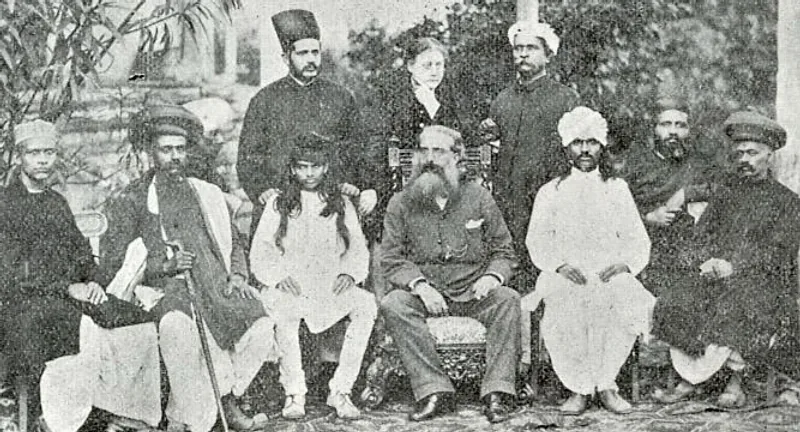
Almost every major New Age theme had a nineteenth-century forerunner. Theosophy supplied karma and reincarnation, subtle bodies, the Masters, Atlantis and an eclectic reverence for Asian religions. The New Thought movement supplied the conviction that mind shapes health and circumstance, later repackaged as the law of attraction. Spiritualism supplied mediumship, which became "channelling". Mesmerism and its successors supplied the language of invisible healing energies.
The historian Wouter Hanegraaff, in his influential study of 1996, described the New Age as a form of secularised Western esotericism: an esoteric worldview reinterpreted through psychology, evolutionary thinking and the comparative study of religions, and pursued by individuals rather than through religious institutions.
The Counterculture and the 1960s–1970s§
The movement took shape in the 1960s and 1970s, when interest in Eastern religion, psychedelics, humanistic psychology and alternative communities converged. Two foundations of 1962 became emblematic. At Findhorn, on the Moray Firth in northern Scotland, Peter and Eileen Caddy and Dorothy Maclean established a community that became famous for its gardens, which members attributed to cooperation with nature spirits. At Big Sur in California, Michael Murphy and Dick Price founded the Esalen Institute, a centre for the "human potential movement" that hosted psychologists, philosophers and spiritual teachers.
The musical Hair (1967), with its song "Aquarius", brought the idea of the dawning age to a mass audience. Gurus from India, Tibetan lamas exiled after 1959, and Japanese Zen teachers found Western students, while writers such as Alan Watts and Ram Dass translated Asian ideas for Western seekers. Elements of the Fourth Way and of Jungian psychology also entered the mix.
Core Beliefs and Practices of the New Age§
Because it lacks a creed, the New Age is best described as a cluster of overlapping themes.
Holism and the self§
New Age thought treats body, mind and spirit as a single whole and the universe as an interconnected living system. Its religious centre is the individual self, understood as divine or as a spark of a universal consciousness, whose inner experience is the final authority; the sociologist Paul Heelas called this "self-spirituality".
Channelling and spirit guides§
Many influential New Age texts were presented as channelled from discarnate teachers. Jane Roberts's "Seth" books, beginning with The Seth Material (1970), A Course in Miracles (1976), scribed by the psychologist Helen Schucman, and JZ Knight's "Ramtha" teachings were widely read.
Healing and energy§
Alternative and complementary therapies, from Reiki to crystal healing, play a large part, often explained in terms of subtle energy, chakras and auras; see our guide to crystals, auras and energy for the history and the scientific evidence.
Reincarnation, astrology and divination§
Belief in reincarnation and past-life regression, astrology, tarot and other forms of divination are widespread, as are interest in ancient civilisations, sacred sites and, in some circles, extraterrestrial contact (see UFO religions).
The Movement's Peak and Popularisation§
The 1980s were the New Age's most visible decade. Marilyn Ferguson's The Aquarian Conspiracy (1980) described a network of people transforming society from within. The actress Shirley MacLaine's memoir Out on a Limb (1983) and its television adaptation introduced millions to channelling and reincarnation. In August 1987 the "Harmonic Convergence", promoted by José Argüelles on the basis of his reading of the Maya calendar, drew gatherings at sacred sites around the world.
Bookshops opened "New Age" sections, and the term became a marketing category for music, books and therapies. By the 1990s many participants had begun to avoid the label, preferring "holistic", "mind-body-spirit" or simply "spiritual". Scholars such as Hanegraaff distinguish the earlier, millenarian New Age "in the strict sense" from this broader, diffuse milieu, which the sociologists Paul Heelas and Linda Woodhead studied in their 2005 account of a "spiritual revolution".
Criticism and Assessment§
The New Age has been criticised from several directions. Christian churches have objected to its syncretism and its view of the divine self. Scientists and skeptics point out that its healing claims, from crystals to energy therapies, are not supported by controlled evidence. Indigenous writers have criticised the appropriation of Native American and other sacred practices, sometimes sold in commercial workshops. Social critics note the movement's commercialisation and its tendency, in teachings such as The Secret (see our article on Rhonda Byrne's The Secret), to imply that people are responsible for their own illness or misfortune. More recently, observers have described an overlap between some wellness communities and conspiracy culture, sometimes called "conspirituality".
Historians, however, take the New Age seriously as a significant chapter in modern religion: a democratic, individual and eclectic spirituality whose assumptions are now shared far beyond those who would ever call themselves New Agers.
Frequently asked questions§
When did the New Age movement begin?§
There is no single starting date. Its ideas developed from Theosophy, New Thought and Spiritualism in the nineteenth century, and Alice Bailey popularised the term in the mid-twentieth. Most historians date the movement proper to the late 1960s and 1970s, with its peak of public visibility in the 1980s.
Is the New Age a religion?§
It has no founder, scripture, clergy or membership, so it does not fit the usual model of a religion. Scholars generally describe it as a religious movement or milieu, a network of practices and ideas that individuals combine in their own ways.
What is the Age of Aquarius?§
It is an astrological era believed to follow the Age of Pisces as a result of the precession of the equinoxes. Many New Age writers associate it with spiritual awakening and global harmony, but astrologers do not agree on when it begins.
Sources and further reading§
- The Aquarian Conspiracy — Marilyn Ferguson, 1980
- Out on a Limb — Shirley MacLaine, 1983
- New Age Religion and Western Culture: Esotericism in the Mirror of Secular Thought — Wouter J. Hanegraaff, 1996
- The New Age Movement: The Celebration of the Self and the Sacralization of Modernity — Paul Heelas, 1996
- Children of the New Age: A History of Spiritual Practices — Steven J. Sutcliffe, 2003
- The Spiritual Revolution: Why Religion Is Giving Way to Spirituality — Paul Heelas and Linda Woodhead, 2005
- A Republic of Mind and Spirit — Catherine L. Albanese, 2007
- Esalen: America and the Religion of No Religion — Jeffrey J. Kripal, 2007