Liber XXII · Occultism · Chapter V: Mesmerism & Magnetism
Mesmerism and Animal Magnetism: History from Mesmer to Hypnosis
The history of mesmerism and animal magnetism: Mesmer's fluid, the 1784 Paris commission, Puységur's magnetic sleep, Braid's hypnotism and the occult revival.

Mesmerism, or animal magnetism, was the theory and healing practice developed by the German physician Franz Anton Mesmer in the 1770s, which held that an invisible universal fluid flowed through all bodies and that illness resulted from its obstruction. Practitioners claimed to restore health by redirecting this fluid with passes of the hands, magnetised objects and the famous baquet. Although a royal commission in Paris rejected the fluid in 1784, mesmerism spread across Europe and America, gave rise to "magnetic sleep", clairvoyance and eventually hypnosis, and supplied the occult revival with its model of invisible forces.
Franz Anton Mesmer and the Universal Fluid§
Mesmer was born in 1734 near Lake Constance and studied medicine at Vienna, where his doctoral dissertation of 1766 discussed the influence of the planets on the human body, drawing on the English physician Richard Mead. In the early 1770s he began experimenting with magnets, following the Jesuit astronomer Maximilian Hell, and soon concluded that the cure came not from the iron but from a force in himself, which he named "animal magnetism".
His theory was set out in the Mémoire sur la découverte du magnétisme animal (1779) in twenty-seven propositions. A subtle fluid, he argued, fills the universe and connects heavenly bodies, the earth and living creatures; the human body has poles like a magnet; disease is a disturbance in the fluid's flow, and health can be restored by provoking a "crisis" that clears the obstruction. The idea joined older notions of sympathy and the world-spirit, familiar from Renaissance occult philosophy, with the new physics of Newtonian attraction and electricity.
Mesmer's Vienna career ended in controversy after his treatment of the blind pianist Maria Theresia von Paradis in 1777, and in 1778 he moved to Paris.
The Baquet and the Paris Sensation§
In Paris mesmerism became a fashion. Mesmer treated patients in groups around the baquet, a covered wooden tub filled with water, glass and iron filings, from which bent iron rods projected for patients to apply to their ailing parts. Linked by cords and touching thumbs, they sat in dim rooms with music, while the magnetiser made passes over their bodies. Many experienced convulsive crises, laughter, tears or fainting, and some reported relief from their symptoms.
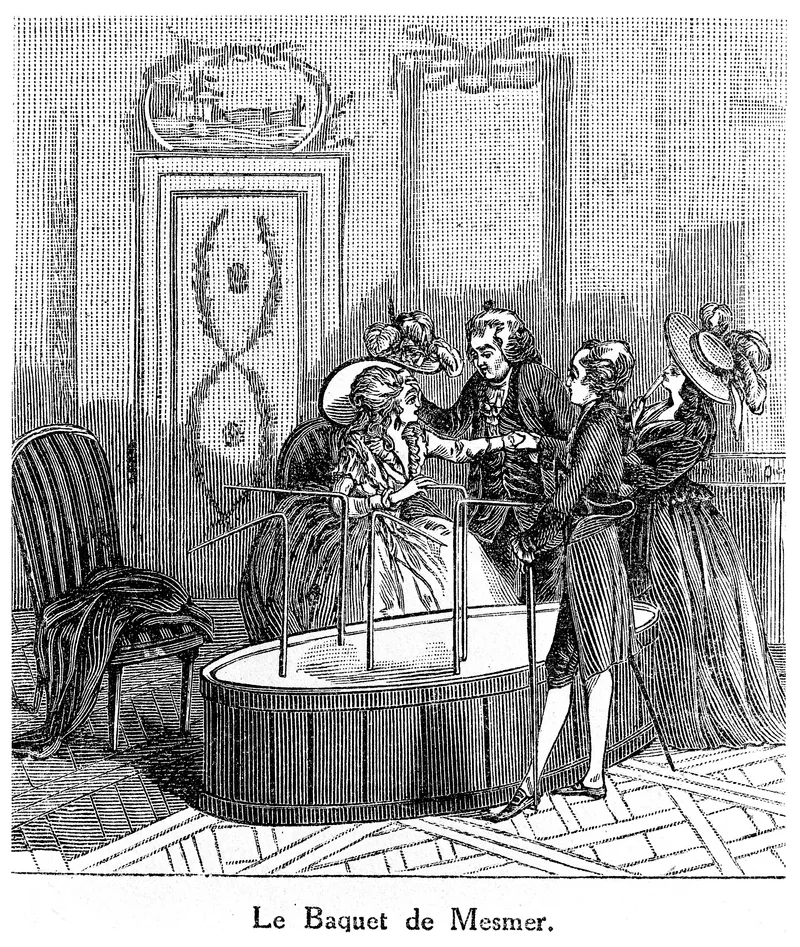
In 1783 Mesmer's supporters Nicolas Bergasse and Guillaume Kornmann organised the Société de l'Harmonie, a subscription society that taught the doctrine to paying members under a pledge of secrecy. Branches spread to Lyon, Strasbourg and other provincial cities. Robert Darnton has shown how, in the 1780s, mesmerism became bound up with radical politics: some Harmonists dreamed of a society restored to natural harmony, and the movement became a vehicle for criticism of the academies and the established order.
The 1784 Royal Commission§
In 1784 Louis XVI appointed two commissions to examine animal magnetism, one from the Academy of Sciences and the Faculty of Medicine, the other from the Royal Society of Medicine. The first included Benjamin Franklin, Antoine Lavoisier, the astronomer Jean-Sylvain Bailly and the physician Joseph-Ignace Guillotin. Working mainly with Mesmer's former pupil Charles d'Eslon, they devised tests in which subjects were blindfolded or deceived about whether they were being magnetised. Effects appeared when subjects believed they were magnetised and failed when they did not know.
The commissioners concluded that the fluid did not exist and that the phenomena were due to imagination, imitation and touch. A secret report to the king added warnings about the moral dangers of treatments in which male magnetisers touched female patients. One member of the second commission, the botanist Antoine-Laurent de Jussieu, issued a dissenting report. Historians of medicine now regard the 1784 investigation as a landmark in the use of blind procedures and in recognising what we call the placebo effect.
Puységur and Magnetic Somnambulism§
The commission's verdict did not end the movement; it transformed it. In the spring of 1784 the Marquis Armand-Marie-Jacques de Chastenet de Puységur, magnetising peasants on his estate at Buzancy near Soissons, found that a young man named Victor Race fell not into convulsions but into a calm sleep-like state in which he spoke more fluently than when awake, seemed to diagnose illnesses and followed the magnetiser's unspoken wishes. Puységur called this "magnetic somnambulism" and reported it in his Mémoires (1784). He also magnetised an elm tree on the village green so that many could be treated at once.
Somnambulism moved the focus from bodily crisis to the mind. In Lyon, magnetisers associated with the Masonic illuminist Jean-Baptiste Willermoz consulted somnambulists on spiritual questions, and some subjects began to speak of the afterlife and of spirits. In the early nineteenth century J. P. F. Deleuze's Histoire critique du magnétisme animal (1813) and his practical instructions made the gentle, benevolent magnetism of the somnambulist school standard, while the Portuguese priest known as Abbé Faria argued that the "lucid sleep" depended on the subject, not on any fluid.
Magnetism across Europe and America§
In the German lands, as described in our article on German occultism, Romantic physicians made magnetism a key to the soul's hidden powers. In Britain, the physician John Elliotson demonstrated mesmerism at University College Hospital until he was forced to resign in 1838, then founded the journal The Zoist (1843–1856); the novelist Harriet Martineau published Letters on Mesmerism (1845) after attributing her recovery from illness to it; and the Scottish surgeon James Esdaile reported hundreds of operations performed on mesmerised patients in Bengal in the 1840s, before chemical anaesthesia was widely available. Alison Winter's study shows how mesmerism became a Victorian debate about authority, class and the mind.
In the United States, the French lecturer Charles Poyen toured New England from 1836. Among those he influenced was the clockmaker Phineas Parkhurst Quimby, who moved from mesmeric healing to a theory that disease was a mistaken belief, a source of the New Thought movement and, controversially, of Christian Science. The entranced "Poughkeepsie Seer" Andrew Jackson Davis, magnetised in the 1840s, became a forerunner of Spiritualism. Edgar Allan Poe's tale of a mesmerised dying man (1845) shows how far the subject had entered popular imagination.
From Animal Magnetism to Hypnosis and the Occult§
In 1841 the Manchester surgeon James Braid saw a travelling magnetiser and set out to explain the trance without any fluid. In Neurypnology (1843) he attributed it to fixed attention and fatigue of the eyes and called it "neuro-hypnotism", soon shortened to hypnotism. Later in the century Jean-Martin Charcot at the Salpêtrière in Paris and Hippolyte Bernheim at Nancy debated whether hypnosis was a pathological state or the effect of suggestion. Sigmund Freud, who studied with Charcot in 1885–1886, began his career using hypnosis, and historians such as Henri Ellenberger and Adam Crabtree trace modern dynamic psychiatry to the magnetic tradition.
Occultists drew a different lesson. Éliphas Lévi identified the magnetic fluid with his "astral light", Reichenbach spoke of Od, and Theosophists of a universal life force. For them magnetism proved that will and imagination could act on matter at a distance, a theme examined in what is occultism and the occult revival. Controlled studies since 1784 have not found any physical magnetic fluid, and modern hypnosis is understood in psychological terms; its clinical uses belong to trained professionals rather than to the historical practices described here.
Frequently asked questions§
What is the difference between mesmerism and hypnosis?§
Mesmerism assumed a physical fluid passing from magnetiser to patient, typically through passes and touch. Hypnosis, as defined by James Braid in 1843 and developed by later physicians, explains the trance through attention, suggestion and the subject's own psychology, without any fluid.
Did the 1784 commission prove Mesmer wrong?§
The commissioners showed that the reported effects depended on what subjects believed rather than on whether they were actually magnetised, and concluded that the fluid did not exist. They did not deny that patients felt real effects; they attributed them to imagination.
Why is mesmerism important to the history of occultism?§
Mesmerism gave nineteenth-century occultists both a theory of invisible forces and a practice for exploring trance, clairvoyance and apparent contact with spirits. Spiritualism, Theosophy and Lévi's doctrine of the astral light all drew on it.
Sources and further reading§
- Mémoire sur la découverte du magnétisme animal — Franz Anton Mesmer, 1779
- Mémoires pour servir à l'histoire et à l'établissement du magnétisme animal — Marquis de Puységur, 1784
- Histoire critique du magnétisme animal — J. P. F. Deleuze, 1813
- Neurypnology, or the Rationale of Nervous Sleep — James Braid, 1843
- Letters on Mesmerism — Harriet Martineau, 1845
- Mesmerism in India — James Esdaile, 1846
- Mesmerism and the End of the Enlightenment in France — Robert Darnton, 1968
- The Discovery of the Unconscious — Henri F. Ellenberger, 1970
- A History of Hypnotism — Alan Gauld, 1992
- From Mesmer to Freud: Magnetic Sleep and the Roots of Psychological Healing — Adam Crabtree, 1993
- Mesmerized: Powers of Mind in Victorian Britain — Alison Winter, 1998