Liber XXII · Occultism · Chapter V: Mesmerism & Magnetism
James Braid and the Origins of Hypnotism: From Mesmer to Mind
How the Manchester surgeon James Braid turned mesmerism into hypnotism in 1841–1843: Neurypnology, eye fixation, suggestion, Esdaile, Charcot and Nancy.

James Braid (1795–1860) was a Scottish surgeon practising in Manchester who, after watching a mesmeric demonstration in 1841, concluded that the trance it produced came not from any magnetic fluid but from the subject's own nervous system and attention. He named the state "neuro-hypnotism", soon shortened to hypnotism, and described it in Neurypnology (1843). Braid is therefore usually regarded as the founder of hypnosis as a physiological and psychological phenomenon, separating it from the occult theories of animal magnetism.
Mesmerism in Britain before Braid§
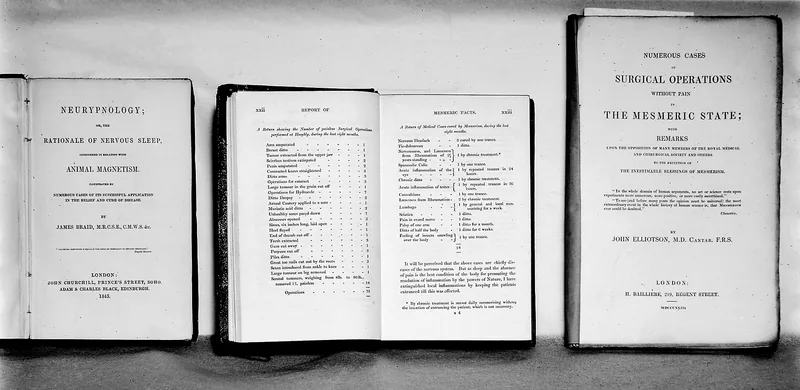
By the 1830s animal magnetism, the theory of Franz Anton Mesmer that a universal fluid flowed through living bodies and could be directed by the operator's hands, had reached Britain from France. Its most prominent advocate was John Elliotson, professor of medicine at University College London, who demonstrated mesmeric trances on patients, among them the sisters Elizabeth and Jane Okey. Accusations that the sisters were faking, and the hostility of the medical establishment, forced Elliotson's resignation in 1838. He went on to found The Zoist (1843–1856), a journal of mesmerism and phrenology.
Mesmerism in this period was a mixture of medical therapy, public entertainment and spiritual speculation. Travelling lecturers induced trances on stage, made subjects rigid, insensitive to pain or apparently clairvoyant, and claimed that magnetised subjects could read sealed letters or see distant places. Respectable doctors tended to dismiss the whole subject as fraud or collusion.
Lafontaine's Demonstrations and Braid's Experiments§
Braid was born in Kinross-shire in 1795, trained in medicine at Edinburgh, and worked as a surgeon to mining communities at Leadhills before settling in Manchester around 1828. He had a reputation for operations on club foot and squint. In November 1841 the Swiss magnetiser Charles Lafontaine gave a series of demonstrations in the city. Braid attended expecting to expose a trick, but at the second session he became convinced that one subject was genuinely unable to open his eyes.
Fixation of the gaze§
Braid set out to reproduce the effect without any of Mesmer's apparatus. He asked friends, his wife and his servant to stare fixedly at an object held a little above the eyes, such as the top of a wine bottle or a lancet case. After some minutes many showed the drooping eyelids, rigidity and altered awareness of the mesmeric trance. Since no passes were made and no fluid could be imagined, he concluded that the state arose from a strain on the nervous system produced by sustained attention, a "nervous sleep".
Braid lectured on his results in Manchester and elsewhere from late 1841, and in 1842 he offered a paper to the British Association when it met in Manchester. It was declined, and he presented his experiments instead at an informal gathering. The following year he published his book.
Neurypnology and the Naming of Hypnotism§
Neurypnology; or, the Rationale of Nervous Sleep, Considered in Relation with Animal Magnetism appeared in 1843. In it Braid coined "neuro-hypnotism", meaning nervous sleep, and "hypnotism" for the state as a whole; earlier French authors, notably the Baron d'Hénin de Cuvillers, had used related words, but Braid's book established the term. He described the use of hypnotism to relieve pain, treat nervous disorders and assist surgery, and argued that it should be taken into ordinary medical practice once freed from the "mysticism" of the magnetisers.
The book also shows that Braid had not escaped the speculative science of his day. He experimented with "phreno-hypnotism", pressing on parts of the skull that phrenologists associated with particular faculties and reporting that his entranced subjects acted out the corresponding emotions. He later came to suspect that such results arose from the subjects' expectations.
From physiology to the dominant idea§
Over the following years Braid placed more weight on mental factors. In The Power of the Mind over the Body (1846) he criticised the claims of Karl von Reichenbach, whose "sensitives" said they saw luminous emanations from magnets in the dark, and showed that similar reports could be produced by telling subjects what to expect. By the early 1850s he described hypnotism as a state of "monoideism", in which the mind is concentrated on a single dominant idea that acts powerfully on the body. This is close to what later writers would call suggestion.
Hypnotism, Anaesthesia and Esdaile in India§
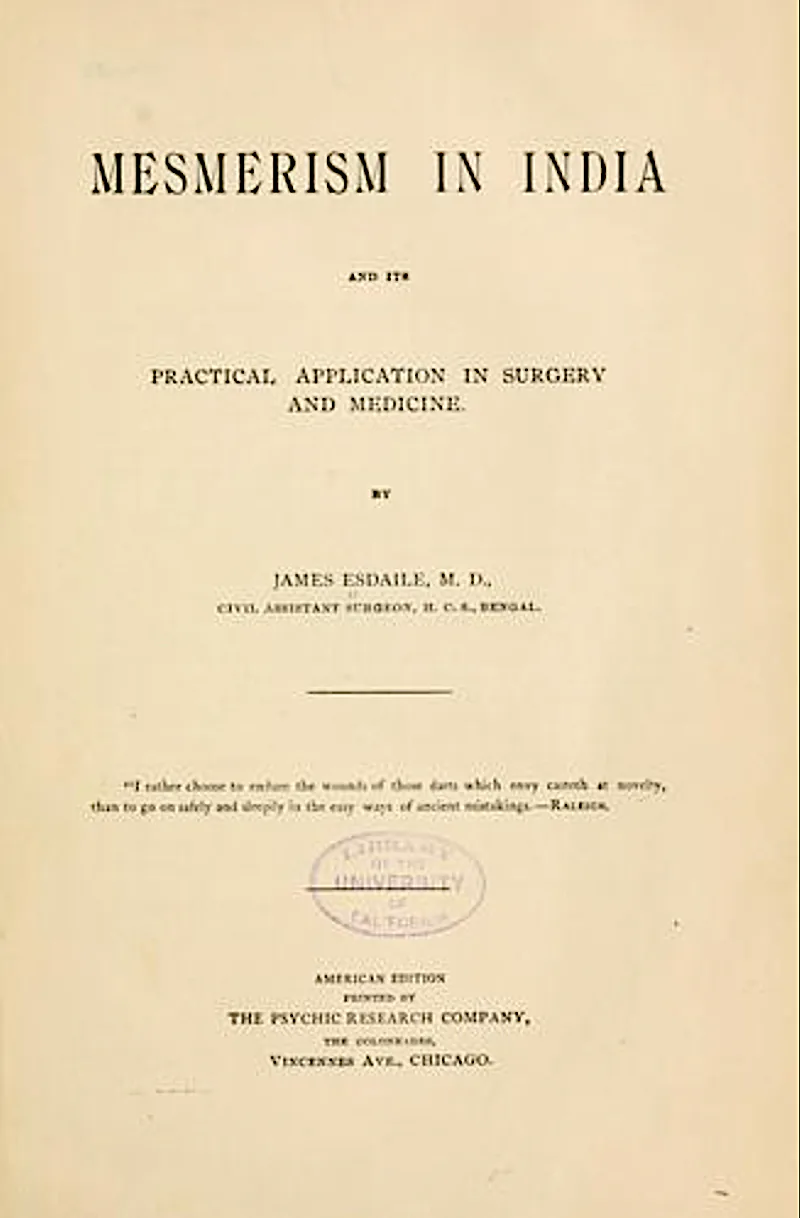
Braid's work coincided with a burst of interest in mesmeric surgery. In Calcutta the Scottish surgeon James Esdaile reported in Mesmerism in India (1846) that he had performed hundreds of operations, including the removal of large tumours, on patients in mesmeric trance, with low mortality. A Mesmeric Infirmary opened in London in 1849. The introduction of ether in 1846 and chloroform in 1847, however, gave surgeons reliable chemical anaesthesia, and medical interest in trance for surgery faded.
Braid also took an interest in reports of Indian yogis who allowed themselves to be buried for long periods, discussing them in Observations on Trance; or, Human Hybernation (1850). He interpreted such feats as an extreme form of self-induced trance, an early example of Western attempts to explain Asian contemplative practice in physiological terms. He died in Manchester on 25 March 1860.
The Rediscovery: Nancy, the Salpêtrière and Freud§
Braid's ideas had limited influence in Britain during his lifetime, but they were taken up in France around 1860, partly through the surgeon Étienne Eugène Azam. The country doctor Ambroise-Auguste Liébeault practised hypnotic therapy among the poor of Nancy, and the professor of medicine Hippolyte Bernheim made his methods famous in the 1880s. The "Nancy school" held that hypnosis was a normal phenomenon of suggestion to which most people were susceptible.
In Paris the neurologist Jean-Martin Charcot, at the Salpêtrière hospital, argued instead that true hypnosis was a pathological condition closely linked to hysteria, with fixed physical stages. His paper to the Académie des sciences in 1882 made hypnotism scientifically respectable in France. The debate between the two schools engaged the young Sigmund Freud, who studied with Charcot in 1885–1886 and visited Bernheim in 1889, before developing psychoanalysis partly in reaction against hypnotic method. Henri Ellenberger and later historians have treated this sequence, from Mesmer through Braid to the dynamic psychiatry of Janet and Freud, as a central line in the discovery of the unconscious.
Hypnotism and the Occult§
The naturalisation of trance did not end its occult career. Many mesmerists rejected Braid's theory and continued to speak of fluids and vital forces, while spiritualists from the 1850s often treated mediumistic trance as a doorway to the spirit world; see spiritualism. Stage "electro-biology" shows of the 1850s and later hypnotic entertainers kept the subject associated with mystery and power.
Occultists in turn absorbed hypnotism into their systems. Éliphas Lévi and later Theosophists interpreted the trance as action on the astral light, and the founders of the Society for Psychical Research set up a committee on mesmerism and hypnotism in 1882, hoping that hypnotic subjects might demonstrate telepathy. Fiction from George du Maurier's Trilby (1894) onward fixed the image of the sinister hypnotist. The history of hypnotism thus illustrates the theme of occultism and science: a phenomenon first claimed by occult theory was redescribed by medicine, while the older interpretation survived alongside it. Clinical hypnosis today is practised by trained health professionals and is understood as a state of focused attention and heightened responsiveness to suggestion, not a supernatural power.
Frequently asked questions§
Did James Braid invent hypnosis?§
Braid did not discover the trance state, which mesmerists had produced for decades. He was, however, the first to explain it convincingly as a product of attention and the nervous system rather than a magnetic fluid, and he popularised the name hypnotism in 1843.
What is the difference between mesmerism and hypnotism?§
Mesmerism explained trance and healing by a supposed universal fluid passed from operator to patient. Hypnotism, as Braid defined it, needed no fluid: the state was produced by the subject's own concentration and expectation, which later came to be called suggestion.
Why did doctors stop using mesmerism for surgery?§
Reports such as Esdaile's from Calcutta suggested that trance could reduce surgical pain. The arrival of ether and chloroform in 1846–1847 provided reliable chemical anaesthesia, and surgeons abandoned the less predictable mesmeric method.
Sources and further reading§
- Neurypnology; or, the Rationale of Nervous Sleep — James Braid, 1843
- Mesmerism in India — James Esdaile, 1846
- The Discovery of the Unconscious: The History and Evolution of Dynamic Psychiatry — Henri F. Ellenberger, 1970
- A History of Hypnotism — Alan Gauld, 1992
- From Mesmer to Freud: Magnetic Sleep and the Roots of Psychological Healing — Adam Crabtree, 1993
- Mesmerized: Powers of Mind in Victorian Britain — Alison Winter, 1998
- The Discovery of Hypnosis: The Complete Writings of James Braid — Donald Robertson (ed.), 2008