Liber XXII · Occultism · Chapter II: Clairvoyance & Psychical Research
The Society for Psychical Research: History and Key Studies
History of the Society for Psychical Research, founded in London in 1882: Sidgwick, Myers and Gurney, Phantasms of the Living, the Hodgson Report and mediums.

The Society for Psychical Research (SPR) is a learned society founded in London in 1882 to investigate, "without prejudice or prepossession", the phenomena claimed by mesmerists, spiritualists and believers in ghosts and second sight. Led at first by the Cambridge philosopher Henry Sidgwick and his circle, it pioneered the systematic collection of testimony, the testing of mediums and the coining of words such as "telepathy". It still exists, and its long record of careful, often sceptical inquiry makes it the founding institution of what later became parapsychology.
The Founding of the Society in 1882§
By the late 1870s the claims of spiritualism had divided educated Victorian opinion. Séances, table-turning and materialisation were reported in respectable drawing rooms, while exposures of fraudulent mediums filled the newspapers. A number of scientists and scholars believed that these claims deserved neither credulous acceptance nor contemptuous dismissal, but investigation.
The immediate impulse came from William Fletcher Barrett, professor of physics in Dublin, who had experimented with thought-reading and mesmeric subjects. In January 1882 he convened a conference in London, and the Society for Psychical Research was formally constituted the following month. Its first president was Henry Sidgwick, Knightbridge Professor of Moral Philosophy at Cambridge, whose authority as an ethicist gave the enterprise intellectual weight. Around him gathered his former pupils Frederic W. H. Myers, a classicist and poet, and Edmund Gurney, a writer on music and psychology, together with Sidgwick's wife, Eleanor, later principal of Newnham College.
The founding statement proposed six committees: on thought-reading, on mesmerism and hypnotism, on the "sensitives" described by Baron von Reichenbach, on apparitions and haunted houses, on the physical phenomena of séances, and on the literature of the subject. The early Society included many spiritualists, but tension between them and the Cambridge group grew quickly; several prominent spiritualists, including the medium and writer William Stainton Moses, resigned in the mid-1880s.
Telepathy, Apparitions and Phantasms of the Living§
The SPR's most distinctive contribution was the collection and analysis of spontaneous experiences. Myers proposed the word "telepathy" in 1882 to replace older terms such as "thought-transference", and the Society's early experiments with card-guessing and drawings tried to test it under controlled conditions. Some early positive results were later undermined when subjects were found to have used codes.
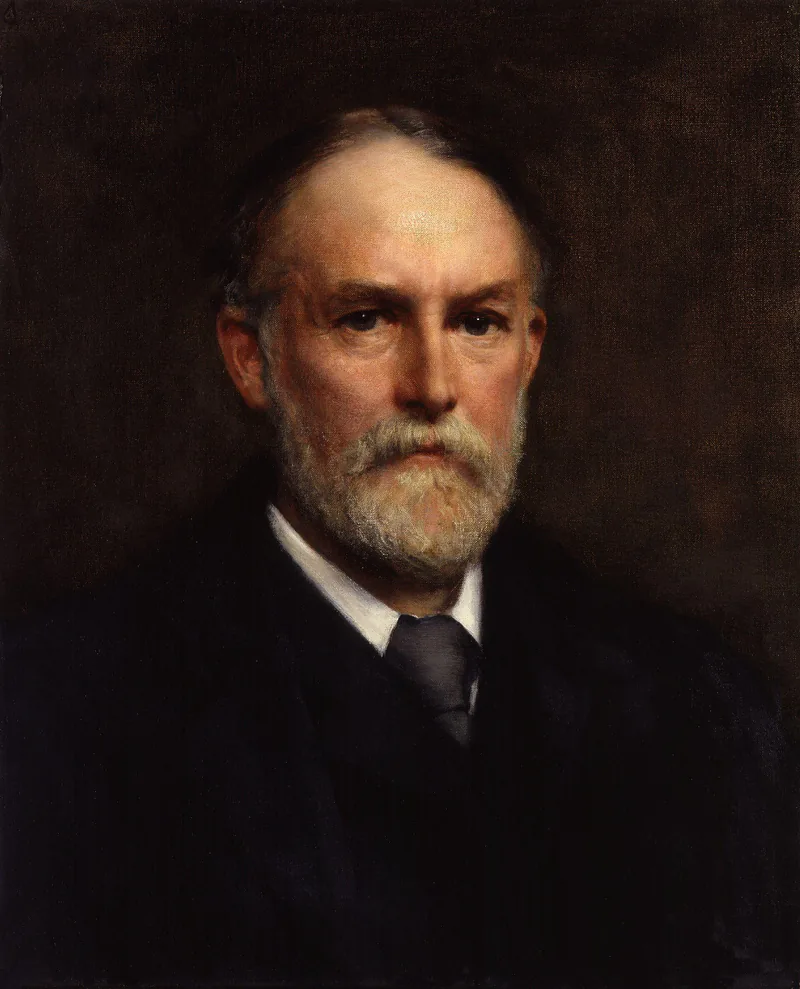
Phantasms of the Living§
In 1886 Gurney, Myers and Frank Podmore published Phantasms of the Living, two large volumes analysing several hundred cases in which a person had seen, heard or felt the presence of someone undergoing a crisis, often death, at a distance. The authors sought corroboration from letters, diaries and second witnesses, and argued that coincidence could not explain the pattern. They interpreted such "crisis apparitions" as telepathic impressions rather than ghosts of the dead, an important shift away from spiritualist assumptions.
The Census of Hallucinations§
The Society followed this with the Census of Hallucinations, an international survey led by Henry Sidgwick and published in 1894. Some seventeen thousand people answered whether, when awake and in good health, they had ever seen or heard something not explained by physical causes. About one in ten said yes. The organisers again concluded that the number of apparitions coinciding with a death exceeded what chance would predict, although critics questioned the reliability of memory and the selection of cases. The data remain a valuable record of Victorian experience, and our article on ghosts and hauntings places them in a longer history.
The Hodgson Report and Theosophy§
The Society's most controversial early investigation concerned Helena Blavatsky and the Theosophical Society. Theosophists claimed that letters from the Mahatmas, Blavatsky's hidden Masters, materialised in a shrine at the society's headquarters at Adyar in India. In 1884 Emma and Alexis Coulomb, former employees, alleged that the phenomena were faked, and the SPR sent the young Australian researcher Richard Hodgson to India to examine the evidence.
Hodgson's report, published in the Society's Proceedings in 1885, concluded that the phenomena were fraudulent and that Blavatsky was "one of the most accomplished, ingenious, and interesting impostors in history". The verdict damaged her reputation for a century. In 1986, however, the Journal of the Society for Psychical Research published a critique by the handwriting expert Vernon Harrison, who argued that Hodgson's investigation had been one-sided and his handwriting analysis flawed. The Society made clear that the report had always been Hodgson's own and not its official view. On the broader story see the Theosophical Society.
Mediums under Investigation: Piper, Palladino and Others§
From the 1880s the Society devoted much effort to trance mediums. The most important was Leonora Piper of Boston, studied by the American philosopher William James from 1885 and then for many years by Hodgson, who moved to America to direct the American branch. Hodgson began as a sceptic and ended convinced that Mrs Piper communicated with the dead; others thought her knowledge could be explained by telepathy from the living, by unconscious information-gathering, or by some combination of the two.
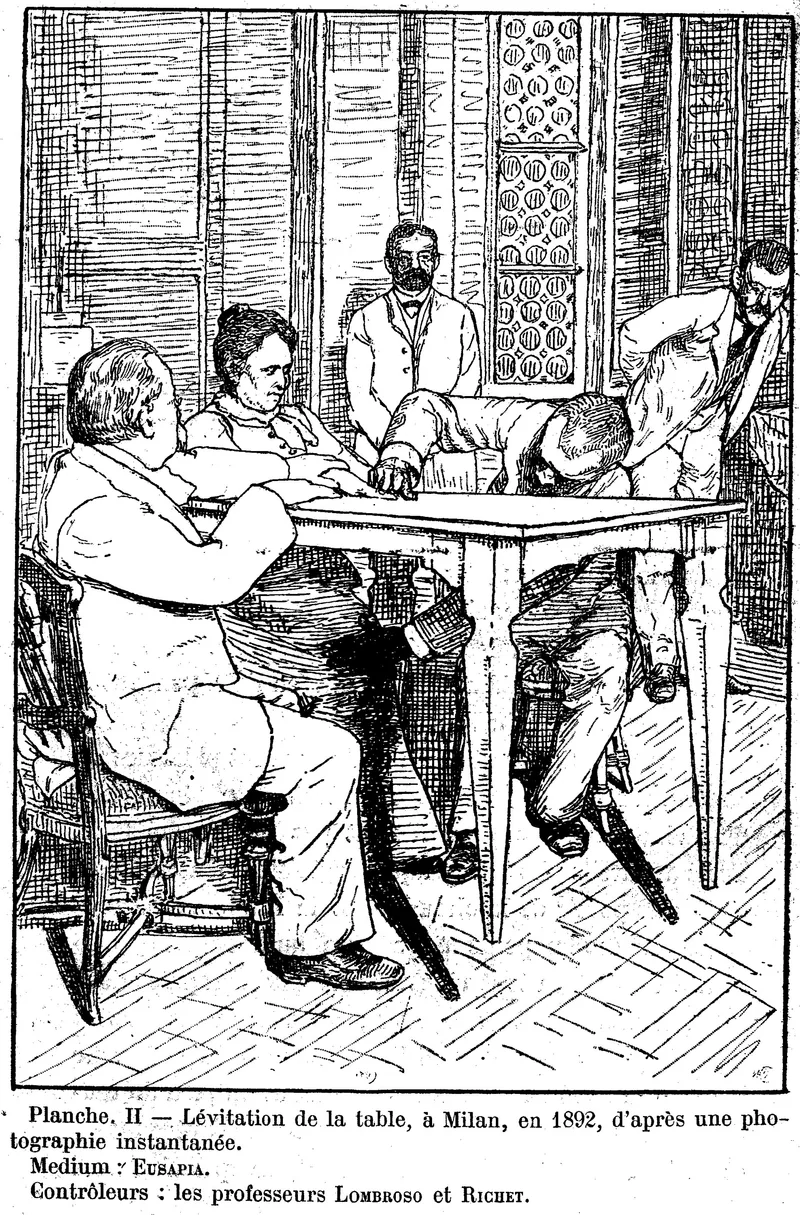
Physical mediums proved more troublesome. The Italian Eusapia Palladino was caught cheating during sittings at Cambridge in 1895, yet a three-man SPR committee that tested her in Naples in 1908 reported phenomena it could not explain, before further trickery was detected during her American tour of 1909–1910. Such episodes illustrate the Society's characteristic difficulty: a medium who sometimes cheated might, its members asked, still sometimes produce genuine effects.
Allied studies of trance speech and automatic writing contributed to the psychology of dissociation, multiple personality and the "subliminal self", a concept Myers developed in detail.
Myers, the Cross-Correspondences and Survival§
Myers' synthesis, Human Personality and Its Survival of Bodily Death, appeared posthumously in 1903. It argued that ordinary consciousness is only part of a larger subliminal self, which in genius, hypnosis, dreams and mediumship may draw on capacities beyond the normal, and which might survive death. William James regarded Myers as a major psychologist, and the book influenced theories of the unconscious alongside those of Pierre Janet and Freud.
After the deaths of Myers (1901), Gurney (1888) and Sidgwick (1900), several women who practised automatic writing, among them Margaret Verrall, Alice Fleming (writing as "Mrs Holland") and Winifred Coombe Tennant ("Mrs Willett"), produced scripts that some researchers believed contained interlocking classical allusions which made sense only when read together. These "cross-correspondences", studied for decades by Eleanor Sidgwick, Gerald Balfour and others, were taken by some as evidence that the dead founders were designing tests from beyond the grave. Sceptics pointed to the scholarly background of the automatists and the elasticity of interpretation.
Members, Influence and the Society Today§
The SPR's presidents read like a roll of late Victorian and Edwardian intellect: the statesman Arthur Balfour, William James, the chemist William Crookes, the physicist Oliver Lodge, the physiologist Charles Richet and the philosopher Henri Bergson, among others. Lodge's Raymond (1916), describing apparent communications from his son killed in the First World War, brought psychical research to a mass audience grieving after the war.
The Society also produced sharp critics. Its 1956 study of Borley Rectory, "the most haunted house in England", exposed the methods of the ghost-hunter Harry Price. The academic discipline of parapsychology developed largely in America after J. B. Rhine's laboratory work of the 1930s, described in our article on clairvoyance and psychical research, but the SPR remained its oldest institutional home.
Historians such as Alan Gauld and Janet Oppenheim have shown that the Society's founders were driven by a crisis of faith: they hoped that science might settle the question of survival which Christian doctrine no longer answered for them. Their insistence on evidence, documentation and open publication distinguished psychical research from both occultism and spiritualism, even as it shared their questions. The SPR continues to publish its Journal and Proceedings, maintains a library and archive, and expressly holds no corporate opinion about the reality of the phenomena it studies.
Frequently asked questions§
Who founded the Society for Psychical Research?§
The SPR was founded in London in 1882 on the initiative of the physicist William Barrett, with Henry Sidgwick as first president. Frederic Myers, Edmund Gurney, Eleanor Sidgwick and Frank Podmore were among its most active early members.
Did the SPR prove that ghosts or telepathy exist?§
No collective conclusion was ever reached, and the Society's rules forbid it to adopt one. Some members became convinced of telepathy or survival after death, while others, including some of its most effective investigators, remained sceptical.
What was the Hodgson Report?§
It was a report published in 1885 by the SPR investigator Richard Hodgson, which concluded that Helena Blavatsky had faked the phenomena attributed to the Theosophical Masters. It has been widely criticised since, notably in a 1986 paper by Vernon Harrison published in the Society's journal.
Is the Society for Psychical Research still active?§
Yes. The SPR remains a registered learned society in London. It publishes research, holds lectures and conferences, and keeps one of the largest archives on psychical research and spiritualism.
Sources and further reading§
- Phantasms of the Living — Edmund Gurney, Frederic W. H. Myers and Frank Podmore, 1886
- Human Personality and Its Survival of Bodily Death — Frederic W. H. Myers, 1903
- Raymond, or Life and Death — Oliver Lodge, 1916
- The Founders of Psychical Research — Alan Gauld, 1968
- The Society for Psychical Research 1882–1982: A History — Renée Haynes, 1982
- The Other World: Spiritualism and Psychical Research in England, 1850–1914 — Janet Oppenheim, 1985
- Immortal Longings: F. W. H. Myers and the Victorian Search for Life after Death — Trevor Hamilton, 2009