Liber XXXIII · Theosophy · Chapter X: Theosophical Society
The Theosophical Society: History, Leaders and Schisms
History of the Theosophical Society from its 1875 founding in New York to Adyar, Point Loma, Besant, Krishnamurti and the branches that survive today.

The Theosophical Society is an international organisation founded in New York in 1875 by Helena Petrovna Blavatsky, Henry Steel Olcott and William Quan Judge to promote universal brotherhood, the comparative study of religion and the investigation of hidden powers in nature and humanity. After moving its headquarters to Adyar in India in 1882, it divided in 1895 into rival branches, and its later history includes the Point Loma community, the presidency of Annie Besant and the Krishnamurti affair. Several Theosophical societies remain active today.
Founding in New York, 1875§
Blavatsky arrived in New York in 1873 and met Olcott the following year at the Eddy farmhouse in Chittenden, Vermont, where he was reporting on spiritualist manifestations for a newspaper. Both were then interested in spiritualism, but Blavatsky increasingly argued that séance phenomena were better explained by occult laws and lower entities than by the returning dead.
In September 1875 a small circle meeting in Blavatsky's rooms agreed to form a society, and on 17 November 1875 Olcott delivered the inaugural presidential address. Early meetings heard lectures on occultism and Kabbalah, and for a time the Society was only one of many New York study groups. Blavatsky's Isis Unveiled (1877) gave it a manifesto, and its sales brought the Society wider notice.
Bombay, Adyar and the Indian Period§
In late 1878 Blavatsky and Olcott sailed for India, arriving in Bombay in February 1879. They briefly allied with the Arya Samaj of Swami Dayananda Saraswati, a Hindu reform movement, but the alliance soon broke down. In 1880, in Ceylon, both founders formally took the Buddhist refuges and precepts, and Olcott threw himself into the Buddhist revival, founding schools and writing A Buddhist Catechism (1881).
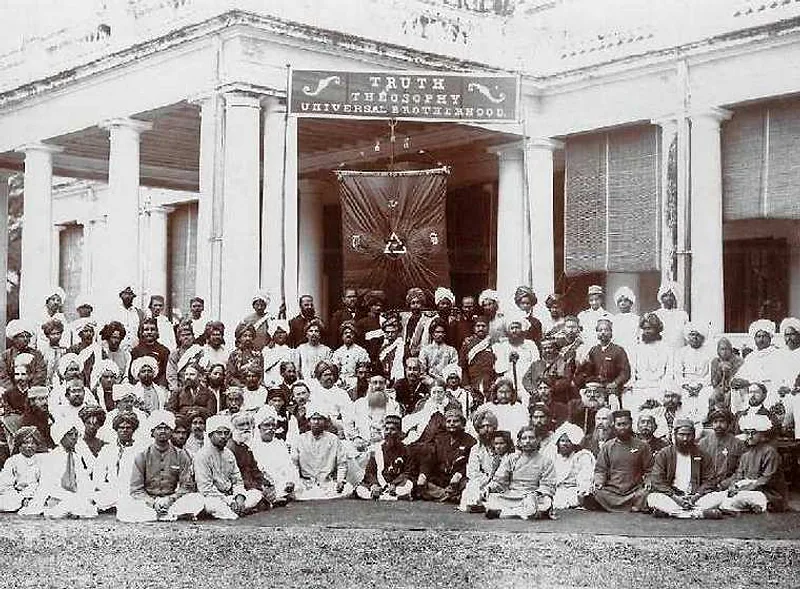
In 1882 the Society bought an estate at Adyar, on the outskirts of Madras, which has remained its international headquarters ever since. The journal The Theosophist, founded in 1879, carried Theosophical teachings to English-educated readers across India. The Society's welcome of Indians as equals, unusual in colonial society, helped make it a meeting ground for Indian reformers, and several early figures of the Indian National Congress were Theosophists.
The Hodgson Report§
In 1884 two former employees at Adyar, Alexis and Emma Coulomb, published letters alleging that Blavatsky had faked phenomena, including the appearance of letters from the Masters in a cabinet known as the "shrine". The Society for Psychical Research sent Richard Hodgson to investigate, and his report of December 1885 called Blavatsky an impostor. Blavatsky left India for Europe and never returned. Theosophists have long disputed the report, and in 1986 a document examiner, Vernon Harrison, published a critique of its methods in the SPR's own journal.
Blavatsky in London and the Esoteric Section§
Blavatsky spent her last years in Germany, Belgium and finally London, where she completed The Secret Doctrine (1888), The Key to Theosophy (1889) and The Voice of the Silence (1889). In 1888 she formed the Esoteric Section, an inner school for committed students who took pledges of discipline and received private instructions. Among her London recruits was Annie Besant, the famous secularist and social reformer, who joined in 1889 after reviewing The Secret Doctrine. Blavatsky died in London on 8 May 1891, a date Theosophists commemorate as White Lotus Day.
The 1895 Schism: Adyar, Point Loma and the ULT§
After Blavatsky's death, tensions between Olcott, Besant and Judge came to a head. Judge was accused of forging messages from the Masters; he denied it, and in 1895 the great majority of the American lodges voted to become the independent Theosophical Society in America under his leadership. Judge died in 1896.

His successor, Katherine Tingley, built a remarkable community at Point Loma, near San Diego, with a school based on her "Raja Yoga" education, Greek dramas, gardens and an open-air theatre. The Point Loma society later moved to Pasadena and survives as the Theosophical Society (Pasadena). In 1909 Robert Crosbie, a former Point Loma member, founded the United Lodge of Theosophists in Los Angeles, which avoids leaders and personal authority and studies only the writings of Blavatsky and Judge. The original society, known as the Theosophical Society (Adyar), remained the largest branch.
Annie Besant, Leadbeater and the World Teacher§
Olcott died at Adyar in 1907, and Annie Besant was elected president, holding office until her death in 1933. Her close collaborator Charles Webster Leadbeater, a former Anglican curate, produced an influential body of clairvoyant writings on auras, thought-forms, the astral plane and the inner government of the world. Together they wrote Thought-Forms (1901), an important source for later ideas about auras and subtle energies. Leadbeater was also the subject of serious scandals over his conduct with boys in his care, which led to his resignation in 1906 and a divisive readmission in 1908.
In 1909 Leadbeater singled out a young Indian boy, Jiddu Krishnamurti, on the beach at Adyar as the future vehicle of a coming World Teacher. Besant and Leadbeater raised him and his brother, and in 1911 the Order of the Star in the East was founded to prepare for his mission. In 1929, at Ommen in the Netherlands, Krishnamurti dissolved the Order, declaring that truth is "a pathless land" that no organisation can lead people to. He went on to teach independently for more than half a century, and the Society lost many members.
Liberal Catholic Church and Co-Masonry§
Besant's Theosophy reached into other institutions. She was a leading figure in the mixed-gender Masonic order Le Droit Humain, known in the English-speaking world as Co-Masonry, and Leadbeater helped found the Liberal Catholic Church in 1916, combining Catholic liturgy with Theosophical doctrine.
Offshoots and Departures§
The Krishnamurti campaign helped provoke the departure of the German Section under its general secretary Rudolf Steiner, who formed the Anthroposophical Society in 1912–1913; see our guide to Anthroposophy. Alice Bailey, who had worked at the American headquarters, founded the Lucis Trust and the Arcane School in the early 1920s, teaching what she presented as dictations from a Tibetan Master. Guy and Edna Ballard's "I AM" Activity in the 1930s, and later Ascended Master groups, borrowed the Theosophical Masters for a more devotional American religion. Many members of early occult orders, including the Hermetic Order of the Golden Dawn, were also Theosophists.
The Theosophical Society Today§
Today the Theosophical Society (Adyar) has national sections in dozens of countries, with the Theosophical Society in America based at Wheaton, Illinois, where its publishing house issues Quest Books. The Pasadena society and the United Lodge of Theosophists continue on a smaller scale. Membership peaked in the late 1920s and is now much lower, but Theosophical libraries, lodges and publishing remain active. Historians see the Society's legacy less in its numbers than in the ideas it spread: karma and reincarnation in the West, a respectful interest in Asian religions, and the conviction, central to the later New Age, that all religions share an esoteric core.
Frequently asked questions§
Is the Theosophical Society still active?§
Yes. The Theosophical Society (Adyar) remains the largest body, with headquarters in Chennai and sections in many countries. The Theosophical Society (Pasadena) and the United Lodge of Theosophists are smaller, independent organisations descended from the 1895 schism.
Why did the Theosophical Society split?§
The 1895 split arose from accusations that William Quan Judge had forged messages from the Masters, combined with rivalries over leadership after Blavatsky's death. Most American lodges sided with Judge and became independent, and later disagreements produced further groups.
What happened between Krishnamurti and the Theosophical Society?§
Annie Besant and C. W. Leadbeater proclaimed Jiddu Krishnamurti the vehicle of a coming World Teacher and founded the Order of the Star in the East around him. In 1929 Krishnamurti dissolved the Order, rejected the role and broke with organised Theosophy.
Sources and further reading§
- Old Diary Leaves — Henry Steel Olcott, 1895
- The Key to Theosophy — Helena P. Blavatsky, 1889
- Thought-Forms — Annie Besant and C. W. Leadbeater, 1901
- Ancient Wisdom Revived: A History of the Theosophical Movement — Bruce F. Campbell, 1980
- The Elder Brother: A Biography of Charles Webster Leadbeater — Gregory Tillett, 1982
- Krishnamurti: The Years of Awakening — Mary Lutyens, 1975
- The Dawning of the Theosophical Movement — Michael Gomes, 1987
- The Theosophical Enlightenment — Joscelyn Godwin, 1994
- Annie Besant: A Biography — Anne Taylor, 1992
- Handbook of the Theosophical Current — Olav Hammer and Mikael Rothstein (eds.), 2013