Liber XXXIII · Theosophy · Chapter I: Anthroposophy
Anthroposophy: Rudolf Steiner's Spiritual Science Explained
Anthroposophy explained: Rudolf Steiner's spiritual science, its break with Theosophy, its core teachings, and Waldorf schools, biodynamics and their critics.

Anthroposophy, from the Greek for "human wisdom", is the spiritual movement founded by the Austrian philosopher Rudolf Steiner (1861–1925), who described it as a "spiritual science" capable of investigating supersensible worlds as rigorously as natural science studies the physical one. Emerging from the German Section of the Theosophical Society, from which it separated in 1912–1913, it places the figure of Christ at the centre of cosmic and human evolution. It is best known today through its practical offshoots: Waldorf schools, biodynamic farming and anthroposophic medicine.
Rudolf Steiner's Life and Intellectual Formation§
Steiner was born in 1861 in Kraljevec, then in the Hungarian part of the Habsburg Empire and now in Croatia, the son of a railway official. He studied at the Technical University in Vienna and, while still young, was invited to edit Goethe's scientific writings for a major German edition. From 1890 he worked at the Goethe and Schiller Archive in Weimar. Goethe's way of observing nature, attentive to form, metamorphosis and the observer's own developing perception, remained the model for everything Steiner later called spiritual science.
His philosophical book The Philosophy of Freedom (1894) argued that free human action springs from thinking that has become conscious of itself. In the late 1890s Steiner lived in Berlin, edited a literary magazine and lectured at a workers' educational school. Around 1900 he began speaking to Theosophical audiences, and in 1902 he became general secretary of the newly founded German Section of the Theosophical Society, working closely with Marie von Sivers, who later became his wife.
From Theosophy to Anthroposophy§
Steiner's Theosophical period produced several of his foundational books: Theosophy (1904), How to Know Higher Worlds (first serialised 1904–1905) and An Outline of Esoteric Science (1910). Even then his emphasis differed from that of Adyar. He drew on Western sources, including Goethe, German idealism and Rosicrucian symbolism, and he presented the incarnation of Christ as the turning point of all world evolution.
The rupture came when Annie Besant and C. W. Leadbeater proclaimed the young Jiddu Krishnamurti as the coming vehicle of the World Teacher and founded the Order of the Star in the East. Steiner rejected the idea that Christ could reincarnate in a human body. Besant revoked the German Section's charter, and in 1912–1913 Steiner and most of his followers formed the Anthroposophical Society. For the background, see our guide to the Theosophical Society.
The Goetheanum§
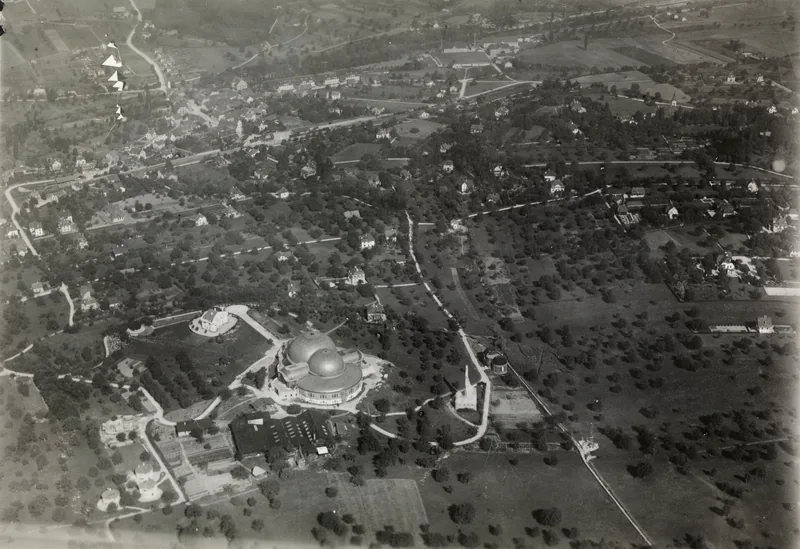
From 1913 Steiner's followers built a great double-domed wooden building at Dornach, near Basel, designed by Steiner himself and named the Goetheanum. It was destroyed by fire on New Year's Eve 1922–1923. Steiner designed a second Goetheanum in poured concrete, completed in 1928 after his death, which remains the seat of the General Anthroposophical Society, refounded by Steiner at the "Christmas Conference" of 1923–1924.
Core Teachings of Anthroposophy§
Steiner gave some six thousand lectures, and his collected works run to more than three hundred volumes, so any summary is selective. Several teachings recur throughout.
The human being: bodies, soul and spirit§
Steiner described the human being as body, soul and spirit, and more specifically as a physical body, an etheric (life) body, an astral body bearing feeling and desire, and an "I" or ego, the eternal individuality. Spiritual development consists in the I gradually transforming the lower bodies. These terms overlap with Theosophical vocabulary, but Steiner gave them his own meanings; a comparison appears in our guide to astral projection and the astral body.
Reincarnation, karma and the Christ event§
Like Theosophy, Anthroposophy teaches repeated earthly lives governed by karma (see reincarnation and the afterlife). Unlike Blavatsky, Steiner made the "Mystery of Golgotha", the death and resurrection of Christ, the central event of cosmic history, through which the spiritual being of Christ united with the earth.
Lucifer and Ahriman§
Steiner described two opposing spiritual temptations: Lucifer, who draws humanity toward pride, fantasy and escape from the earth, and Ahriman, who draws it toward cold materialism and mechanism. Christ, in this view, holds the balance between them, an image Steiner gave sculptural form in a large wooden carving known as the Representative of Humanity.
Knowledge of higher worlds§
Steiner taught that anyone could develop supersensible perception through meditation, moral discipline and exercises in concentrated thinking. He claimed to read the "Akashic Record", a spiritual memory of all events, and from it described Atlantis, Lemuria and the earlier planetary stages of the earth. Critics note that these accounts cannot be independently tested.
Practical Applications of Anthroposophy§
Waldorf education§
In 1919 the industrialist Emil Molt asked Steiner to found a school for the children of workers at the Waldorf-Astoria cigarette factory in Stuttgart. Waldorf (or Steiner) education, based on Steiner's model of child development in seven-year stages, emphasises art, movement, storytelling and delayed formal academics. There are now well over a thousand Waldorf schools worldwide.

Biodynamic agriculture and medicine§
Lectures given at Koberwitz in 1924 founded biodynamic agriculture, an early form of organic farming that treats the farm as a self-contained organism and uses special preparations and an astronomical sowing calendar. With the physician Ita Wegman, Steiner also developed anthroposophic medicine, associated with the Weleda company, and the movement art of eurythmy. The Camphill communities for people with disabilities, founded by Karl König in Scotland around 1940, and the Christian Community church, founded in 1922, are further offshoots.
Criticism and Scholarly Assessment§
Anthroposophy has been criticised on several fronts. Scientific reviews have not found good evidence that biodynamic preparations improve yields beyond ordinary organic methods, and anthroposophic remedies such as mistletoe extracts for cancer have not been shown to be effective in rigorous trials. Some Waldorf schools have also faced criticism over low vaccination rates among families.
Steiner's lectures include statements about race that reflected the racial theories of his era. A commission set up by the Dutch Anthroposophical Society reported in 2000 that a small number of passages would be considered discriminatory today, while concluding that Steiner's work as a whole was not racist; critics such as the historian Peter Staudenmaier have argued for a more serious problem. The German historian Helmut Zander's large study places Anthroposophy firmly within the history of Theosophy and modern esotericism.
Frequently asked questions§
What is the difference between Theosophy and Anthroposophy?§
Anthroposophy grew out of Theosophy and shares its belief in reincarnation, karma and subtle bodies. The main differences are that Steiner centred his system on Christ and on Western sources, rejected the Theosophical Masters as necessary guides, and emphasised individual spiritual research modelled on Goethe's science.
Do you have to be an anthroposophist to attend a Waldorf school?§
No. Waldorf schools are open to families of any belief, and many parents choose them for their arts-rich curriculum. Anthroposophical ideas underlie the teacher training and curriculum, which some parents and critics feel should be stated more openly.
Is Anthroposophy a religion?§
Steiner presented it as a path of knowledge rather than a religion, and the Anthroposophical Society has no creed or worship. The separate Christian Community, founded with Steiner's help, provides sacraments for those who want them. Scholars generally classify Anthroposophy as a modern esoteric movement.
Sources and further reading§
- The Philosophy of Freedom — Rudolf Steiner, 1894
- Theosophy — Rudolf Steiner, 1904
- How to Know Higher Worlds — Rudolf Steiner, 1904
- An Outline of Esoteric Science — Rudolf Steiner, 1910
- The Course of My Life — Rudolf Steiner, 1925
- Rudolf Steiner: An Introduction to His Life and Work — Gary Lachman, 2007
- Sun at Midnight: The Rudolf Steiner Movement and the Western Esoteric Tradition — Geoffrey Ahern, 1984
- Anthroposophie in Deutschland — Helmut Zander, 2007
- Between Occultism and Nazism: Anthroposophy and the Politics of Race in the Fascist Era — Peter Staudenmaier, 2014