Liber IX · Gnosticism · Chapter IV: Christian Theosophy
Jacob Boehme: The Shoemaker Mystic, Aurora and the Ungrund
Jacob Boehme, the shoemaker mystic of Görlitz: his life, Aurora, the Ungrund, divine Sophia, Christian theosophy and his influence on Blake and Hegel.

Jacob Boehme (1575–1624) was a Lutheran shoemaker from Görlitz in Upper Lusatia whose visionary writings founded the tradition known as Christian theosophy. Beginning with Aurora in 1612, he described God as emerging from an unfathomable "Ungrund", the eternal self-revelation of the divine through conflicting forces, and the figure of the heavenly virgin Sophia. Though persecuted by the local pastor, he influenced mystics and theologians across Europe, including Johann Georg Gichtel, William Law and William Blake, and left a deep mark on German Idealism.
The Shoemaker of Görlitz: Life of Jacob Boehme§
Jacob Boehme (also spelled Böhme or Behmen) was born in 1575 in Alt Seidenberg, a village near Görlitz in Upper Lusatia, today in Poland near the German border. His family were Lutheran peasants of some standing. He attended a village school, was apprenticed to a shoemaker, and after a period as a journeyman settled in Görlitz, where he purchased a master's position and married Katharina Kuntzschmann in 1599. The couple had four sons. Later he sold his workshop and traded in woollen gloves and yarn, which gave him more time to write.
Görlitz was a prosperous town with a lively culture of learned laymen, physicians and readers of Paracelsus, Valentin Weigel and Caspar Schwenckfeld. Boehme's friends included the physician Balthasar Walter, who had travelled in the East, and the nobleman Abraham von Franckenberg, who wrote the first biography of him. Through such circles he absorbed the vocabulary of alchemy, Paracelsian medicine and spiritualist Protestantism, though he insisted his knowledge came from inner illumination rather than books.
According to Franckenberg, in 1600 Boehme gazed at a pewter vessel reflecting the sunlight and was drawn into a vision in which he seemed to see into the inner nature of all things. He later described a further, deeper illumination around 1610. He kept these experiences to himself for twelve years before beginning to write.
Aurora (1612) and the Conflict with Pastor Richter§
In 1612 Boehme wrote Morgenröte im Aufgang ("The Dawn Rising"), known by the Latin title Aurora, given it by an admirer. It was an unfinished attempt to describe the nature of God, the angels, the fall of Lucifer and the creation, written in vivid and often difficult German. Boehme did not intend to publish it, but a manuscript copy circulated and came into the hands of Gregor Richter, the chief Lutheran pastor of Görlitz.

Richter denounced the book from the pulpit as heretical. In 1613 the town council briefly arrested Boehme, confiscated the manuscript and ordered him to stop writing. He obeyed for about five years. Encouraged by friends, he began writing again in 1618, and in the remaining six years of his life produced some thirty works, including The Three Principles of the Divine Essence (1619), The Threefold Life of Man (1620), Forty Questions on the Soul (1620), Of the Incarnation of Jesus Christ (1620), De signatura rerum (The Signature of All Things, 1622), Mysterium Magnum, a commentary on Genesis (1623), and a series of devotional tracts.
The only work printed in his lifetime was a collection of these devotional pieces, Der Weg zu Christo (The Way to Christ), published in 1624. Its appearance revived Richter's attacks, and Boehme left Görlitz for Dresden, where he was received with some interest at the Saxon court. He fell ill, returned home and died in November 1624. Richter died shortly before him; Richter's successor, at the town council's insistence, conducted Boehme's funeral reluctantly.
The Ungrund: God Beyond Ground and the Birth of the Divine§
The most celebrated of Boehme's ideas is the Ungrund, a word he coined to describe the divine as it is in itself, prior to any manifestation. The Ungrund is "groundless": it has no basis, no cause and no determinate nature. It is an eternal stillness, nothing and all, without qualities. This resembles the apophatic theology discussed in our article on Pseudo-Dionysius and Christian mysticism and Meister Eckhart's "ground", though Boehme gives it a dynamic twist.
In the Ungrund there is a will, a longing to find and know itself. This will seeks a mirror, an "eye" in which to see itself, and that mirror is divine Wisdom. To become manifest, the will must pass through a process of contraction and expansion. Boehme describes this as a kind of eternal nature in God, structured by seven "source-spirits" (Quellgeister) or properties:
- Harshness or astringency, a contracting desire.
- Bitterness or attraction, a stinging motion against the first.
- Anguish, the turning wheel produced by their conflict.
- Fire or lightning, the flash in which darkness is broken and light appears.
- Light and love.
- Sound or understanding.
- Body or essence, in which the others are realised.
The first three form a "dark world" of wrath and desire; the fire is the turning point; the last three form the "light world" of love. In God, the dark fire is eternally transformed into light, so that divine love is not static goodness but the overcoming of a hidden wrath. Boehme speaks of three principles: the dark world, the light world, and the visible world, which is a mixture of the two. Evil arises when a creature, as Lucifer did, chooses to remain in the fiery desire instead of passing through to love.
These ideas have often been compared with Gnostic myths, alchemical processes and the self-contraction of the divine described in our article on Lurianic Kabbalah and tzimtzum. Direct dependence on Luria is impossible, since Lurianic teaching was barely known in Germany in Boehme's lifetime, but some historians have argued for indirect contact with Christian Kabbalah. Boehme also differs sharply from ancient Gnostics in rejecting any evil creator; for him the world, though fallen, is a real manifestation of God (contrast our article on the demiurge).
Divine Sophia: The Heavenly Virgin§
Wisdom, or the Virgin Sophia, plays a central role in Boehme's writings. She is the eternal mirror in which God beholds the wonders of his own nature, not a fourth person of the Trinity but the "body" or manifestation of the divine. Boehme often calls her the "noble Virgin" or "the Virgin of God's Wisdom".
Boehme's account of the fall gives Sophia an anthropological role. Adam was originally androgynous, united with the heavenly Virgin, and possessed a paradisal body. When his desire turned away from God toward the outer, earthly world, he lost Sophia; his sleep in Genesis 2 represents this loss, and the creation of Eve from his side signals the division of the sexes. Christ restores the lost Virgin, and the believer's rebirth involves an inner marriage with Sophia. Boehme describes the soul's relationship with her in the language of a lover's longing, drawing on the Song of Songs.
The theme of a feminine divine Wisdom that is lost and restored invites comparison with the myth of Sophia in Valentinian Gnosticism. Most historians see both as independent developments of the biblical Wisdom literature rather than evidence of a hidden Gnostic tradition.
Theosophy, Alchemy and the Signature of Things§
Boehme's followers called his teaching theosophia, "divine wisdom", a term that later took on a different sense with the Theosophical Society of 1875. In early modern usage, Christian theosophy meant a visionary knowledge of God, nature and humanity, grounded in scripture and inner illumination. Antoine Faivre, a leading historian of Western esotericism, regarded Boehme as the founder of this current.
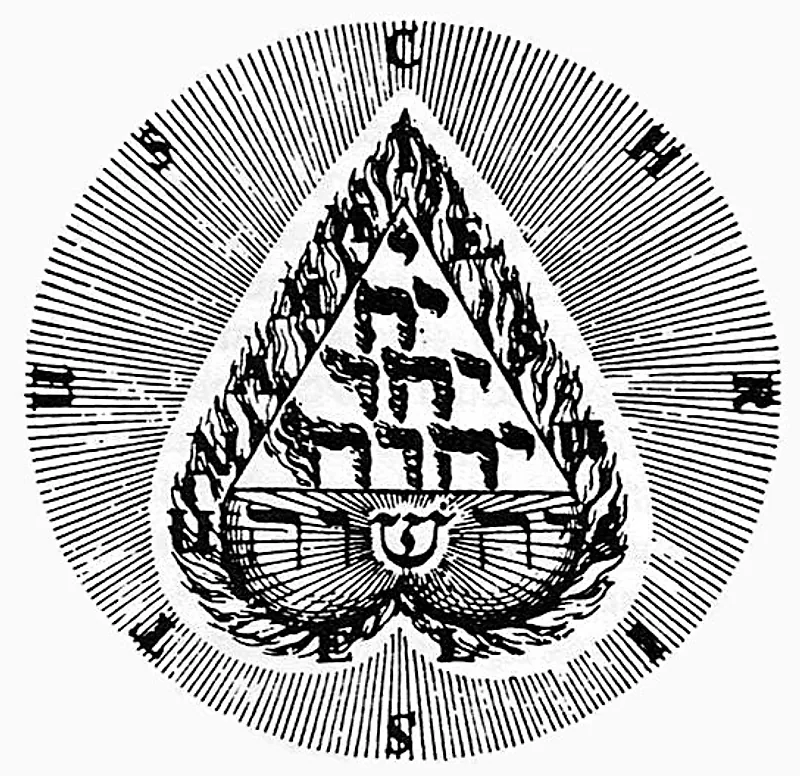
Boehme's language is heavily alchemical. He speaks of salt, sulphur and mercury, the three Paracelsian principles; of the "tincture" that transforms; and of the "philosopher's stone", which for him is Christ in the regenerated soul. His Signatura rerum develops the doctrine of signatures, the idea that the outward form of every creature expresses its inner nature, which Paracelsian physicians used to infer the medicinal qualities of plants. For Boehme, the signature is above all a key to spiritual knowledge. The alchemical background is covered in our article on Western alchemy.
He also taught a "language of nature" (Natursprache), the original language of Adam in which the sounds of words expressed the essence of things, and he analysed German words syllable by syllable to recover their hidden meaning, a method his critics found especially fanciful.
Boehme's Followers: Gichtel, the Philadelphians and William Law§
Boehme's manuscripts were copied and collected by friends, and in the decades after his death they spread through Silesia, the Netherlands and England. The Amsterdam merchant Abraham Willemsz van Beyerland sponsored editions and Dutch translations. Johann Georg Gichtel (1638–1710), a lawyer from Regensburg who settled in Amsterdam after conflicts with Lutheran authorities, published the first complete edition of Boehme's works in 1682. Gichtel led a celibate community, the "Angelic Brethren", who sought union with Sophia; his letters were later published as Theosophia practica.
In England, John Sparrow and others translated nearly all of Boehme's works between 1645 and 1662, during the upheavals of the Civil War and Interregnum, when radical religious ideas circulated freely. Boehme was read by Quakers, Diggers and many independent seekers. The physician John Pordage and the visionary Jane Lead (1624–1704) founded a Boehme-inspired circle that became the Philadelphian Society in the 1690s; Lead's numerous writings describe visions of the Virgin Sophia.
William Law (1686–1761), the Anglican author of the devotional classic A Serious Call to a Devout and Holy Life (1729), discovered Boehme in the 1730s and was profoundly changed by him. Law's later works, such as The Spirit of Prayer and The Spirit of Love, present a Boehmenist theology of divine love. An English edition based on Law's papers, the so-called "Law edition", was published between 1764 and 1781 with remarkable symbolic engravings from the drawings of Dionysius Andreas Freher. In France, Louis-Claude de Saint-Martin, the "Unknown Philosopher", translated several of Boehme's works at the end of the eighteenth century and integrated his ideas into the current later called Martinism.
Influence on Blake, German Idealism and Romanticism§
William Blake (1757–1827) read Boehme in the Law edition and spoke admiringly of him. In The Marriage of Heaven and Hell (c. 1790) he named "Paracelsus or Jacob Behmen" as writers who could produce countless volumes of value. Boehme's dialectic of fire and light, wrath and love, and his notion that opposites are necessary for manifestation, resonate in Blake's statement that without contraries there is no progression, and in his mythology of fallen and redeemed powers.
In Germany, Boehme's reputation revived around 1800. Ludwig Tieck and Novalis read him enthusiastically. Franz von Baader, a Catholic philosopher and mining engineer, became his most devoted modern interpreter. Friedrich Schelling's Philosophical Investigations into the Essence of Human Freedom (1809) adopts the Boehmean idea of a "ground" in God distinct from God's existence, and uses it to explain the possibility of evil. G. W. F. Hegel, in his Lectures on the History of Philosophy, called Boehme the first German philosopher, admiring his attempt to grasp the divine as a living process of self-differentiation, while criticising his "barbarous" and pictorial form of expression.
Later readers include Arthur Schopenhauer, the Russian religious philosophers Vladimir Solovyov and Nikolai Berdyaev (who drew on Boehme's Ungrund in his idea of "meonic" freedom), and the Protestant theologian Paul Tillich. Carl Jung reproduced Boehmean mandalas in his writings on symbolism. Modern study has been shaped by scholars such as Alexandre Koyré, whose La philosophie de Jacob Boehme (1929) remains a classic, Andrew Weeks, and Cyril O'Regan. Boehme thus stands at an intersection between the mystical tradition, the esoteric currents surveyed in our overview of Gnosticism and their modern reception, and the main line of German philosophy.
Frequently asked questions§
What is the Ungrund in Jacob Boehme?§
The Ungrund, or "groundless", is Boehme's term for God as he is in himself, before any manifestation: an abyss without qualities, cause or ground. Within it a will longs to know itself, and this longing gives rise to the eternal nature and the Trinity's self-revelation. Schelling and Berdyaev later developed the idea philosophically.
Was Jacob Boehme a Gnostic?§
Boehme was a Lutheran Christian who never knew the ancient Gnostic texts, most of which were rediscovered only in the twentieth century. He shares with some Gnostic myths an interest in Sophia and in an inner drama within God, but he rejected the idea of an evil creator. Scholars generally classify him as a Christian theosophist and mystic.
What did Boehme write?§
His first work was Aurora (1612). Between 1618 and 1624 he wrote about thirty more, including The Three Principles of the Divine Essence, The Signature of All Things, Mysterium Magnum and The Way to Christ, the only book published in his lifetime.
How did Boehme influence William Blake?§
Blake read Boehme in the English Law edition and praised him in The Marriage of Heaven and Hell. Boehme's ideas about the necessity of contraries, the fall into division and divine imagination are widely seen as important for Blake's mythology, alongside Swedenborg, Paracelsus and the Bible.
Sources and further reading§
- Aurora (Morgenröte im Aufgang) — Jacob Boehme, 1612
- Der Weg zu Christo (The Way to Christ) — Jacob Boehme, 1624
- De signatura rerum — Jacob Boehme, 1622
- Theosophia revelata (complete works) — Johann Georg Gichtel (ed.), 1682
- La philosophie de Jacob Boehme — Alexandre Koyré, 1929
- Boehme: An Intellectual Biography of the Seventeenth-Century Philosopher and Mystic — Andrew Weeks, 1991
- Gnostic Apocalypse: Jacob Boehme's Haunted Narrative — Cyril O'Regan, 2002
- Philosophical Investigations into the Essence of Human Freedom — F. W. J. Schelling, 1809
- Access to Western Esotericism — Antoine Faivre, 1994