Liber XXV · Secret Societies · Chapter III: Initiatory Orders
Martinism: Pasqually, Saint-Martin and the Martinist Order
Martinism explained: Martinez de Pasqually's Élus Coëns, Louis-Claude de Saint-Martin's inner way, Papus's Martinist Order of 1891 and its branches today.

Martinism is a current of Christian esotericism that derives from two eighteenth-century French teachers, Martinez de Pasqually and his disciple Louis-Claude de Saint-Martin, and that was organised as an initiatory order by Papus and Augustin Chaboseau at the end of the nineteenth century. Its central idea is the "reintegration" of fallen humanity into its original divine state, pursued through ritual, study and, above all, inner prayer; today it exists in many independent Martinist orders.
Martinez de Pasqually and the Élus Coëns§
Almost everything about Martinez de Pasqually is disputed, from his birthplace and family origins to the spelling of his name. He appears in the historical record in the 1750s and 1760s as a teacher moving between Masonic lodges in southern France, especially at Bordeaux, where he gathered disciples into an order he called the Knight-Masons Élus Coëns of the Universe. Coën reflects the Hebrew kohen, priest: the members were to be an elect priesthood.
The order sat on top of ordinary Masonic degrees and culminated in the grade of Réau-Croix. Its members carried out elaborate ceremonial "operations", above all around the equinoxes, in which they drew circles and signs, recited invocations and sought the presence of benevolent spiritual beings. Success was indicated by "passes", luminous or sensory signs interpreted as evidence that the operator was being reconciled with the divine order. These rites belong to the history of theurgy, the ancient idea that ritual can raise the soul towards God, rather than to magic for worldly ends.
Pasqually set out his doctrine in the unfinished Traité de la réintégration des êtres (Treatise on the Reintegration of Beings), written around 1770–1772 and circulated in manuscript until its publication in 1899. In a bold reading of Genesis, he taught that God emanated spiritual beings, some of whom rebelled; that Adam, created as a glorious being to guard the rebels, fell by imitating them and was imprisoned in a material body; and that history is the long work of reintegration, completed by Christ as the Repairer. In 1772 Pasqually sailed to Saint-Domingue to settle a family inheritance and died at Port-au-Prince in 1774. Without him the Élus Coëns gradually dissolved.
Louis-Claude de Saint-Martin, the Unknown Philosopher§
Louis-Claude de Saint-Martin was born at Amboise in 1743 into a minor noble family. After a brief legal training he became an officer in the Foix regiment at Bordeaux, where he was received into the Élus Coëns and for a time served as Pasqually's secretary. He admired his master but came to doubt the necessity of the ceremonial operations, preferring what he called the inner way, the direct turning of the heart towards God.
He published under the pseudonym "le Philosophe inconnu", the Unknown Philosopher. His first book, Des erreurs et de la vérité (Of Errors and Truth, 1775), argued that the disorders of philosophy and politics arose from forgetting humanity's spiritual origin, and that man is the key to understanding nature rather than the reverse. Later works such as Tableau naturel (1782), L'Homme de désir (1790), Le Nouvel Homme (1792) and Le Ministère de l'Homme-Esprit (1802) developed a mystical anthropology of longing, repentance and inner rebirth.
In Strasbourg between 1788 and 1791 Saint-Martin discovered the writings of Jacob Boehme, learned German to read them and translated several into French. Boehme became, with Pasqually, his second master. Saint-Martin lived quietly through the Revolution, which he interpreted as a providential judgment, and died in 1803. He founded no order: he communicated his teaching through books, letters and personal friendships. A later tradition held that he transmitted an informal initiation to chosen friends, and this claim became the charter of nineteenth-century Martinism. Historians treat the existence of a continuous chain of such initiations as unproven.
Willermoz and the Rectified Scottish Rite§
The third heir of Pasqually was the Lyon silk merchant Jean-Baptiste Willermoz (1730–1824), an energetic Masonic organiser and an Élu Coën. Willermoz saw that the Coën order could not survive on its own, and he worked instead to place its doctrine within mainstream Freemasonry. At the Convent of the Gauls in Lyon in 1778 and the Convent of Wilhelmsbad in 1782, he helped transform the German Templar system of the Strict Observance into a Christian chivalric rite, later known as the Rectified Scottish Rite, whose final order was the Knights Beneficent of the Holy City (see the Templar survival legend).
Pasqually's teaching on the fall and reintegration was reserved for two secret classes at the summit of the system, the Profession and Grand Profession. The Rectified Rite survived the Revolution, especially in Switzerland, and was later revived in France. Through it, Martinez's ideas continued in a Masonic setting quite separate from the later Martinist Order.
Papus, Chaboseau and the Martinist Order§
Modern Martinism as an order was created in Paris during the occult revival of the 1880s (see French occultism from Lévi to Papus). Gérard Encausse (1865–1916), a medical student who wrote as Papus, claimed to have received Saint-Martin's initiation through the writer Henri Delaage, whose family was said to have known the Unknown Philosopher. Augustin Chaboseau (1868–1946) claimed a separate line through his aunt. Around 1887–1888 the two young men exchanged their initiations and began initiating others, and in 1891 they constituted a Supreme Council of the Martinist Order, whose early members included Stanislas de Guaita and F.-Ch. Barlet.
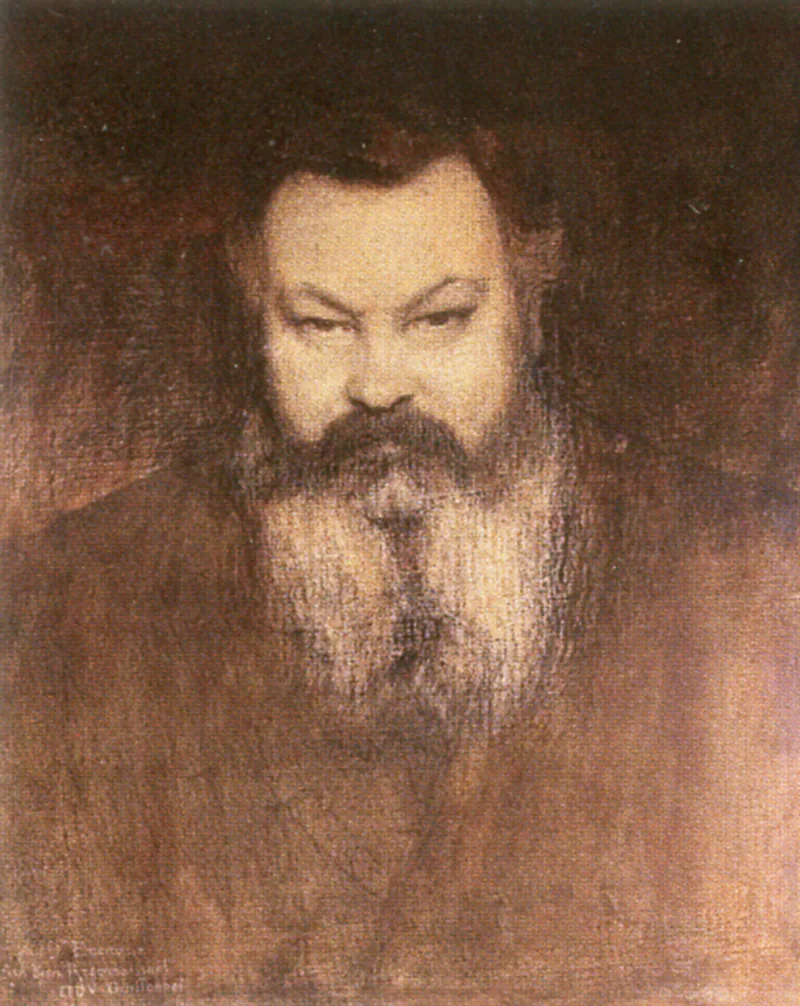
Papus was a tireless publicist. His journal L'Initiation, founded in 1888, his books on Kabbalah and on the tarot (see the history of tarot), and his roles in the Ordre Kabbalistique de la Rose-Croix and in Egyptian-rite Freemasonry made Martinism part of a wider network. Lodges spread through France, Belgium, Italy, Switzerland and Latin America, and Papus's visits to Russia in the early 1900s brought Martinism into aristocratic circles there.
Martinist Teaching, Degrees and Symbols§
Martinist orders differ, but most share a common structure and vocabulary. Initiation is conferred in a small number of degrees, classically three: Associate, Initiate and Supérieur Inconnu (Unknown Superior, abbreviated S.I.), with a further rank for initiators. Groups are small and called lodges, groups or heptads, and the order has historically admitted both men and women, unlike regular Freemasonry.
The ritual symbols express the ideal of anonymous, inward work. The initiate wears a mask, signifying the setting aside of personal vanity and the equality of members, and a cloak, signifying withdrawal from the world and the protection of silence. Three candles, a cordon and a seal combining a circle, interlaced triangles and a cross are common features. The emphasis is on meditation, prayer and study of Saint-Martin, Pasqually and the Christian mystical tradition, rather than on ceremonial evocation; in Saint-Martin's spirit, the heart is the true temple.
Doctrinally Martinism is a form of Christian theosophy in the older sense: a speculative and devotional teaching about God, the fall and restoration, rather than the Theosophy of Blavatsky, which Papus criticised.
Martinism in the Twentieth Century and Today§
The First World War and Papus's death in 1916 fractured the movement. Jean Bricaud in Lyon led one branch closely tied to Freemasonry and to a Gnostic church; his successor Constant Chevillon was murdered by the collaborationist Milice in 1944. Chaboseau revived a Traditional Martinist Order in 1931, and in the 1940s the writer Robert Ambelain founded an order that tried to restore Pasqually's Coën operations. The Vichy regime dissolved esoteric societies along with Masonic lodges, and Martinists were among those listed and persecuted (see anti-Masonry).
After 1945 Papus's son Philippe Encausse revived the Ordre Martiniste, and a Traditional Martinist Order became affiliated with the Rosicrucian organisation AMORC. Today numerous independent Martinist orders operate in Europe, the Americas and Africa, each claiming its own line of descent. Scholars of Western esotericism, notably Antoine Faivre, study Saint-Martin as a significant Christian theosopher of the Enlightenment era whose influence reached Joseph de Maistre, Balzac and the Russian Masonic mystics, independently of the orders that bear his name (see initiatory orders).
Frequently asked questions§
What is a Martinist?§
A Martinist is a member of one of the initiatory orders inspired by Louis-Claude de Saint-Martin and Martinez de Pasqually. Martinists pursue the "reintegration" of the soul with God through study, meditation and prayer, usually within a Christian framework, and are initiated in a small series of degrees culminating in the Unknown Superior.
Is Martinism part of Freemasonry?§
Not exactly. Martinist orders are separate from Freemasonry and often admit women, though many Martinists have also been Masons. Pasqually's doctrine survives within Freemasonry in the Rectified Scottish Rite, which is a distinct tradition.
Did Saint-Martin found the Martinist Order?§
No. Saint-Martin founded no order. The Martinist Order was established in the late 1880s and early 1890s by Papus and Augustin Chaboseau, who claimed a chain of personal initiations leading back to Saint-Martin; historians regard that chain as unverified.
What does the mask mean in Martinism?§
The mask represents anonymity and the effacement of the ego: members meet without social distinction, and the initiate works in silence rather than for recognition. It also recalls Saint-Martin's own pseudonym, the Unknown Philosopher.
Sources and further reading§
- Traité de la réintégration des êtres — Martinès de Pasqually, 1899
- Des erreurs et de la vérité — Louis-Claude de Saint-Martin, 1775
- The Life of Louis Claude de Saint-Martin, the Unknown Philosopher — Arthur Edward Waite, 1901
- Un thaumaturge au XVIIIe siècle: Martines de Pasqually — Gérard van Rijnberk, 1935
- Papus, sa vie, son œuvre — Philippe Encausse, 1949
- Access to Western Esotericism — Antoine Faivre, 1994
- Dictionary of Gnosis and Western Esotericism — Wouter J. Hanegraaff, 2005