Liber IX · Gnosticism · Chapter IV: Christian Theosophy
Christian Theosophy: Boehme and His Heirs from Gichtel to Baader
Christian theosophy explained: Jacob Boehme's vision and its heirs, from Gichtel, Pordage and Jane Lead to Oetinger, Saint-Martin, Baader and the Romantics.

Christian theosophy is the current of Protestant esoteric thought that grew from the writings of the German shoemaker Jacob Boehme (1575–1624) and was carried on by his readers in Germany, the Netherlands, England, France and Russia into the nineteenth century. Its writers claimed a visionary knowledge of God, nature and the human being — the inner birth of God, the divine Wisdom or Sophia, and the hidden signatures of creation — and they expressed it in a dense symbolic language drawn from Scripture, alchemy and personal illumination. It should not be confused with the Theosophical Society founded by Helena Blavatsky in 1875, which borrowed the old word for a very different, largely Asian-inspired teaching.
What Christian Theosophy Means§
The Greek word theosophia was used by late antique Neoplatonists and by Pseudo-Dionysius for the divine wisdom that surpasses human reasoning. In the early seventeenth century German writers began to apply it to a particular kind of knowledge: not the abstract theology of the universities but an experiential, imaginative insight into the inner life of God and the structure of the cosmos. By the 1620s the term was being attached to Boehme himself, and his followers were soon called "theosophers" or, in England, "Behmenists".
The historian Antoine Faivre, who did more than anyone to define the field, described theosophy as a hermeneutic of three poles — God, humanity and nature — read together. Theosophers do not only speculate about God; they claim to see how the divine life unfolds, how the human being fell out of it, and how the whole of creation, not merely the soul, will be restored. They read Scripture, especially Genesis and Revelation, as a code for these processes, and they borrow alchemical language for spiritual transformation. In this they stand close to the Gnostic interest in saving knowledge, though they remain Christian in their belief in the goodness of creation and the centrality of Christ.
Jacob Boehme and the Founding Vision§
Everything in the tradition goes back to Jacob Boehme, a shoemaker of Görlitz in Upper Lusatia who described a sudden illumination around 1600 in which he "saw through" the being of all things. His first book, Aurora (1612), circulated in manuscript and brought him into conflict with the local pastor, Gregor Richter, who had him forbidden to write. He resumed in 1619 and, before his death in 1624, produced some thirty treatises, among them The Three Principles of the Divine Essence, Mysterium Magnum and De Signatura Rerum.
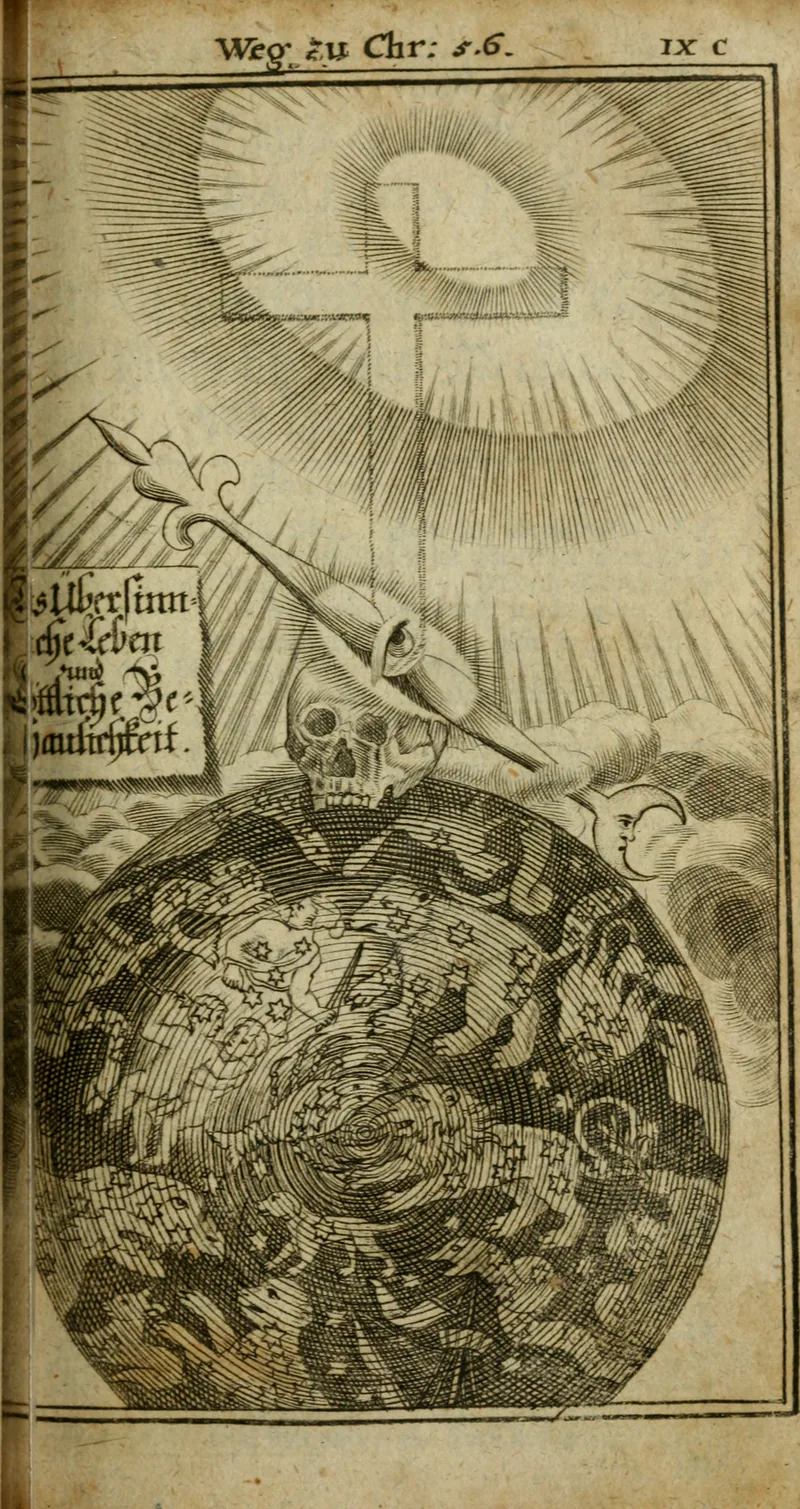
Boehme's key ideas became the shared vocabulary of later theosophy:
- The Ungrund — the groundless abyss beyond all qualities, from which God eternally "births" himself as Trinity through desire and will.
- The seven source-spirits — qualities of nature (harshness, attraction, anguish, fire, light, sound and body) through which the divine life becomes manifest.
- Sophia — the heavenly Virgin Wisdom, the mirror of God, whom Adam lost in the fall and whom the regenerate soul may "marry" again (see Sophia in the Gnostic and Christian traditions).
- Signatures — the outward forms of things as expressions of their inner spirit, a theme he shared with Paracelsus.
Boehme's writing is difficult, full of neologisms and alchemical images, and his readers spent much of the next two centuries explaining, systematising and illustrating it.
Gichtel, the Angelic Brethren and the Dutch Circle§
The first great editor of Boehme was Johann Georg Gichtel (1638–1710), a lawyer from Regensburg who was banished from his home city for religious radicalism and settled in Amsterdam. With the merchant Coenraad van Beuningen he produced the first complete edition of Boehme's works in 1682. Later Amsterdam editions, above all the Theosophia Revelata of 1730, added emblematic plates that became the standard visual form of the theosophical cosmos. Gichtel gathered a circle of celibate followers, later known as the Angelic Brethren, who aimed to live in a "Melchizedek priesthood" of prayer and to unite with Sophia in place of an earthly spouse.
Gichtel's own letters, published in 1722 as Theosophia Practica, are among the most personal documents of the tradition. They describe a long inward struggle with the "wrath-fire" of the soul and a mystical marriage with the divine Virgin. The Dutch milieu also produced, about the same time, a Latin and German theosophical literature that reached Pietist readers throughout the German lands.
English Behmenists: Pordage, Jane Lead and William Law§
Boehme's works were translated into English by John Sparrow and others between 1645 and 1662, during the period of religious ferment around the Civil War. Readers included Quakers, Ranters and Anglican divines, but the most important English theosophical circle formed around John Pordage (1607–1681), rector of Bradfield in Berkshire, who was ejected from his living in 1654 partly on charges of consorting with spirits. Pordage and his household reported visions of the angelic and dark worlds, and his Theologia Mystica appeared posthumously in 1683, while a much larger metaphysical work survived to be published in German translation in the early eighteenth century.
Pordage's closest successor was the visionary widow Jane Lead (1624–1704), whose many books recount conversations with the Virgin Wisdom and who became the spiritual centre of the Philadelphian Society in the 1690s; her story is told in Jane Lead and the Philadelphian Society. In the eighteenth century the Anglican spiritual writer William Law (1686–1761), already famous for A Serious Call to a Devout and Holy Life (1729), turned to Boehme and devoted his late works, such as The Spirit of Prayer, to a gentle, devotional version of his theology. An English edition of Boehme's works, the so-called "Law edition", appeared in 1764–1781, and its plates by Dionysius Andreas Freher circulated widely. William Blake read this tradition and is reported to have called Boehme a divinely inspired man.
Pietism and Swabian Theosophy: Arnold and Oetinger§
In Germany, theosophy flowed into radical and churchly Pietism. Gottfried Arnold (1666–1714) wrote a famous Impartial History of the Church and Heretics (1699–1700), which rehabilitated many condemned mystics, and The Mystery of the Divine Sophia (1700), a devotional treatise on Wisdom much indebted to Boehme.
The most learned theosopher of the eighteenth century was Friedrich Christoph Oetinger (1702–1782), a Lutheran prelate in Württemberg. Oetinger combined Boehme with Kabbalah, the natural science of his day and close study of the Bible. He wrote a commentary on the great painted teaching panel commissioned by Princess Antonia of Württemberg for the church at Bad Teinach, completed in 1673, which depicts the ten sefirot as a Christian allegory. He also engaged critically with Emanuel Swedenborg, whose works he partly translated. Oetinger's best-known dictum, that "corporeality is the end of the works of God", sums up the theosophical conviction that matter is not a prison to be escaped but a creation to be glorified. His influence passed through the Tübingen seminary, where Hegel, Schelling and Hölderlin studied, and through the Swabian clergyman Philipp Matthäus Hahn.
Saint-Martin, Baader and the Romantic Era§
In France, Louis-Claude de Saint-Martin (1743–1803), "the Unknown Philosopher", moved from the ritual theurgy of Martinez de Pasqually to an inward Christianity and, late in life, learned German in order to read and translate Boehme. His teaching of an interior "way of the heart" later gave its name to Martinism, although he himself founded no formal order.
Saint-Martin was in turn the favourite author of the Bavarian mining engineer and philosopher Franz von Baader (1765–1841), the most important theosopher of the Romantic generation. Baader is usually credited with drawing Schelling's attention to Boehme; lectured on him in Munich and sought to unite Catholic theology, natural philosophy and theosophical speculation. Through Baader and Schelling, Boehme's language of God's dark ground, desire and self-revelation entered German Idealism, and historians such as Ernst Benz have traced a direct line from the theosophers to the philosophy of the Romantic period. In Russia, Boehme and Saint-Martin were read in Masonic circles of the late eighteenth century, and their teaching on Sophia contributed to the sophiology of Vladimir Solovyov and Sergei Bulgakov.
Christian Theosophy and the Theosophical Society§
When Helena Blavatsky, Henry Steel Olcott and others founded the Theosophical Society in New York in 1875, they chose a respected old word. But the modern Theosophy they created, with its masters, root races and doctrines drawn from Hindu and Buddhist sources, has little in common with the Christian theosophers apart from the name and a general interest in esoteric knowledge. Scholars therefore often distinguish "Christian theosophy" or "Boehmian theosophy" from "modern Theosophy" with a capital T.
The Boehmian tradition never formed a church. It lived in small circles, private correspondence, manuscripts and books, and it survived into the twentieth century chiefly through philosophers, poets and scholars. Its distinctive contribution to Western esotericism lies in its imaginative theology of nature: the belief that the visible world, rightly read, reveals the inner life of God, and that the whole creation shares in the hope of redemption.
Frequently asked questions§
What is the difference between Christian theosophy and Theosophy?§
Christian theosophy is the older, Protestant tradition based on Jacob Boehme and his interpreters from the seventeenth to the nineteenth century. Theosophy with a capital T usually refers to the teaching of the Theosophical Society, founded in 1875 by Helena Blavatsky and Henry Olcott, which draws heavily on Asian religions. The two share a name and a claim to esoteric knowledge but differ in doctrine and history.
Who were the main Christian theosophers?§
The founder figure is Jacob Boehme. His major successors include Johann Georg Gichtel in Amsterdam, John Pordage and Jane Lead in England, William Law, Gottfried Arnold and Friedrich Christoph Oetinger in Germany, Louis-Claude de Saint-Martin in France and Franz von Baader in Munich.
Is Christian theosophy a form of Gnosticism?§
It shares with ancient Gnosticism a stress on revealed knowledge and a myth of fall and return involving divine Wisdom. Unlike most Gnostic systems, however, it holds that the material world is good and will be transfigured, and its authors regarded themselves as faithful, if unconventional, Christians.
Does Christian theosophy still exist?§
There is no organised theosophical church, but Boehme and his heirs are still read by philosophers, by members of Martinist and other esoteric groups, and by some Christian contemplatives. Academic study of the tradition has grown considerably since the 1960s.
Sources and further reading§
- Access to Western Esotericism — Antoine Faivre, 1994
- Theosophy, Imagination, Tradition: Studies in Western Esotericism — Antoine Faivre, 2000
- Wisdom's Children: A Christian Esoteric Tradition — Arthur Versluis, 1999
- Theosophia: Hidden Dimensions of Christianity — Arthur Versluis, 1994
- Boehme: An Intellectual Biography of the Seventeenth-Century Philosopher and Mystic — Andrew Weeks, 1991
- The Mystical Sources of German Romantic Philosophy — Ernst Benz, 1983
- The Behmenists and the Philadelphians — Nils Thune, 1948